Laboratory of Entomology, Wageningen University & Research, P.O. Box 16, 6700 AA, Wageningen, The Netherlands.
Theoretical Ecology group, Institute for Biodiversity and Ecosystem Dynamics, University of Amsterdam, P.O. Box 94248, 1090 GE, Amsterdam, The Netherlands.
Sci Rep. 2017 Jul 10;7(1):5022. doi: 10.1038/s41598-017-05185-4.
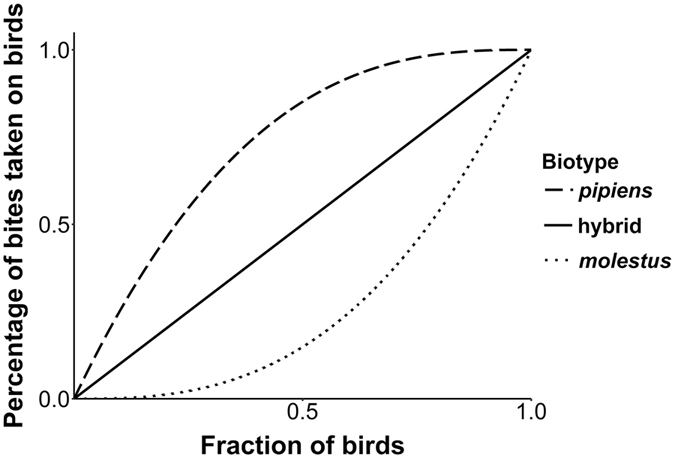
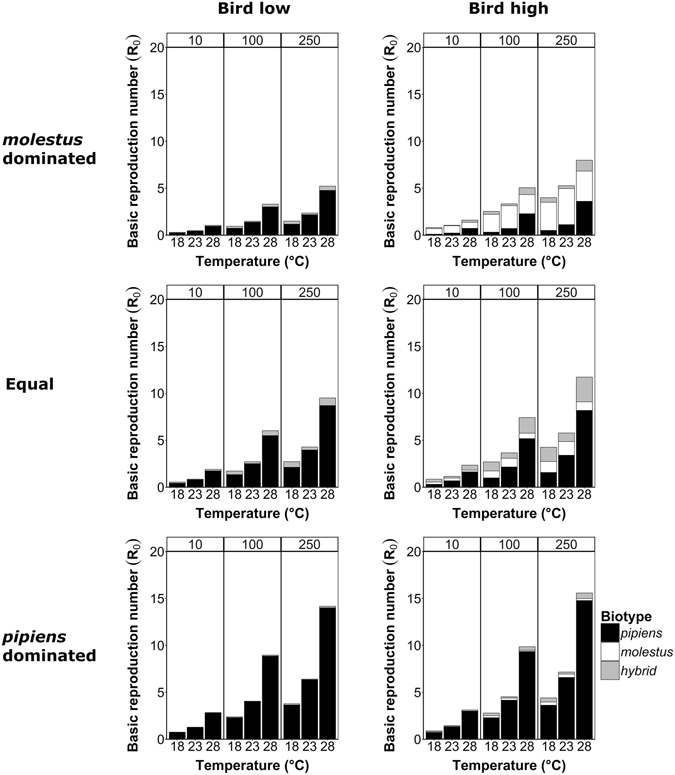
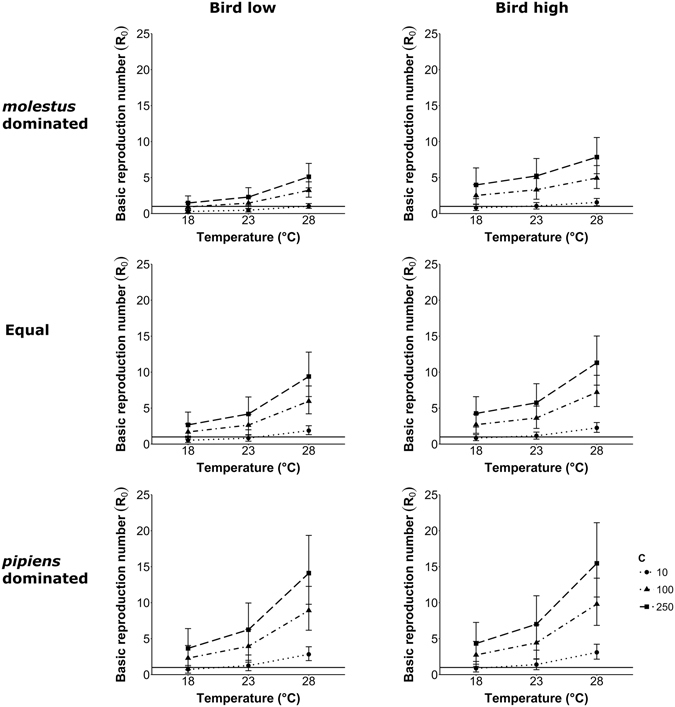
West Nile virus (WNV) is a mosquito-borne flavivirus which has caused repeated outbreaks in humans in southern and central Europe, but thus far not in northern Europe. The main mosquito vector for WNV, Culex pipiens, consists of two behaviourally distinct biotypes, pipiens and molestus, which can form hybrids. Differences between biotypes, such as vector competence and host preference, could be important in determining the risk of WNV outbreaks. Risks for WNV establishment can be modelled with basic reproduction number (R ) models. However, existing R models have not differentiated between biotypes. The aim of this study was, therefore, to explore the role of temperature-dependent and biotype-specific effects on the risk of WNV establishment in Europe. We developed an R model with temperature-dependent and biotype-specific parameters, and calculated R values using the next-generation matrix for several scenarios relevant for Europe. In addition, elasticity analysis was done to investigate the contribution of each biotype to R . Global warming and increased mosquito-to-host ratios can possibly result in more intense WNV circulation in birds and spill-over to humans in northern Europe. Different contributions of the Cx. pipiens biotypes to R shows the importance of including biotype-specific parameters in models for reliable WNV risk assessments.
西尼罗河病毒(WNV)是一种蚊媒黄病毒,已在欧洲南部和中部多次引发人类疫情,但迄今为止尚未在北欧出现。WNV 的主要蚊媒库蚊(Culex pipiens)由两种行为上明显不同的生物型组成,即 pipiens 和 molestus,它们可以形成杂种。生物型之间的差异,如媒介效能和宿主偏好,可能在确定 WNV 爆发的风险方面很重要。基本繁殖数 (R) 模型可用于模拟 WNV 建立的风险。然而,现有的 R 模型并未区分生物型。因此,本研究旨在探讨温度依赖性和生物型特异性效应对欧洲 WNV 建立风险的作用。我们开发了一个具有温度依赖性和生物型特异性参数的 R 模型,并使用下一代矩阵为与欧洲相关的几个情景计算了 R 值。此外,还进行了弹性分析,以调查每个生物型对 R 的贡献。全球变暖以及蚊媒与宿主比例的增加,可能导致北欧鸟类中 WNV 的传播更加剧烈,并向人类传播。Cx. pipiens 生物型对 R 的不同贡献表明,在可靠的 WNV 风险评估模型中包含生物型特异性参数非常重要。