Zhang Ling, Zheng Jie, Wang Yinqiao, Zhang Lei, Jin Zhaohui, Hong Liang, Wang Yujie, Zhang Jie
School of Physics and Astronomy, Shanghai Jiao Tong University, Shanghai, 200240, China.
Institute of Natural Sciences, Shanghai Jiao Tong University, Shanghai, 200240, China.
Nat Commun. 2017 Jul 10;8(1):67. doi: 10.1038/s41467-017-00106-5.
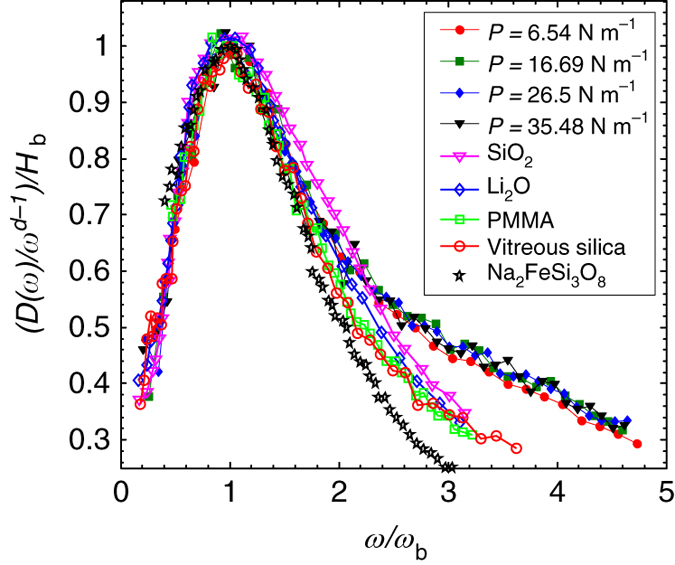
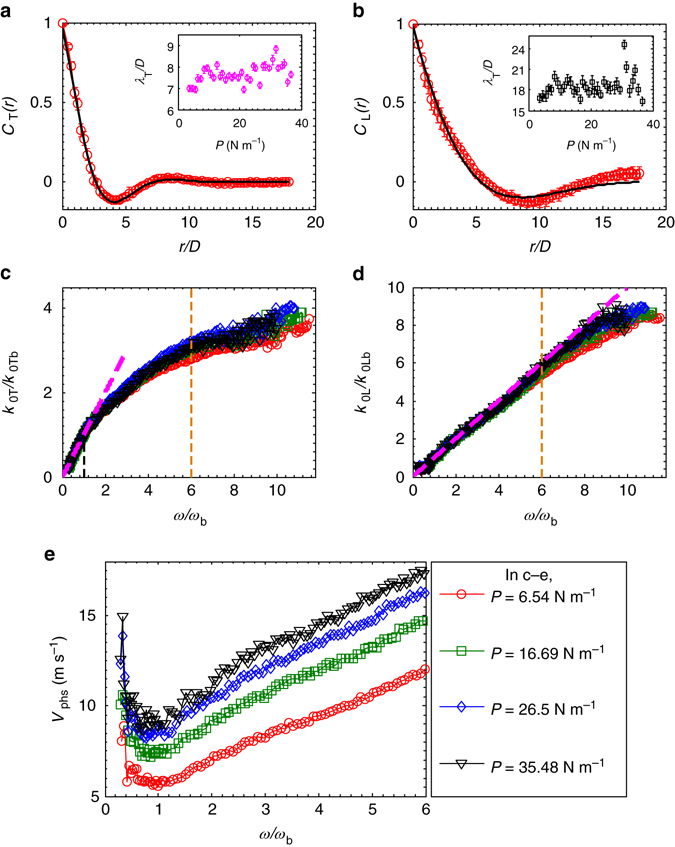
The boson peak, which represents an excess of vibrational states compared to Debye's prediction at low frequencies, has been studied extensively, and yet, its nature remains controversial. In this study, we focus on understanding the nature of the boson peak based on the spatial heterogeneity of modulus fluctuations using a simple model system of a highly jammed two-dimensional granular material. Despite the simplicity of our system, we find that the boson peak in our two-dimensional system shows a shape very similar to that of three-dimensional molecular glasses when approaching their boson peak frequencies. Our finding indicates a strong connection between the boson peak and the spatial heterogeneity of shear modulus fluctuations.The low-frequency collective vibrational modes, known as the boson peak, characterize many glasses at low temperature, yet its origin remains elusive. Zhang et al. show a correlation between the boson peak and the spatial heterogeneity of shear modulus fluctuation in a two-dimensional granular system.
玻色子峰代表了在低频下与德拜预测相比振动状态的过剩,已经得到了广泛研究,然而其本质仍然存在争议。在本研究中,我们使用高度堵塞的二维颗粒材料的简单模型系统,基于模量涨落的空间异质性来专注于理解玻色子峰的本质。尽管我们的系统很简单,但我们发现二维系统中的玻色子峰在接近其玻色子峰频率时呈现出与三维分子玻璃非常相似的形状。我们的发现表明玻色子峰与剪切模量涨落的空间异质性之间存在紧密联系。低频集体振动模式,即所谓的玻色子峰,在低温下表征了许多玻璃,但其起源仍然难以捉摸。张等人展示了二维颗粒系统中玻色子峰与剪切模量涨落的空间异质性之间的相关性。