Cowley Patrick M, Nair Divya R, DeRuisseau Lara R, Keslacy Stefan, Atalay Mustafa, DeRuisseau Keith C
Syracuse University, Department of Exercise Science, Syracuse, NY, USA; University of California and Veterans Affairs Medical Center, San Francisco, CA, USA.
Weizmann Institute of Science, Department of Biological Regulation, Rehovot, Israel.
Redox Biol. 2017 Oct;13:421-425. doi: 10.1016/j.redox.2017.07.003. Epub 2017 Jul 4.
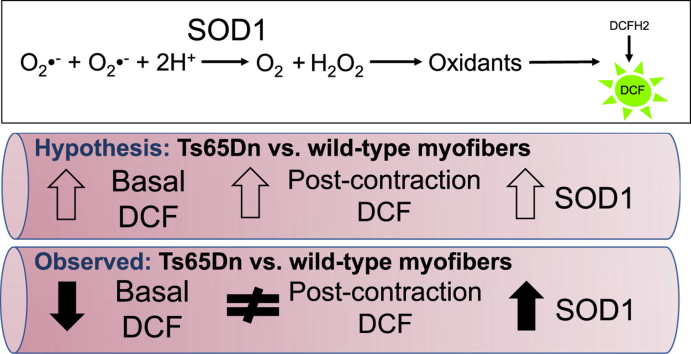
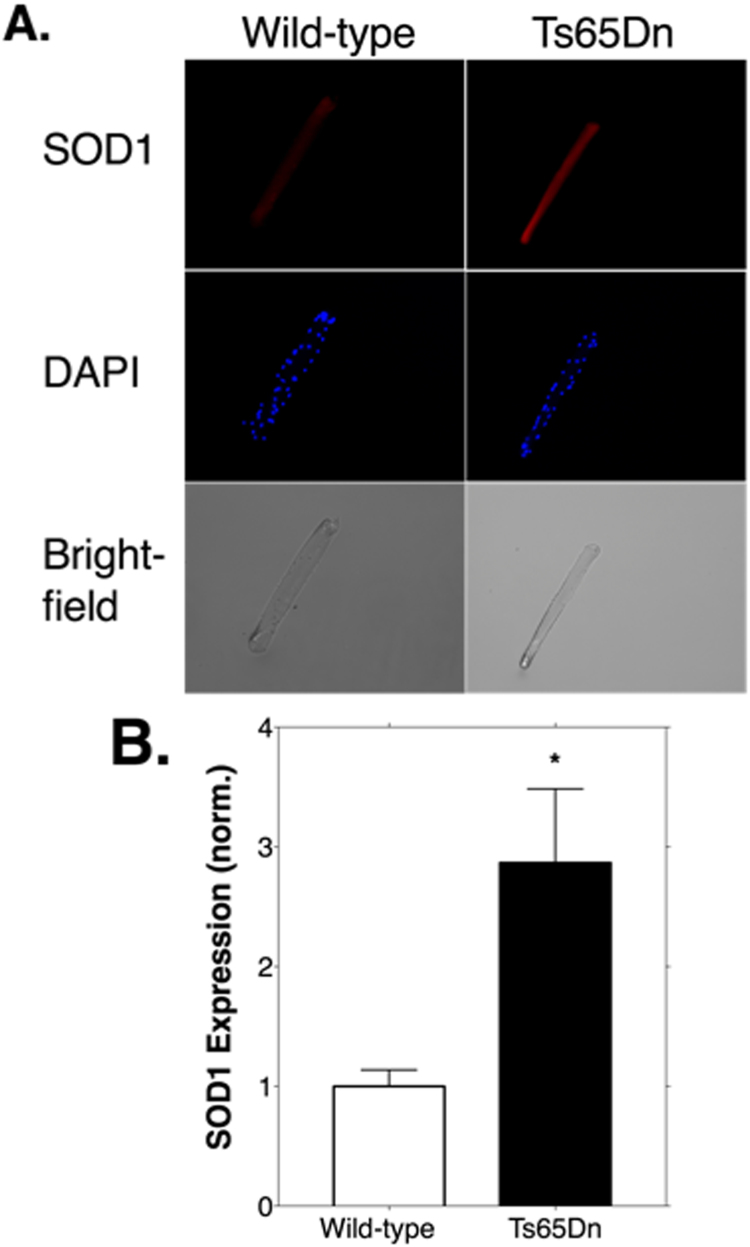
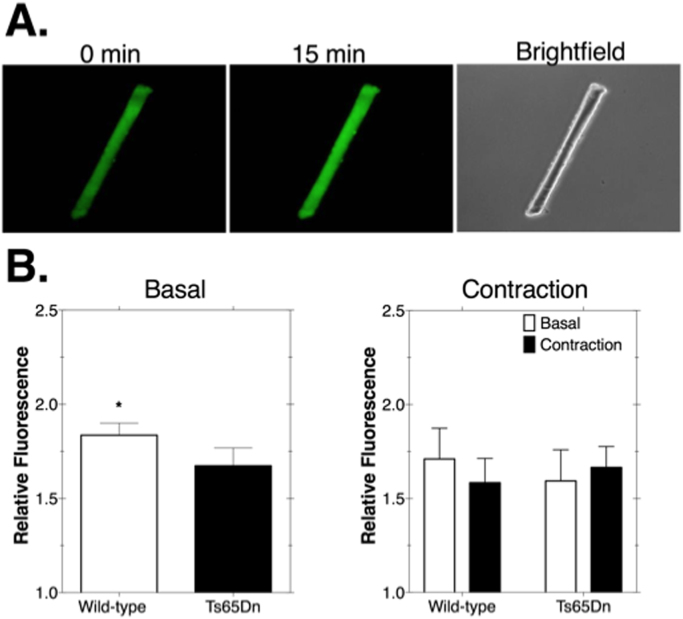
Down syndrome (DS) is a genetic condition caused by the triplication of chromosome 21. Persons with DS exhibit pronounced muscle weakness, which also occurs in the Ts65Dn mouse model of DS. Oxidative stress is thought to be an underlying factor in the development of DS-related pathologies including muscle dysfunction. High-levels of oxidative stress have been attributed to triplication and elevated expression of superoxide dismutase 1 (SOD1); a gene located on chromosome 21. The elevated expression of SOD1 is postulated to increase production of hydrogen peroxide and cause oxidative injury and cell death. However, it is unknown whether SOD1 protein expression is associated with greater oxidant production in skeletal muscle from Ts65Dn mice. Thus, our objective was to assess levels of SOD1 expression and oxidant production in skeletal myofibers from the flexor digitorum brevis obtained from Ts65Dn and control mice. Measurements of oxidant production were obtained from myofibers loaded with 2',7'-dichlorodihydrofluorescein diacetate (DCFH2-DA) in the basal state and following 15min of stimulated unloaded contraction. Ts65Dn myofibers exhibited a significant decrease in basal DCF emissions (p < 0.05) that was associated with an approximate 3-fold increase in SOD1 (p < 0.05). DCF emissions were not affected by stimulating contraction of Ts65Dn or wild-type myofibers (p > 0.05). Myofibers from Ts65Dn mice tended to be smaller and myonuclear domain was lower (p < 0.05). In summary, myofibers from Ts65Dn mice exhibited decreased basal DCF emissions that were coupled with elevated protein expression of SOD1. Stimulated contraction in isolated myofibers did not affect DCF emissions in either group. These findings suggest the skeletal muscle dysfunction in the adult Ts65Dn mouse is not associated with skeletal muscle oxidative stress.
唐氏综合征(DS)是一种由21号染色体三体性引起的遗传疾病。唐氏综合征患者表现出明显的肌肉无力,在唐氏综合征的Ts65Dn小鼠模型中也会出现这种情况。氧化应激被认为是包括肌肉功能障碍在内的唐氏综合征相关病理发展的一个潜在因素。高水平的氧化应激归因于超氧化物歧化酶1(SOD1)的三体性和表达升高;SOD1是位于21号染色体上的一个基因。SOD1表达的升高被推测会增加过氧化氢的产生,并导致氧化损伤和细胞死亡。然而,尚不清楚SOD1蛋白表达是否与Ts65Dn小鼠骨骼肌中更多的氧化剂产生有关。因此,我们的目标是评估从Ts65Dn小鼠和对照小鼠获得的拇短屈肌骨骼肌肌纤维中SOD1的表达水平和氧化剂的产生。氧化剂产生的测量是在基础状态下以及在15分钟的无负荷收缩刺激后,从加载了2',7'-二氯二氢荧光素二乙酸酯(DCFH2-DA)的肌纤维中获得的。Ts65Dn肌纤维的基础DCF发射显著降低(p < 0.05),这与SOD1大约增加3倍相关(p < 0.05)。刺激Ts65Dn或野生型肌纤维收缩对DCF发射没有影响(p > 0.05)。Ts65Dn小鼠的肌纤维往往较小,肌核域较低(p < 0.05)。总之,Ts65Dn小鼠的肌纤维表现出基础DCF发射降低,同时SOD1蛋白表达升高。分离的肌纤维中的刺激收缩对两组的DCF发射均无影响。这些发现表明成年Ts65Dn小鼠的骨骼肌功能障碍与骨骼肌氧化应激无关。