van Gelderen Saskia C, Zegers Marieke, Boeijen Wilma, Westert Gert P, Robben Paul B, Wollersheim Hub C
Radboud University Medical Center, Radboud Institute for Health Sciences, Scientific Center for Quality of Healthcare (IQ healthcare), Nijmegen, The Netherlands.
Radboud University Medical Center, Department of Quality and Safety, Nijmegen, The Netherlands.
BMJ Open. 2017 Jul 10;7(7):e015506. doi: 10.1136/bmjopen-2016-015506.
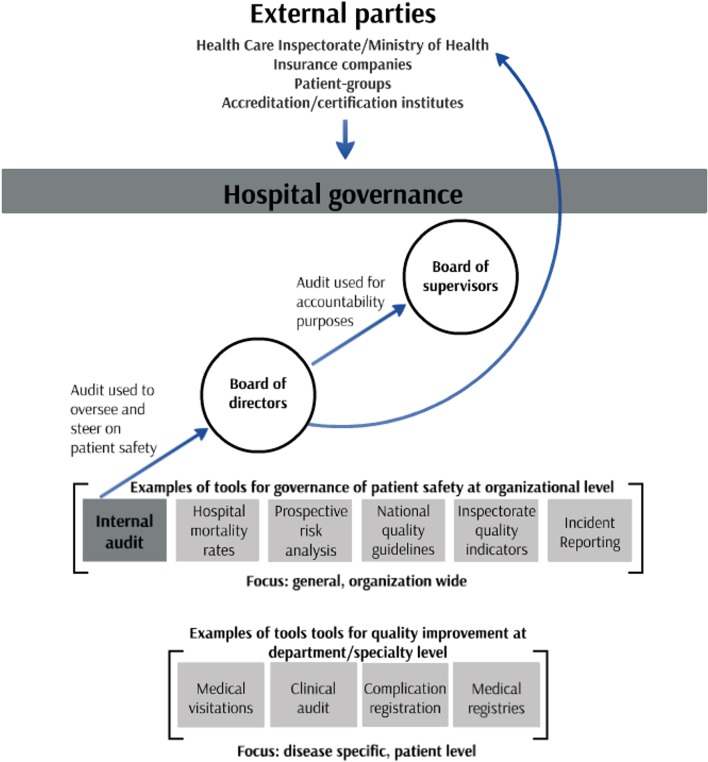
Hospital boards are legally responsible for safe healthcare. They need tools to assist them in their task of governing patient safety. Almost every Dutch hospital performs internal audits, but the effectiveness of these audits for hospital governance has never been evaluated. The aim of this study is to evaluate the organisation of internal audits and their effectiveness for hospitals boards to govern patient safety.
A mixed-methods study consisting of a questionnaire regarding the organisation of internal audits among all Dutch hospitals (n=89) and interviews with stakeholders regarding the audit process and experienced effectiveness of audits within six hospitals.
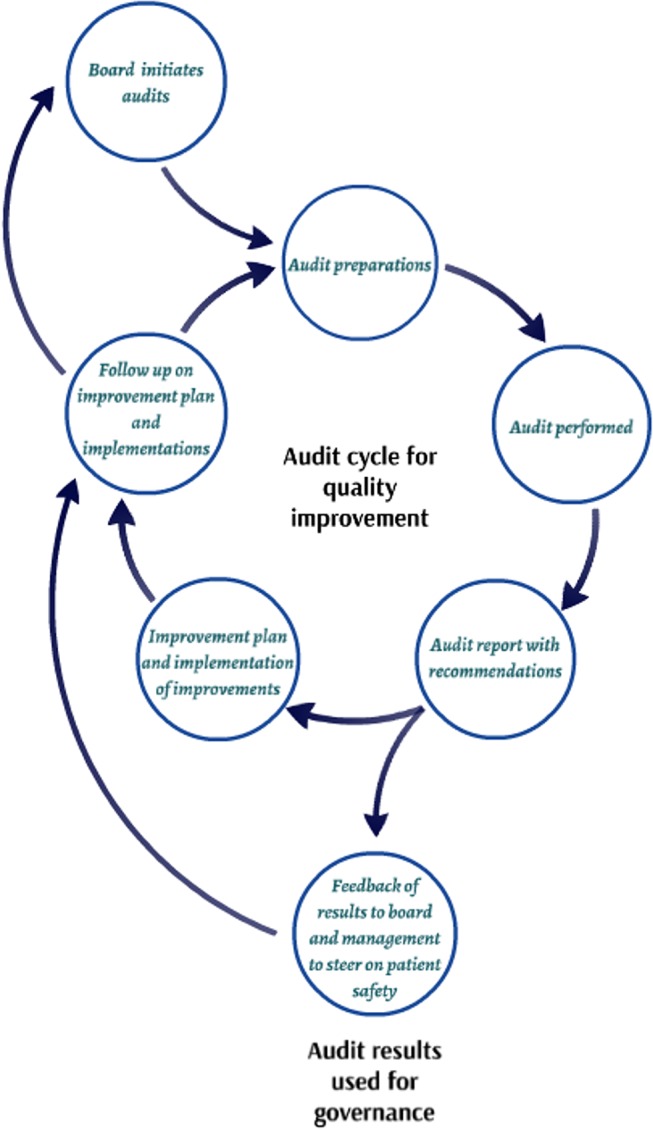
Response rate of the questionnaire was 76% and 43 interviews were held. In every responding hospital, the internal audits followed the plan-do-check-act cycle. Every hospital used interviews, document analysis and site visits as input for the internal audit. Boards stated that effective aspects of internal audits were their multidisciplinary scope, their structured and in-depth approach, the usability to monitor improvement activities and to change hospital policy and the fact that results were used in meetings with staff and boards of supervisors. The qualitative methods (interviews and site visits) used in internal audits enable the identification of soft signals such as unsafe culture or communication and collaboration problems. Reported disadvantages were the low frequency of internal audits and the absence of soft signals in the actual audit reports.
This study shows that internal audits are regarded as effective for patient safety governance, as they help boards to identify patient safety problems, proactively steer patient safety and inform boards of supervisors on the status of patient safety. The description of the Dutch internal audits makes these audits replicable to other healthcare organisations in different settings, enabling hospital boards to complement their systems to govern patient safety.
医院董事会在法律上对医疗安全负责。他们需要工具来协助其履行管理患者安全的职责。几乎每家荷兰医院都开展内部审计,但这些审计对医院治理的有效性从未得到评估。本研究的目的是评估内部审计的组织情况及其对医院董事会管理患者安全的有效性。
一项混合方法研究,包括对所有荷兰医院(n = 89)进行关于内部审计组织情况的问卷调查,以及对六家医院的利益相关者就审计过程和审计的实际有效性进行访谈。
问卷回复率为76%,进行了43次访谈。在每家回复的医院中,内部审计都遵循计划 - 执行 - 检查 - 行动循环。每家医院都将访谈、文件分析和实地考察作为内部审计的依据。董事会表示,内部审计的有效方面包括其多学科范围、结构化和深入的方法、对监测改进活动和改变医院政策的可用性,以及结果在与员工和监事会会议中被使用这一事实。内部审计中使用的定性方法(访谈和实地考察)能够识别不安全文化或沟通与协作问题等软信号。报告的缺点是内部审计频率低,以及实际审计报告中缺乏软信号。
本研究表明,内部审计被认为对患者安全治理有效,因为它们帮助董事会识别患者安全问题,积极引导患者安全,并向监事会通报患者安全状况。对荷兰内部审计的描述使这些审计能够在不同环境下被其他医疗组织复制,使医院董事会能够完善其管理患者安全的系统。