Division of HIV Prevention, U.S. Centers for Disease Control and Prevention, Atlanta, Georgia, United States of America.
Thailand Ministry of Public Health, U.S. Centers for Disease Control and Prevention Collaboration, Nonthaburi, Thailand.
PLoS One. 2024 Jul 5;19(7):e0305296. doi: 10.1371/journal.pone.0305296. eCollection 2024.
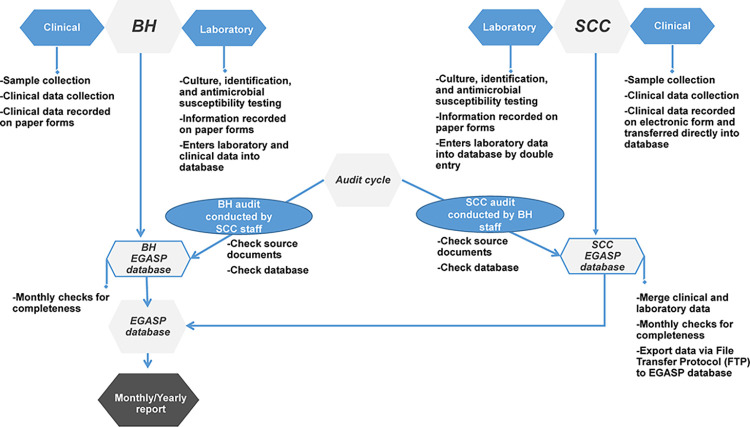
Quality assessments of gonococcal surveillance data are critical to improve data validity and to enhance the value of surveillance findings. Detecting data errors by systematic audits identifies areas for quality improvement. We designed and implemented an internal audit process to evaluate the accuracy and completeness of surveillance data for the Thailand Enhanced Gonococcal Antimicrobial Surveillance Programme (EGASP).
We conducted a data quality audit of source records by comparison with the data stored in the EGASP database for five audit cycles from 2015-2021. Ten percent of culture-confirmed cases of Neisseria gonorrhoeae were randomly sampled along with any cases identified with elevated antimicrobial susceptibility testing results and cases with repeat infections. Incorrect and incomplete data were investigated, and corrective action and preventive actions (CAPA) were implemented. Accuracy was defined as the percentage of identical data in both the source records and the database. Completeness was defined as the percentage of non-missing data from either the source document or the database. Statistical analyses were performed using the t-test and the Fisher's exact test.
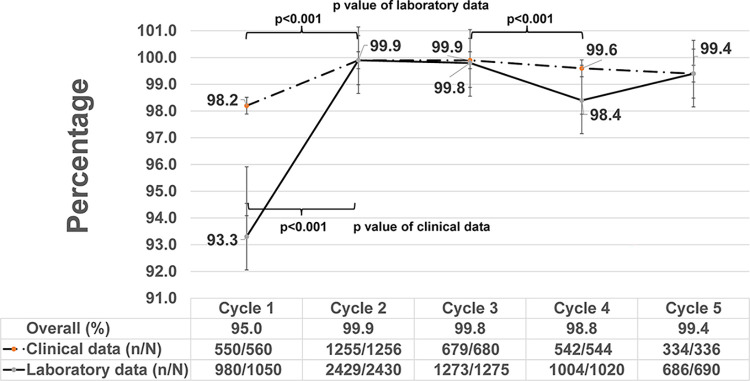
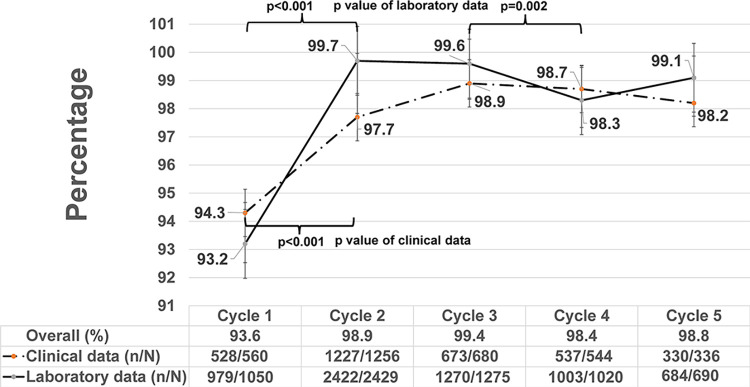
We sampled and reviewed 70, 162, 85, 68, and 46 EGASP records during the five audit cycles. Overall accuracy and completeness in the five audit cycles ranged from 93.6% to 99.4% and 95.0% to 99.9%, respectively. Overall, completeness was significantly higher than accuracy (p = 0.017). For each laboratory and clinical data element, concordance was >85% in all audit cycles except for two laboratory data elements in two audit cycles. These elements significantly improved following identification and CAPA implementation.
We found a high level of data accuracy and completeness in the five audit cycles. The implementation of the audit process identified areas for improvement. Systematic quality assessments of laboratory and clinical data ensure high quality EGASP surveillance data to monitor for antimicrobial resistant Neisseria gonorrhoeae in Thailand.
对淋球菌监测数据进行质量评估对于提高数据的有效性和增强监测结果的价值至关重要。通过系统审核发现数据错误可以确定需要改进的质量领域。我们设计并实施了内部审核流程,以评估泰国强化淋球菌抗菌药物监测计划(EGASP)监测数据的准确性和完整性。
我们对五个审核周期(2015-2021 年)的来源记录与 EGASP 数据库中存储的数据进行了数据质量审核。随机抽取 10%的培养确诊淋病奈瑟菌病例,以及任何出现药敏试验结果升高和重复感染的病例。调查了错误和不完整的数据,并实施了纠正和预防措施(CAPA)。准确性定义为来源记录和数据库中相同数据的百分比。完整性定义为来源文件或数据库中非缺失数据的百分比。使用 t 检验和 Fisher 精确检验进行统计分析。
在五个审核周期中,我们抽取并审查了 70、162、85、68 和 46 个 EGASP 记录。五个审核周期的整体准确性和完整性分别在 93.6%至 99.4%和 95.0%至 99.9%之间。总体而言,完整性明显高于准确性(p=0.017)。除了两个审核周期中的两个实验室数据元素外,所有审核周期中每个实验室和临床数据元素的一致性都>85%。在确定并实施 CAPA 后,这些元素显著改善。
我们发现五个审核周期的数据准确性和完整性都很高。审核流程的实施确定了需要改进的领域。对实验室和临床数据的系统质量评估确保了高质量的 EGASP 监测数据,以监测泰国耐抗菌药物淋病奈瑟菌。