University of Siena, Department of Medical Biotechnologies, Siena, 53100, Italy.
University of Florence, Department of Surgery and Translational Medicine, Florence, 50134, Italy.
Sci Rep. 2017 Jul 11;7(1):5071. doi: 10.1038/s41598-017-05167-6.
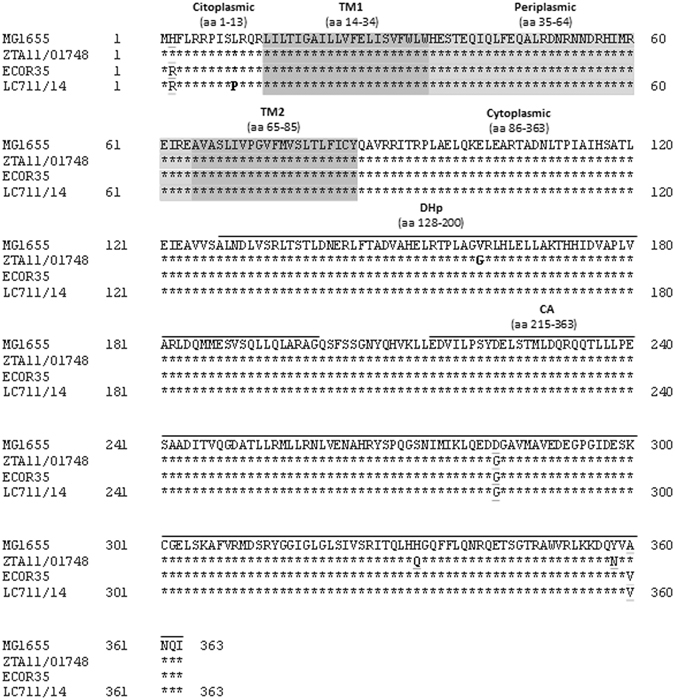
We investigated the colistin resistance mechanism in an Escherichia coli strain (LC711/14) isolated in Italy in 2014, from an urinary tract infection, which was previously shown to express a colistin resistance mechanism different from mcr-1. LC711/14 was found to carry a novel mutation in the pmrB gene, resulting in a leucine to proline amino acid substitution at position 10 of the PmrB sensor kinase component of the PmrAB signal transduction system. The role of this substitution in colistin resistance was documented by expression of the wild-type and mutated alleles in a pmrB deletion derivative of the E. coli reference strain MG1655, in which expression of the mutated allele conferred colistin resistance and upregulation of the endogenous pmrHFIJKLM lipid A modification system. Complementation of LC711/14 with the wild-type pmrB allele restored colistin susceptibility and decreased expression of pmrHFIJKLM, confirming the role of this PmrB mutation. Substitution of leucine at position 10 of PmrB with other amino acids (glycine and glutamine) resulted in loss of function, underscoring a key role of this residue which is located in the cytoplasmic secretion domain of the protein. This work demonstrated that mutation in this domain of the PmrB sensor kinase can be responsible for acquired colistin resistance in E. coli strains of clinical origin.
我们研究了 2014 年在意大利从尿路感染分离出的大肠杆菌菌株(LC711/14)的多粘菌素耐药机制,该菌株先前表现出不同于 mcr-1 的多粘菌素耐药机制。LC711/14 被发现携带 pmrB 基因的新突变,导致 PmrAB 信号转导系统的 PmrB 传感器激酶成分的第 10 位由亮氨酸突变为脯氨酸。通过在大肠杆菌参考菌株 MG1655 的 pmrB 缺失衍生物中表达野生型和突变等位基因,证明了这种取代在多粘菌素耐药中的作用,其中突变等位基因的表达赋予了多粘菌素耐药性,并上调了内源性 pmrHFIJKLM 脂质 A 修饰系统。用野生型 pmrB 等位基因对 LC711/14 进行互补恢复了多粘菌素敏感性并降低了 pmrHFIJKLM 的表达,证实了这种 PmrB 突变的作用。用其他氨基酸(甘氨酸和谷氨酰胺)取代 PmrB 第 10 位的亮氨酸导致功能丧失,突出了该残基位于蛋白质细胞质分泌结构域的关键作用。这项工作表明,PmrB 传感器激酶该结构域的突变可能导致临床来源的大肠杆菌菌株获得多粘菌素耐药性。