Academic Center for Evidence based Sports medicine (ACES), Academic Medical Center, Amsterdam, The Netherlands.
Department of Orthopaedic Surgery, Academic Medical Center, Amsterdam, The Netherlands.
Knee Surg Sports Traumatol Arthrosc. 2018 Mar;26(3):946-954. doi: 10.1007/s00167-017-4644-1. Epub 2017 Jul 11.
Psychological factors have shown to be predictors of injury in professional football. However, it seems that this is a two-way relationship, as severe musculoskeletal time-loss injuries have shown to be associated with the onset of symptoms of common mental disorders (CMD). There is no longitudinal study performed exploring this interaction between symptoms of CMD and injuries. The purpose of this study was to explore the interaction between severe musculoskeletal time-loss injuries and symptoms of CMD in professional football players over a 12-month period.
Players were recruited by their national players' unions in five European countries. Symptoms of CMD included in the study were related to distress, anxiety/depression, sleep disturbance and adverse alcohol use.
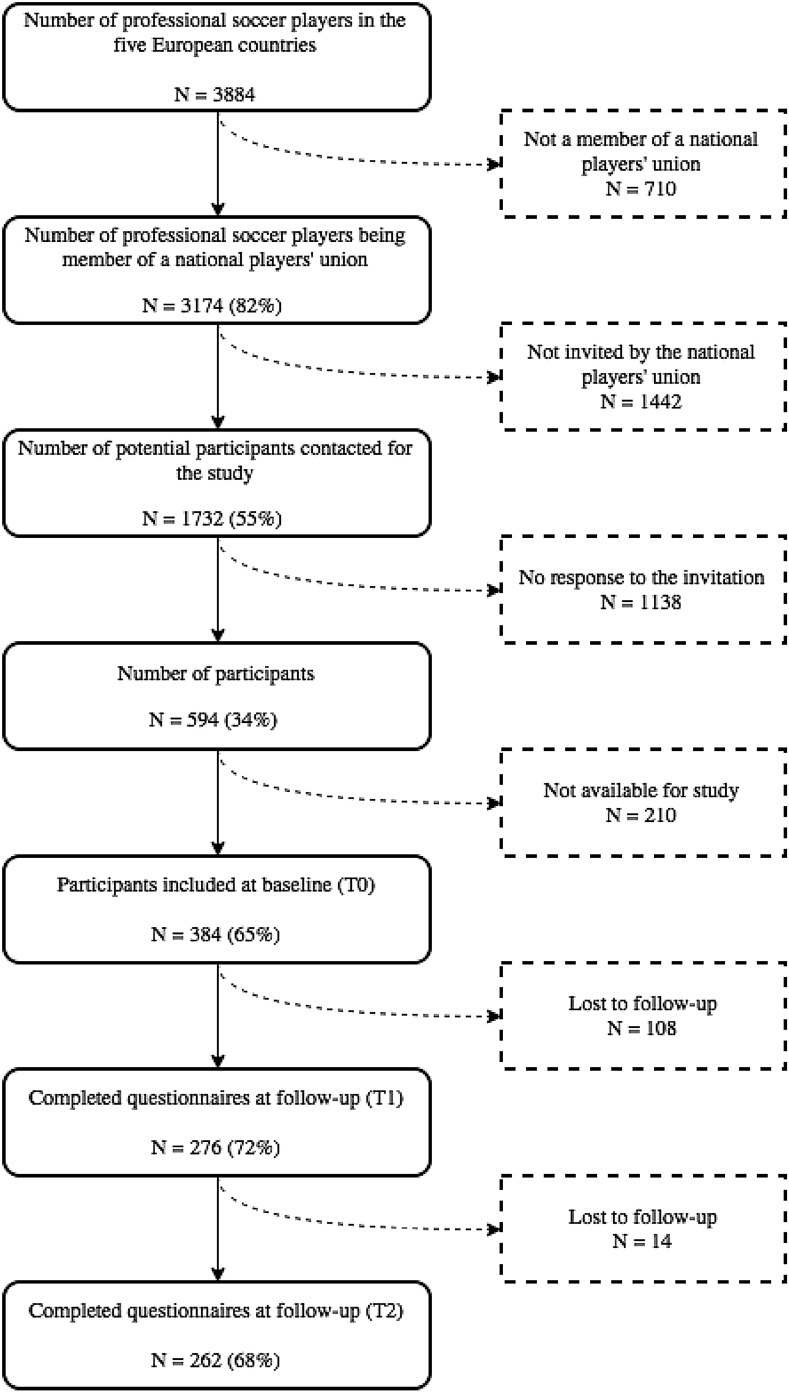
A total of 384 professional football players were enrolled in the study, of whom 262 (68%) completed the 12-month follow-up period. The mean age of the participants at baseline was 27 ± 5 years, and they had played professional football for 8 ± 5 years on average. Symptoms of CMD at baseline were not associated with the onset of severe musculoskeletal time-loss injuries during the follow-up period with relative risks (and 95% CI) ranging from 0.6 (0.3-1.0) to 1.0 (0.5-2.2). In contrast, severe musculoskeletal time-loss injuries reported at baseline were associated with the onset of symptoms of CMD during the follow-up period with relative risks ranging from 1.8 (0.8-3.7) to 6.9 (4.0-11.9).
No relationship was found between symptoms of CMD and the onset of severe musculoskeletal time-loss injuries. However, professional football players who suffered from severe musculoskeletal time-loss injuries are likely to develop subsequent symptoms of CMD. This study emphasizes the need for an interdisciplinary medical approach, which not only focuses on the physical but also on the mental health of professional football players. An early identification of players at risk of symptoms of CMD, such as those suffering from severe musculoskeletal injuries, creates the opportunity for an interdisciplinary clinical medical team to treat the players timely and adequately.
Prospective cohort study, Level II.
心理因素已被证明是职业足球运动员受伤的预测因素。然而,这似乎是一个双向关系,因为严重的肌肉骨骼时间损失损伤与常见精神障碍(CMD)症状的发作有关。目前还没有进行研究探索 CMD 症状与损伤之间的这种相互作用。本研究旨在探讨职业足球运动员在 12 个月期间严重肌肉骨骼时间损失损伤与 CMD 症状之间的相互作用。
通过五个欧洲国家的国家球员联盟招募球员。研究中包括的 CMD 症状与痛苦、焦虑/抑郁、睡眠障碍和不良饮酒有关。
共有 384 名职业足球运动员参加了这项研究,其中 262 名(68%)完成了 12 个月的随访期。参与者在基线时的平均年龄为 27±5 岁,平均职业足球生涯为 8±5 年。基线时的 CMD 症状与随访期间严重肌肉骨骼时间损失损伤的发作无关,相对风险(和 95%CI)范围从 0.6(0.3-1.0)到 1.0(0.5-2.2)。相比之下,基线时报告的严重肌肉骨骼时间损失损伤与随访期间 CMD 症状的发作相关,相对风险范围从 1.8(0.8-3.7)到 6.9(4.0-11.9)。
未发现 CMD 症状与严重肌肉骨骼时间损失损伤的发作之间存在关系。然而,遭受严重肌肉骨骼时间损失损伤的职业足球运动员可能会出现随后的 CMD 症状。这项研究强调了需要采用跨学科的医疗方法,不仅要关注运动员的身体健康,还要关注他们的心理健康。早期识别有 CMD 症状风险的运动员,如遭受严重肌肉骨骼损伤的运动员,为跨学科临床医疗团队提供了及时和充分治疗运动员的机会。
前瞻性队列研究,二级。