Room G03, Macaulay Hall, Institute for Sport, Physical Activity and Leisure, Centre for Sports Performance, Headingley Campus, Leeds Beckett University, West Yorkshire, LS6 3GZ, UK.
Yorkshire Carnegie Rugby Union Club, Kirkstall Training Ground, Leeds Rugby Academy, Leeds, West Yorkshire, UK.
Eur J Appl Physiol. 2017 Sep;117(9):1877-1889. doi: 10.1007/s00421-017-3680-3. Epub 2017 Jul 11.
Investigate the acute and short-term (i.e., 24 h) effects of traditional (TRAD), superset (SS), and tri-set (TRI) resistance training protocols on perceptions of intensity and physiological responses.
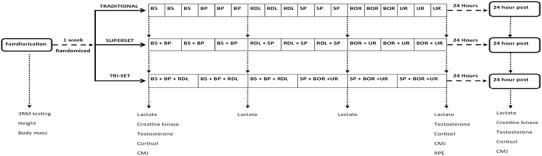
Fourteen male participants completed a familiarisation session and three resistance training protocols (i.e., TRAD, SS, and TRI) in a randomised-crossover design. Rating of perceived exertion, lactate concentration ([Lac]), creatine kinase concentration ([CK]), countermovement jump (CMJ), testosterone, and cortisol concentrations was measured pre, immediately, and 24-h post the resistance training sessions with magnitude-based inferences assessing changes/differences within/between protocols.
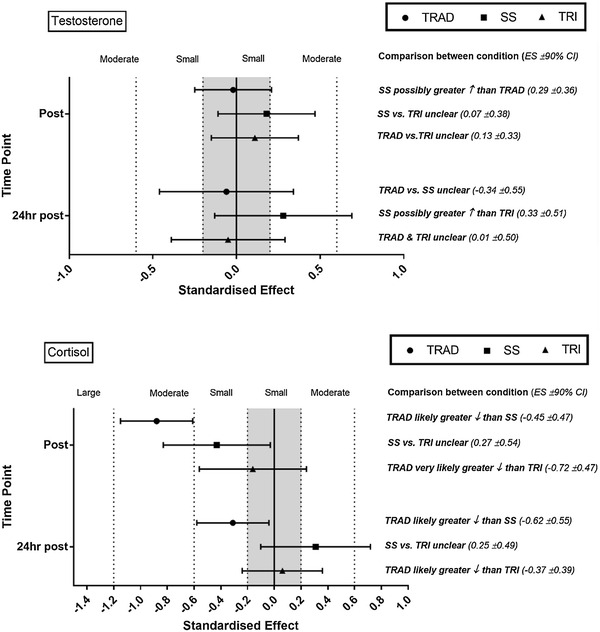
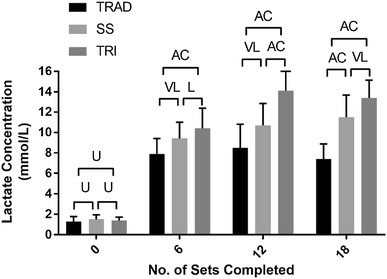
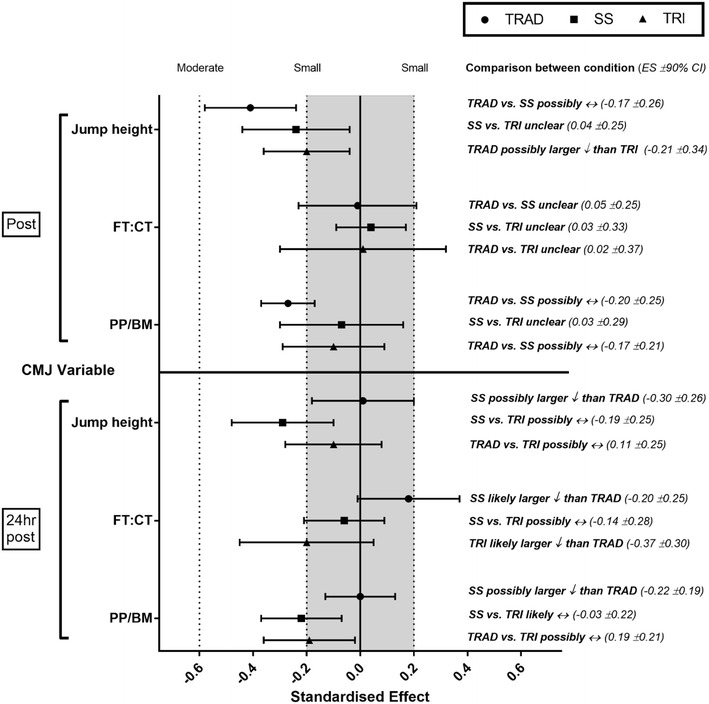
TRI reported possible to almost certainly greater efficiency and rate of perceived exertion, although session perceived load was very likely lower. SS and TRI had very likely to almost certainly greater lactate responses during the protocols, with changes in [CK] being very likely and likely increased at 24 h, respectively. At 24-h post-training, CMJ variables in the TRAD protocol had returned to baseline; however, SS and TRI were still possibly to likely reduced. Possible increases in testosterone immediately post SS and TRI protocols were reported, with SS showing possible increases at 24-h post-training. TRAD and SS showed almost certain and likely decreases in cortisol immediately post, respectively, with TRAD reporting likely decreases at 24-h post-training.
SS and TRI can enhance training efficiency and reduce training time. However, acute and short-term physiological responses differ between protocols. Athletes can utilise SS and TRI resistance training, but may require additional recovery post-training to minimise effects of fatigue.
研究传统(TRAD)、超级组(SS)和三联组(TRI)抗阻训练方案对强度感知和生理反应的急性和短期(即 24 小时)影响。
14 名男性参与者按照随机交叉设计完成了一次预适应训练和三种抗阻训练方案(即 TRAD、SS 和 TRI)。在抗阻训练前后即刻和 24 小时测量了感觉用力程度、血乳酸浓度 ([Lac])、肌酸激酶浓度 ([CK])、下蹲跳(CMJ)、睾酮和皮质醇浓度,并用基于效应量的推断来评估方案内/方案间的变化/差异。
TRI 报告了可能甚至几乎确定更高的效率和感觉用力程度,尽管训练时的感觉负荷可能较低。SS 和 TRI 在训练期间可能有更高的乳酸反应,[CK]的变化可能且在 24 小时后很可能增加。在训练后 24 小时,TRAD 方案中的 CMJ 变量已恢复到基线水平;然而,SS 和 TRI 仍可能降低。SS 和 TRI 方案在训练后即刻报告了可能的睾酮增加,SS 在 24 小时后报告了可能的增加。TRAD 和 SS 方案在训练后即刻分别显示出几乎确定和可能的皮质醇降低,TRAD 方案在 24 小时后报告了可能的降低。
SS 和 TRI 可以提高训练效率并减少训练时间。然而,方案之间的急性和短期生理反应不同。运动员可以使用 SS 和 TRI 抗阻训练,但可能需要在训练后额外恢复以最小化疲劳的影响。