Zhang Xing, Weakley Jonathon, Li Hansen, Li Zhaoqian, García-Ramos Amador
Department of Physical Education and Sport, Faculty of Sport Sciences, University of Granada, Granada, Spain.
School of Behavioural and Health Sciences, Australian Catholic University, Brisbane, QLD, Australia.
Sports Med. 2025 Apr;55(4):953-975. doi: 10.1007/s40279-025-02176-8. Epub 2025 Feb 4.
Supersets are a time-efficient resistance training (RT) method that involve the sequencing of two exercises with little or no rest between them. However, despite their common implementation during RT, a comprehensive and quantitative review is still lacking.
The primary aim of this systematic review and meta-analysis was to compare the acute and chronic effects of superset and traditional set prescriptions on mechanical, metabolic, and perceptual variables. We also aimed to conduct subgroup analyses to determine the effect of different types of supersets (agonist-antagonist, similar biomechanical, and alternate peripheral supersets).
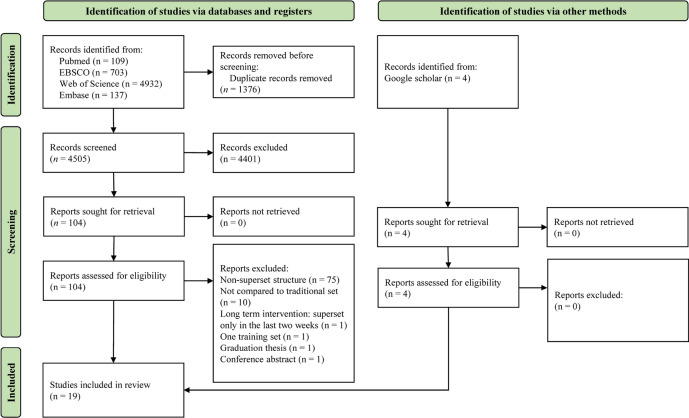
A systematic literature search was conducted in PubMed, Web of Science, Embase, and EBSCO databases from inception to 10 February 2024. Studies written in English and meeting our inclusion criteria were included. Pooled meta-analysis and subgroup meta-analysis were performed using a random-effects model.
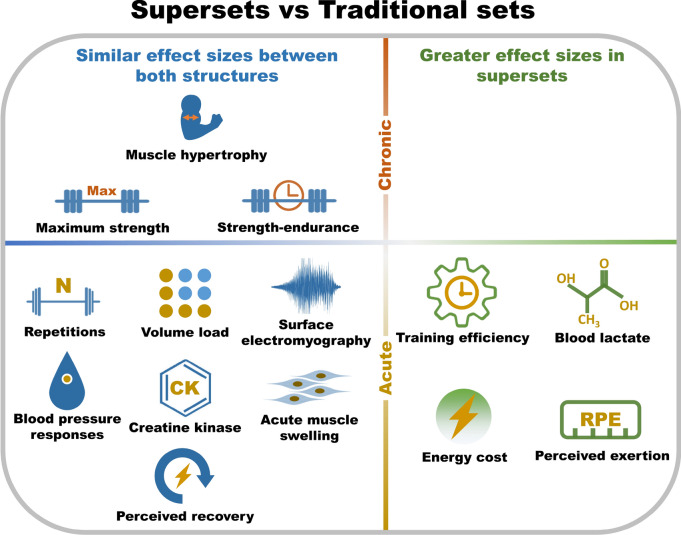
Nineteen studies involving 313 participants were included. Although there was considerable variance in certain outcomes, our estimated effects suggested that, compared with traditional set prescription, supersets allow for (1) a similar total number of repetitions [standardized mean differences (SMD) = - 0.03; p = 0.92] and volume load (SMD = 0.05; p = 0.86) with a shorter session duration and increased training efficiency (SMD = 1.74; p = 0.01); (2) higher blood lactate concentration during (SMD = 0.94; p = 0.03) and after (SMD = 1.13; p < 0.01) RT; (3) higher energy cost during RT (SMD = 1.93; p = 0.04); (4) similar creatine kinase concentration after RT (SMD = 0.22; p = 0.36), surface electromyography (SMD = 0.01; p = 0.98), acute muscle swelling (SMD = - 0.28; p = 0.36) and blood pressure (systolic blood pressure [SMD = 0.08; p = 0.71], diastolic blood pressure [SMD = - 0.05; p = 0.85], and mean arterial pressure [SMD = - 0.03; p = 0.88]); (5) higher rating of perceived exertion (SMD = 0.77; p = 0.02) and similar perceived recovery (SMD = 0.32; p = 0.33); and (6) similar chronic adaptations in maximal strength (SMD = 0.10; p = 0.36), strength endurance (SMD = 0.07; p = 0.81), and muscle hypertrophy (SMD = - 0.05; p = 0.87). The subgroup analysis revealed that utilizing agonist-antagonist supersets leads to a significant increase in the number of repetitions that are able to be completed compared with traditional sets (SMD = 0.68; p = 0.01). Similar biomechanical supersets led to less volume load (SMD = - 1.08; p < 0.01) compared with traditional sets.
Supersets provide a time-efficient alternative to traditional RT, reducing session duration without compromising training volume, muscle activation, perceived recovery, or chronic adaptations in maximal strength, strength endurance, and muscle hypertrophy. Thus, supersets can be effectively implemented by athletes with busy schedules and RT enthusiasts whose main barrier to exercise is time. However, it should be noted that supersets generally induce higher internal loads, more severe muscle damage, and increased perceived exertion, potentially necessitating extended recovery times between sessions. Additionally, superset RT may have a similar potential to traditional RT in eliciting post-exercise hypotension. Regarding different types of supersets, agonist-antagonist supersets are more suitable for maintaining training volume, while similar biomechanical supersets concentrate stimulation on the same muscle group, compromising volume load.
The original protocol for this review was prospectively registered with the International Prospective Register of Systematic Reviews (PROSPERO) in December 2023 (CRD42023491533).
超级组训练法是一种高效的抗阻训练(RT)方法,它涉及两个练习动作的连续进行,动作之间几乎没有或完全没有休息时间。然而,尽管在抗阻训练中经常采用这种方法,但仍缺乏全面的定量综述。
本系统评价和荟萃分析的主要目的是比较超级组训练法与传统组训练法对力学、代谢和感知变量的急性和慢性影响。我们还旨在进行亚组分析,以确定不同类型超级组训练法(拮抗肌-主动肌超级组、相似生物力学超级组和交替外周超级组)的效果。
从数据库建库至2024年2月10日,在PubMed、Web of Science、Embase和EBSCO数据库中进行了系统的文献检索。纳入用英文撰写且符合我们纳入标准的研究。采用随机效应模型进行汇总荟萃分析和亚组荟萃分析。
纳入了19项研究,共313名参与者。尽管某些结果存在相当大的差异,但我们的估计效应表明,与传统组训练法相比,超级组训练法能够:(1)在训练时间更短且训练效率提高的情况下(标准化均数差[SMD]=1.74;P=0.01),完成相似的重复总次数(SMD=-0.03;P=0.92)和容量负荷(SMD=0.05;P=0.86);(2)在抗阻训练期间(SMD=0.94;P=0.03)和训练后(SMD=1.13;P<0.01)血乳酸浓度更高;(3)抗阻训练期间能量消耗更高(SMD=1.93;P=0.04);(4)抗阻训练后肌酸激酶浓度(SMD=0.22;P=0.36)、表面肌电图(SMD=0.01;P=0.98)、急性肌肉肿胀(SMD=-0.28;P=0.36)和血压(收缩压[SMD=0.08;P=0.71]、舒张压[SMD=-0.05;P=0.85]和平均动脉压[SMD=-0.03;P=0.88])相似;(5)主观用力感觉评分更高(SMD=0.77;P=0.02),主观恢复感觉相似(SMD=0.32;P=0.33);(6)最大力量(SMD=0.10;P=0.36)、力量耐力(SMD=0.07;P=0.81)和肌肉肥大(SMD=-0.05;P=0.87)的慢性适应性变化相似。亚组分析显示,与传统组训练法相比,采用拮抗肌-主动肌超级组训练法能够显著增加完成的重复次数(SMD=0.68;P=0.01)。与传统组训练法相比,相似生物力学超级组训练法导致容量负荷更低(SMD=-1.08;P<0.01)。
超级组训练法为传统抗阻训练提供了一种高效的替代方法,在不影响训练量、肌肉激活、主观恢复感觉或最大力量、力量耐力和肌肉肥大的慢性适应性变化的情况下,缩短了训练时间。因此,对于日程繁忙的运动员和主要运动障碍是时间的抗阻训练爱好者来说,超级组训练法可以有效实施。然而,应该注意的是,超级组训练法通常会引起更高的内部负荷、更严重的肌肉损伤和主观用力感觉增加,这可能需要在训练之间延长恢复时间。此外,超级组抗阻训练在引发运动后低血压方面可能与传统抗阻训练具有相似的潜力。关于不同类型的超级组训练法,拮抗肌-主动肌超级组更适合维持训练量,而相似生物力学超级组将刺激集中在同一肌肉群上,会影响容量负荷。
本综述的原始方案于2023年12月在国际前瞻性系统评价注册库(PROSPERO)进行了前瞻性注册(CRD42023491533)。