Garabedian C, Champion C, Servan-Schreiber E, Butruille L, Aubry E, Sharma D, Logier R, Deruelle P, Storme L, Houfflin-Debarge V, De Jonckheere J
Univ. Lille, EA 4489 - Perinatal Environment and Health, Lille, France.
CHU Lille, Department of Obstetrics, Lille, France.
PLoS One. 2017 Jul 10;12(7):e0180653. doi: 10.1371/journal.pone.0180653. eCollection 2017.
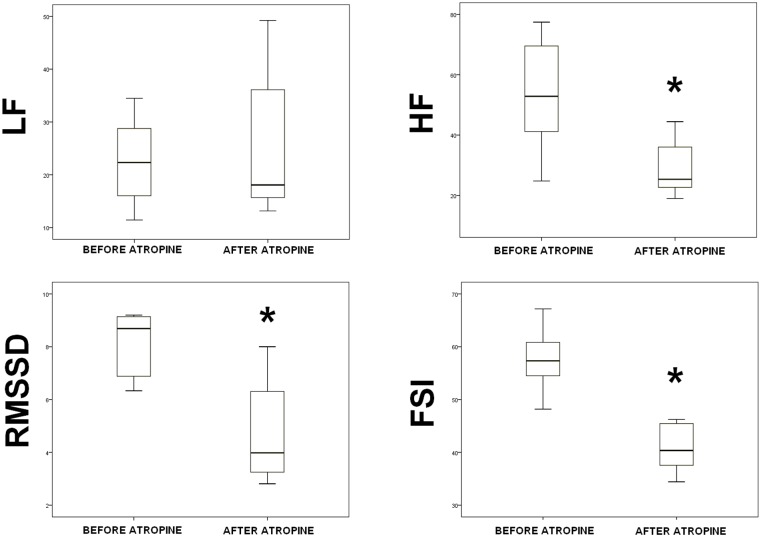
Analysis of heart rate variability (HRV) is a recognized tool in the assessment of autonomic nervous system (ANS) activity. Indeed, both time and spectral analysis techniques enable us to obtain indexes that are related to the way the ANS regulates the heart rate. However, these techniques are limited in terms of the lack of thresholds of the numerical indexes, which is primarily due to high inter-subject variability. We proposed a new fetal HRV analysis method related to the parasympathetic activity of the ANS. The aim of this study was to evaluate the performance of our method compared to commonly used HRV analysis, with regard to i) the ability to detect changes in ANS activity and ii) inter-subject variability. This study was performed in seven sheep fetuses. In order to evaluate the sensitivity and specificity of our index in evaluating parasympathetic activity, we directly administered 2.5 mg intravenous atropine, to inhibit parasympathetic tone, and 5 mg propranolol to block sympathetic activity. Our index, as well as time analysis (root mean square of the successive differences; RMSSD) and spectral analysis (high frequency (HF) and low frequency (LF) spectral components obtained via fast Fourier transform), were measured before and after injection. Inter-subject variability was estimated by the coefficient of variance (%CV). In order to evaluate the ability of HRV parameters to detect fetal parasympathetic decrease, we also estimated the effect size for each HRV parameter before and after injections. As expected, our index, the HF spectral component, and the RMSSD were reduced after the atropine injection. Moreover, our index presented a higher effect size. The %CV was far lower for our index than for RMSSD, HF, and LF. Although LF decreased after propranolol administration, fetal stress index, RMSSD, and HF were not significantly different, confirming the fact that those indexes are specific to the parasympathetic nervous system. In conclusion, our method appeared to be effective in detecting parasympathetic inhibition. Moreover, inter-subject variability was much lower, and effect size higher, with our method compared to other HRV analysis methods.
心率变异性(HRV)分析是评估自主神经系统(ANS)活动的一种公认工具。实际上,时域和频域分析技术都能使我们获得与ANS调节心率方式相关的指标。然而,这些技术在数值指标缺乏阈值方面存在局限性,这主要是由于个体间差异较大。我们提出了一种与ANS副交感神经活动相关的新型胎儿HRV分析方法。本研究的目的是评估我们的方法与常用HRV分析方法相比的性能,具体涉及:i)检测ANS活动变化的能力;ii)个体间差异。本研究在七只绵羊胎儿中进行。为了评估我们的指标在评估副交感神经活动方面的敏感性和特异性,我们直接静脉注射2.5mg阿托品以抑制副交感神经张力,并注射5mg普萘洛尔以阻断交感神经活动。在注射前后测量我们的指标,以及时域分析(逐次差值的均方根;RMSSD)和频域分析(通过快速傅里叶变换获得的高频(HF)和低频(LF)频谱成分)。个体间差异通过变异系数(%CV)进行估计。为了评估HRV参数检测胎儿副交感神经功能降低的能力,我们还估计了注射前后每个HRV参数的效应量。正如预期的那样,注射阿托品后我们的指标、HF频谱成分和RMSSD均降低。此外,我们的指标呈现出更高的效应量。我们的指标的%CV远低于RMSSD、HF和LF。虽然注射普萘洛尔后LF降低,但胎儿应激指数、RMSSD和HF没有显著差异,这证实了这些指标对副交感神经系统具有特异性这一事实。总之,我们的方法似乎在检测副交感神经抑制方面是有效的。此外,与其他HRV分析方法相比,我们的方法个体间差异更低,效应量更高。