Chen Vincent Chin-Hung, Hsu Tsai-Ching, Chen Li-Jeng, Chou Hong-Chun, Weng Jun-Cheng, Tzang Bor-Show
Department of Psychiatry, Chang Gung University, Taoyuan, Taiwan.
Department of Psychiatry, Chiayi Chang Gung Memorial Hospital, Chiayi, Taiwan.
PLoS One. 2017 Jul 10;12(7):e0181122. doi: 10.1371/journal.pone.0181122. eCollection 2017.
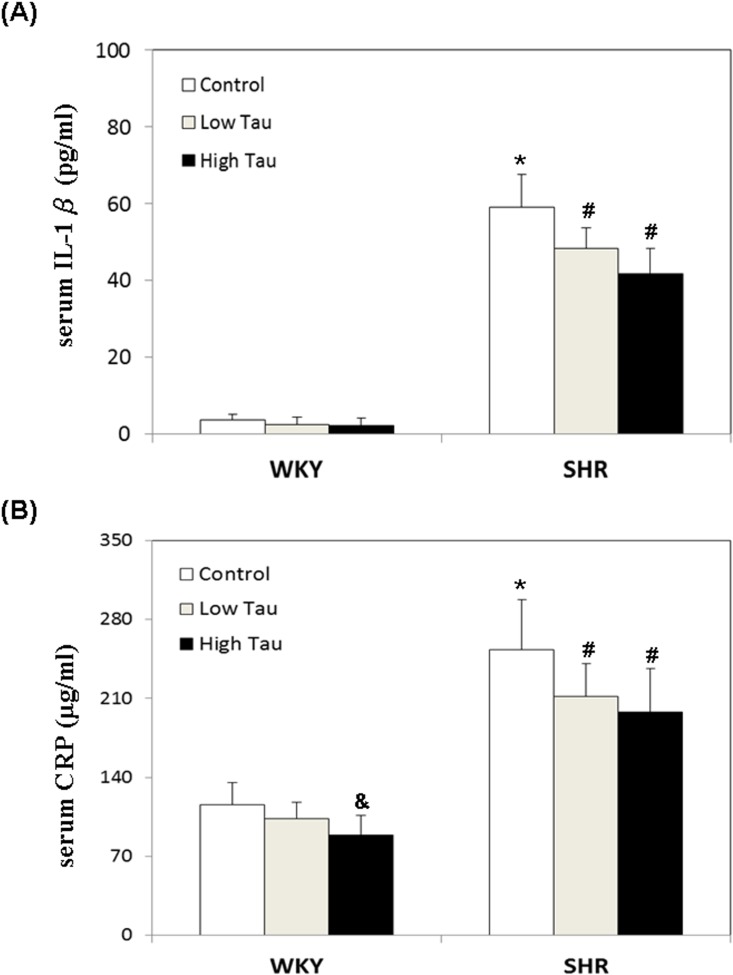
Attention deficit hyperactivity disorder (ADHD) is a global behavior illness among children and adults. To investigate the effects of taurine on resting-state fMRI activity in ADHD, a spontaneously hypertensive rat (SHR) animal model was adopted. Significantly decreased serum C-reactive protein (CRP) was detected in rats of Wistar Kyoto (WKY) high-taurine group and significantly decreased interleukin (IL)-1β and CRP were detected in rats of SHR low-taurine and high-taurine groups. Moreover, significantly higher horizontal locomotion was detected in rats of WKY low-taurine and SHR low-taurine groups than in those of controls. In contrast, significantly lower horizontal locomotion was detected in rats of the SHR high-taurine group than in those of the SHR control group. Additionally, significantly lower functional connectivity (FC) and mean amplitude of low-frequency fluctuation (mALFF) in the bilateral hippocampus in rats of WKY high-taurine and SHR high-taurine groups was detected. Notably, the mALFF in rats of the SHR low-taurine and high-taurine groups was significantly lower than in those of the SHR control group. These findings suggest that the administration of a high-dose taurine probably improves hyperactive behavior in SHR rats by ameliorating the inflammatory cytokines and modulating brain functional signals in SHR rats.
注意缺陷多动障碍(ADHD)是一种在儿童和成人中普遍存在的行为疾病。为了研究牛磺酸对ADHD静息态功能磁共振成像(fMRI)活动的影响,采用了自发性高血压大鼠(SHR)动物模型。在Wistar Kyoto(WKY)高牛磺酸组大鼠中检测到血清C反应蛋白(CRP)显著降低,在SHR低牛磺酸组和高牛磺酸组大鼠中检测到白细胞介素(IL)-1β和CRP显著降低。此外,WKY低牛磺酸组和SHR低牛磺酸组大鼠的水平运动明显高于对照组。相比之下,SHR高牛磺酸组大鼠的水平运动明显低于SHR对照组。此外,在WKY高牛磺酸组和SHR高牛磺酸组大鼠的双侧海马中检测到功能连接性(FC)和低频波动平均幅度(mALFF)显著降低。值得注意的是,SHR低牛磺酸组和高牛磺酸组大鼠的mALFF明显低于SHR对照组。这些发现表明,高剂量牛磺酸的给药可能通过改善炎症细胞因子和调节SHR大鼠的脑功能信号来改善SHR大鼠的多动行为。