Nissen Silas Boye, Perera Marta, Gonzalez Javier Martin, Morgani Sophie M, Jensen Mogens H, Sneppen Kim, Brickman Joshua M, Trusina Ala
StemPhys, Niels Bohr Institute, University of Copenhagen, Copenhagen, Denmark.
The Danish Stem Cell Centre, DanStem, University of Copenhagen, Copenhagen, Denmark.
PLoS Biol. 2017 Jul 12;15(7):e2000737. doi: 10.1371/journal.pbio.2000737. eCollection 2017 Jul.
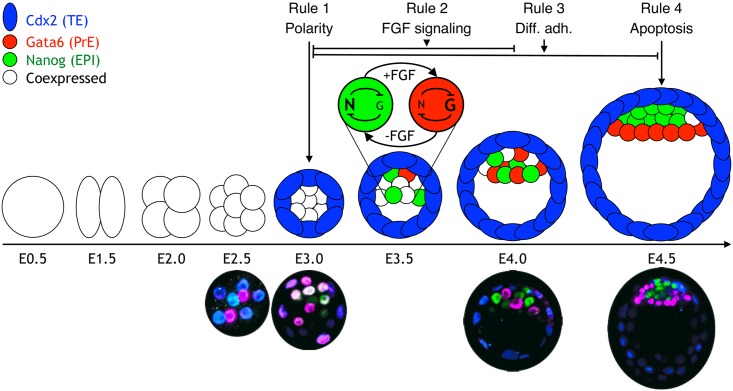
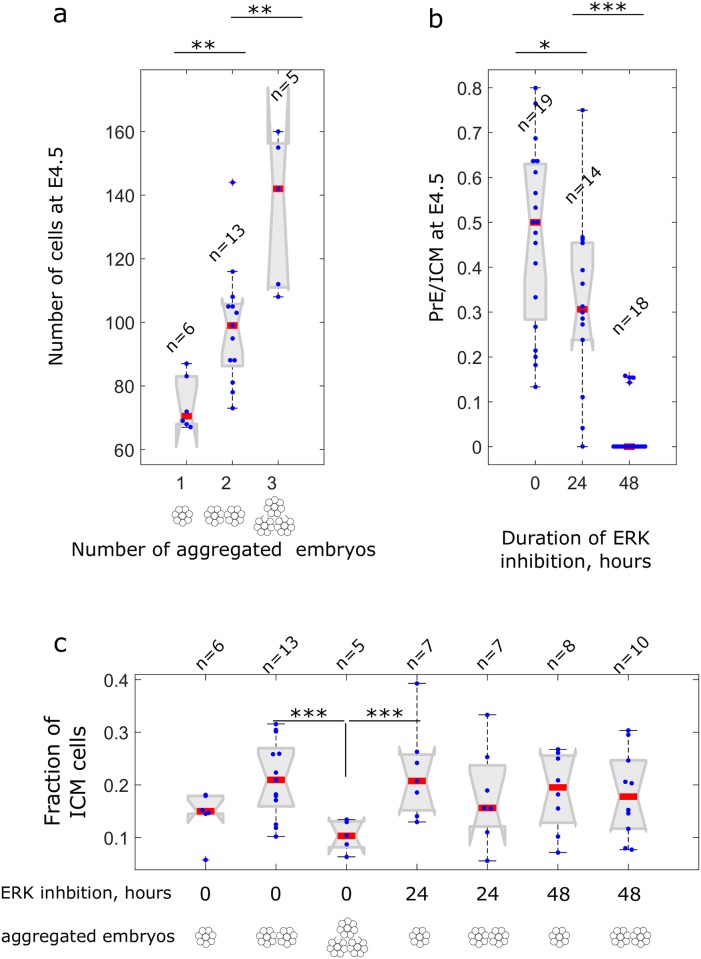
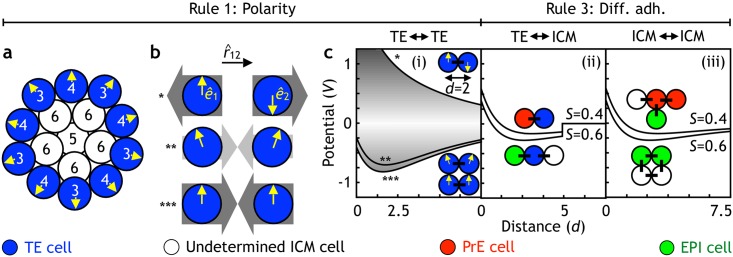
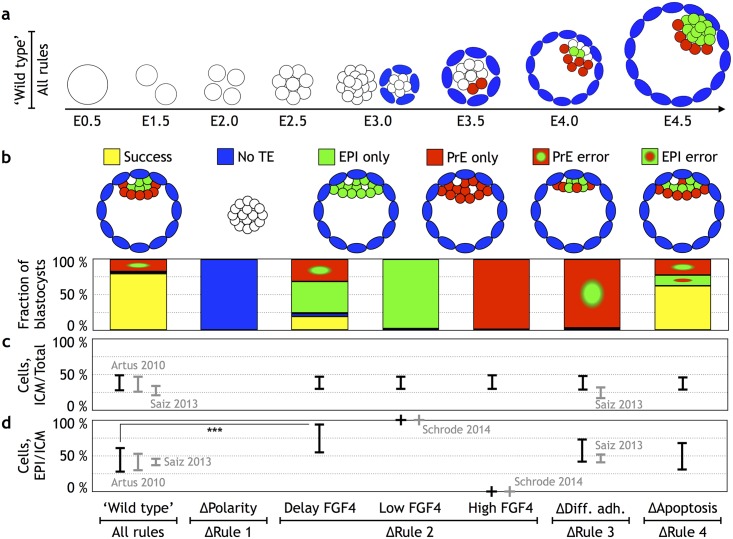
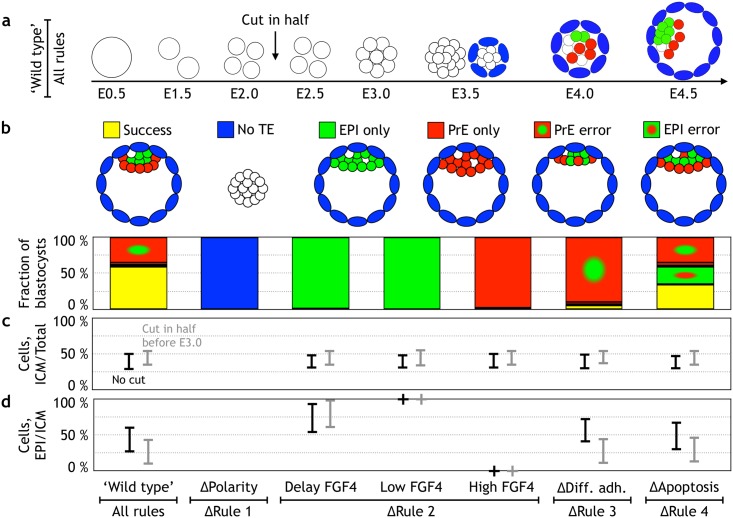
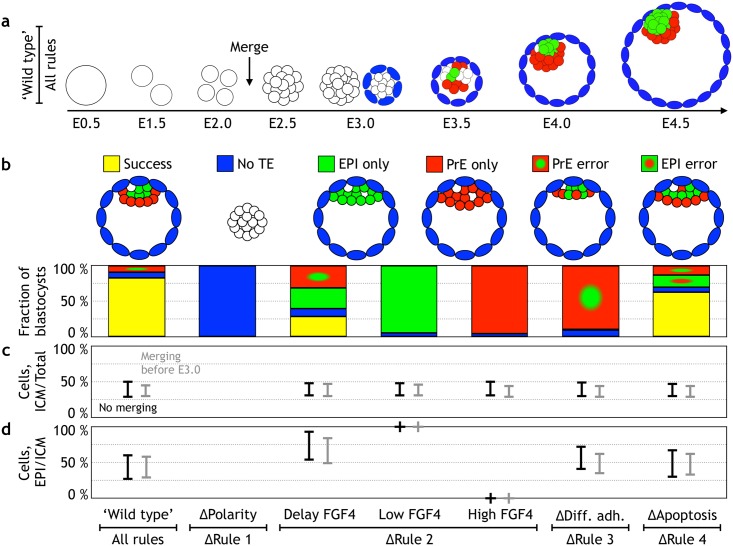
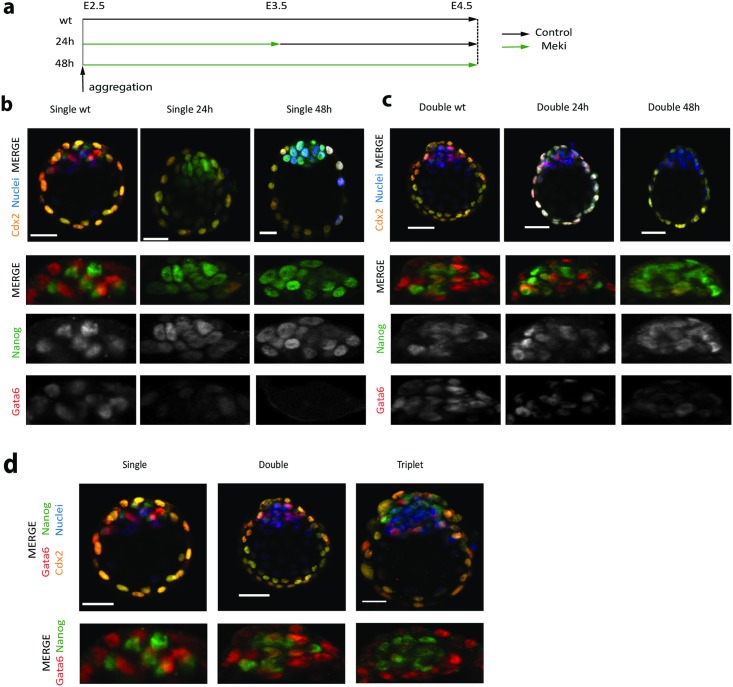
Early mammalian development is both highly regulative and self-organizing. It involves the interplay of cell position, predetermined gene regulatory networks, and environmental interactions to generate the physical arrangement of the blastocyst with precise timing. However, this process occurs in the absence of maternal information and in the presence of transcriptional stochasticity. How does the preimplantation embryo ensure robust, reproducible development in this context? It utilizes a versatile toolbox that includes complex intracellular networks coupled to cell-cell communication, segregation by differential adhesion, and apoptosis. Here, we ask whether a minimal set of developmental rules based on this toolbox is sufficient for successful blastocyst development, and to what extent these rules can explain mutant and experimental phenotypes. We implemented experimentally reported mechanisms for polarity, cell-cell signaling, adhesion, and apoptosis as a set of developmental rules in an agent-based in silico model of physically interacting cells. We find that this model quantitatively reproduces specific mutant phenotypes and provides an explanation for the emergence of heterogeneity without requiring any initial transcriptional variation. It also suggests that a fixed time point for the cells' competence of fibroblast growth factor (FGF)/extracellular signal-regulated kinase (ERK) sets an embryonic clock that enables certain scaling phenomena, a concept that we evaluate quantitatively by manipulating embryos in vitro. Based on these observations, we conclude that the minimal set of rules enables the embryo to experiment with stochastic gene expression and could provide the robustness necessary for the evolutionary diversification of the preimplantation gene regulatory network.
早期哺乳动物发育具有高度的调节性和自组织性。它涉及细胞位置、预先确定的基因调控网络以及环境相互作用之间的相互作用,以在精确的时间内生成囊胚的物理排列。然而,这个过程是在没有母体信息且存在转录随机性的情况下发生的。在这种情况下,植入前胚胎如何确保稳健、可重复的发育呢?它利用了一个多功能的工具箱,其中包括与细胞间通讯耦合的复杂细胞内网络、通过差异黏附进行的分离以及细胞凋亡。在这里,我们探讨基于这个工具箱的一组最小发育规则是否足以实现成功的囊胚发育,以及这些规则在多大程度上能够解释突变体和实验表型。我们在一个基于代理的物理相互作用细胞的计算机模拟模型中,将实验报道的极性、细胞间信号传导、黏附及细胞凋亡机制作为一组发育规则来实施。我们发现这个模型能够定量地重现特定的突变体表型,并为异质性的出现提供一种解释,而无需任何初始转录变异。它还表明,成纤维细胞生长因子(FGF)/细胞外信号调节激酶(ERK)的细胞感受态的固定时间点设定了一个胚胎时钟,这使得某些缩放现象成为可能,我们通过体外操作胚胎对这一概念进行了定量评估。基于这些观察结果,我们得出结论,这组最小规则使胚胎能够对随机基因表达进行试验,并可能为植入前基因调控网络的进化多样化提供必要的稳健性。