Reimer André, Schmitt Andreas, Ehrmann Dominic, Kulzer Bernhard, Hermanns Norbert
Research Institute of the Diabetes Academy Mergentheim (FIDAM), Bad Mergentheim, Germany.
Diabetes Center Mergentheim (DZM), Bad Mergentheim, Germany.
PLoS One. 2017 Jul 10;12(7):e0181218. doi: 10.1371/journal.pone.0181218. eCollection 2017.
Depressive symptoms in people with diabetes are associated with increased risk of adverse outcomes. Although successful psychosocial treatment options are available, little is known about factors that facilitate treatment response for depression in diabetes. This prospective study aims to examine the impact of known risk factors on improvement of depressive symptoms with a special interest in the role of diabetes-related distress.
181 people with diabetes participated in a randomized controlled trial. Diabetes-related distress was assessed using the Problem Areas In Diabetes (PAID) scale; depressive symptoms were assessed using the Center for Epidemiologic Studies Depression (CES-D) scale. Multiple logistic and linear regression analyses were used to assess associations between risk factors for depression (independent variables) and improvement of depressive symptoms (dependent variable). Reliable change indices were established as criteria of meaningful reductions in diabetes distress and depressive symptoms.
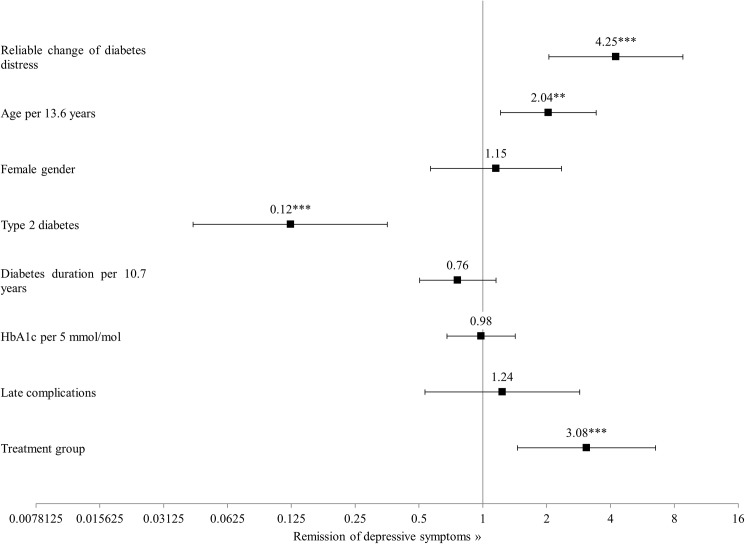
A reliable reduction of diabetes-related distress (15.43 points in the PAID) was significantly associated with fourfold increased odds for reliable improvement of depressive symptoms (OR = 4.25, 95% CI: 2.05-8.79; P<0.001). This result was corroborated using continuous measures of diabetes distress and depressive symptoms, showing that greater reduction of diabetes-related distress independently predicted greater improvement in depressive symptoms (ß = -0.40; P<0.001). Higher age had a positive (Odds Ratio = 2.04, 95% CI: 1.21-3.43; P<0.01) and type 2 diabetes had a negative effect on the meaningful reduction of depressive symptoms (Odds Ratio = 0.12, 95% CI: 0.04-0.35; P<0.001).
The reduction of diabetes distress is a statistical predictor of improvement of depressive symptoms. Diabetes patients with comorbid depressive symptomatology might benefit from treatments to reduce diabetes-related distress.
糖尿病患者的抑郁症状与不良结局风险增加相关。尽管有成功的心理社会治疗方案,但对于促进糖尿病患者抑郁治疗反应的因素知之甚少。这项前瞻性研究旨在探讨已知风险因素对抑郁症状改善的影响,特别关注糖尿病相关困扰的作用。
181名糖尿病患者参与了一项随机对照试验。使用糖尿病问题领域(PAID)量表评估糖尿病相关困扰;使用流行病学研究中心抑郁量表(CES-D)评估抑郁症状。采用多元逻辑回归和线性回归分析评估抑郁风险因素(自变量)与抑郁症状改善(因变量)之间的关联。将可靠变化指数确定为糖尿病困扰和抑郁症状有意义减轻的标准。
糖尿病相关困扰的可靠减轻(PAID量表降低15.43分)与抑郁症状可靠改善的几率增加四倍显著相关(OR = 4.25,95% CI:2.05 - 8.79;P < 0.001)。使用糖尿病困扰和抑郁症状的连续测量结果证实了这一结果,表明糖尿病相关困扰的更大减轻独立预测了抑郁症状的更大改善(β = -0.40;P < 0.001)。年龄较大有积极影响(优势比 = 2.04,95% CI: