Azurmendi L, Lapierre-Fetaud V, Schneider J, Montaner J, Katan M, Sanchez Jean-Charles
Translational Biomarker Group, Department of Human Protein Sciences, University of Geneva, Rue Michel Servet 1, 1211 Geneve 4, Switzerland.
Department of Neurology, University Hospital of Zurich, Zurich, Switzerland.
Clin Proteomics. 2017 Jul 12;14:27. doi: 10.1186/s12014-017-9162-0. eCollection 2017.
Post-stroke infections occur in 20-36% of stroke patients and are associated with high morbidity and mortality rates. Early identification of patients at risk of developing an infection could improve care via an earlier treatment leading to a better outcome. We used proteomic tools in order to discover biomarkers able to stratify patients at risk of post-stroke infection.
The post hoc analysis of a prospective cohort study including 40 ischemic stroke patients included 21 infected and 19 non-infected participants. A quantitative, isobaric labeling, proteomic strategy was applied to the plasma samples of 5 infected and 5 non-infected patients in order to highlight any significantly modulated proteins. A parallel reaction monitoring (PRM) assay was applied to 20 additional patients (10 infected and 10 non-infected) to verify discovery results. The most promising protein was pre-validated using an ELISA immunoassay on 40 patients and at different time points after stroke onset.
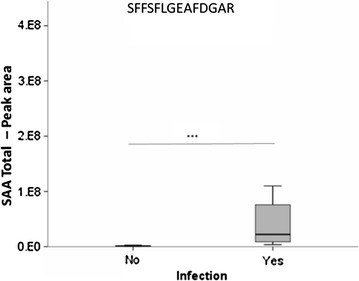
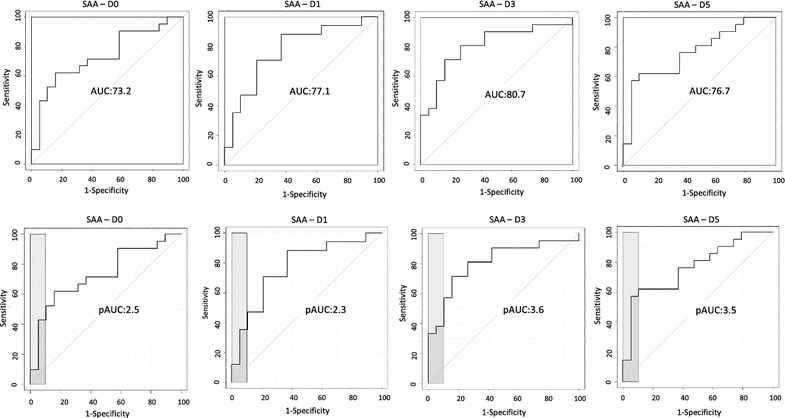
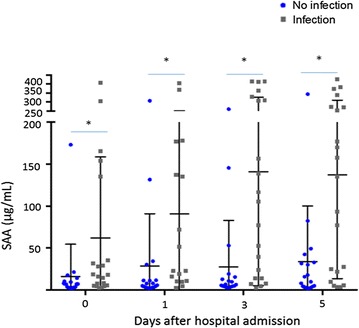
Tandem mass analysis identified 266 proteins, of which only serum amyloid A (SAA1/2) was significantly ( = 0.007) regulated between the two groups of patients. This acute-phase protein appeared to be 2.2 times more abundant in infected patients than in non-infected ones. These results were verified and validated using PRM and ELISA immunoassays, which showed that infected patients had significantly higher concentrations of SAA1/2 than non-infected patients at hospital admission, but also at 1, 3, and 5 days after admission.
The present study demonstrated that SAA1/2 is a promising predictor, at hospital admission, of stroke patients at risk of developing an infection. Further large, multicenter validation studies are needed to confirm these results. If confirmed, SAA1/2 concentrations could be used to identify the patients most at risk of post-stroke infections and therefore implement treatments more rapidly, thus reducing mortality.
中风后感染发生在20%-36%的中风患者中,与高发病率和死亡率相关。早期识别有感染风险的患者可通过更早的治疗改善护理,从而带来更好的结果。我们使用蛋白质组学工具来发现能够对中风后感染风险患者进行分层的生物标志物。
一项前瞻性队列研究的事后分析纳入了40例缺血性中风患者,其中包括21例感染患者和19例未感染参与者。对5例感染患者和5例未感染患者的血浆样本应用定量、等压标记蛋白质组学策略,以突出任何显著调节的蛋白质。对另外20例患者(10例感染患者和10例未感染患者)应用平行反应监测(PRM)分析来验证发现结果。使用酶联免疫吸附测定(ELISA)免疫测定法在40例患者中以及中风发作后的不同时间点对最有前景的蛋白质进行预验证。
串联质谱分析鉴定出266种蛋白质,其中只有血清淀粉样蛋白A(SAA1/2)在两组患者之间有显著(P = 0.007)调节。这种急性期蛋白在感染患者中的丰度似乎比未感染患者高2.2倍。使用PRM和ELISA免疫测定法对这些结果进行了验证,结果表明感染患者在入院时以及入院后1、3和5天的SAA1/2浓度显著高于未感染患者。
本研究表明,SAA1/2是入院时中风患者发生感染风险的一个有前景的预测指标。需要进一步的大型多中心验证研究来证实这些结果。如果得到证实,SAA1/2浓度可用于识别中风后感染风险最高的患者,从而更快地实施治疗,进而降低死亡率。