• 文献检索
  • 文档翻译
  • 深度研究
  • 学术资讯
  • Suppr Zotero 插件Zotero 插件
  • 邀请有礼
  • 套餐&价格
  • 历史记录
应用&插件
Suppr Zotero 插件Zotero 插件浏览器插件Mac 客户端Windows 客户端微信小程序
定价
高级版会员购买积分包购买API积分包
服务
文献检索文档翻译深度研究API 文档MCP 服务
关于我们
关于 Suppr公司介绍联系我们用户协议隐私条款
关注我们

Suppr 超能文献

核心技术专利:CN118964589B侵权必究
粤ICP备2023148730 号-1Suppr @ 2026

文献检索

告别复杂PubMed语法,用中文像聊天一样搜索,搜遍4000万医学文献。AI智能推荐,让科研检索更轻松。

立即免费搜索

文件翻译

保留排版,准确专业,支持PDF/Word/PPT等文件格式,支持 12+语言互译。

免费翻译文档

深度研究

AI帮你快速写综述,25分钟生成高质量综述,智能提取关键信息,辅助科研写作。

立即免费体验

网络上的负面自我表露:减轻内疚感的作用。

Negative Self-Disclosure on the Web: The Role of Guilt Relief.

作者信息

Levontin Liat, Yom-Tov Elad

机构信息

Faculty of Industrial Engineering and Management, Technion - Israel Institute of TechnologyHaifa, Israel.

Microsoft Israel R&D CenterHerzliya, Israel.

出版信息

Front Psychol. 2017 Jun 28;8:1068. doi: 10.3389/fpsyg.2017.01068. eCollection 2017.

DOI:10.3389/fpsyg.2017.01068
PMID:28701982
原文链接:https://pmc.ncbi.nlm.nih.gov/articles/PMC5487427/
Abstract

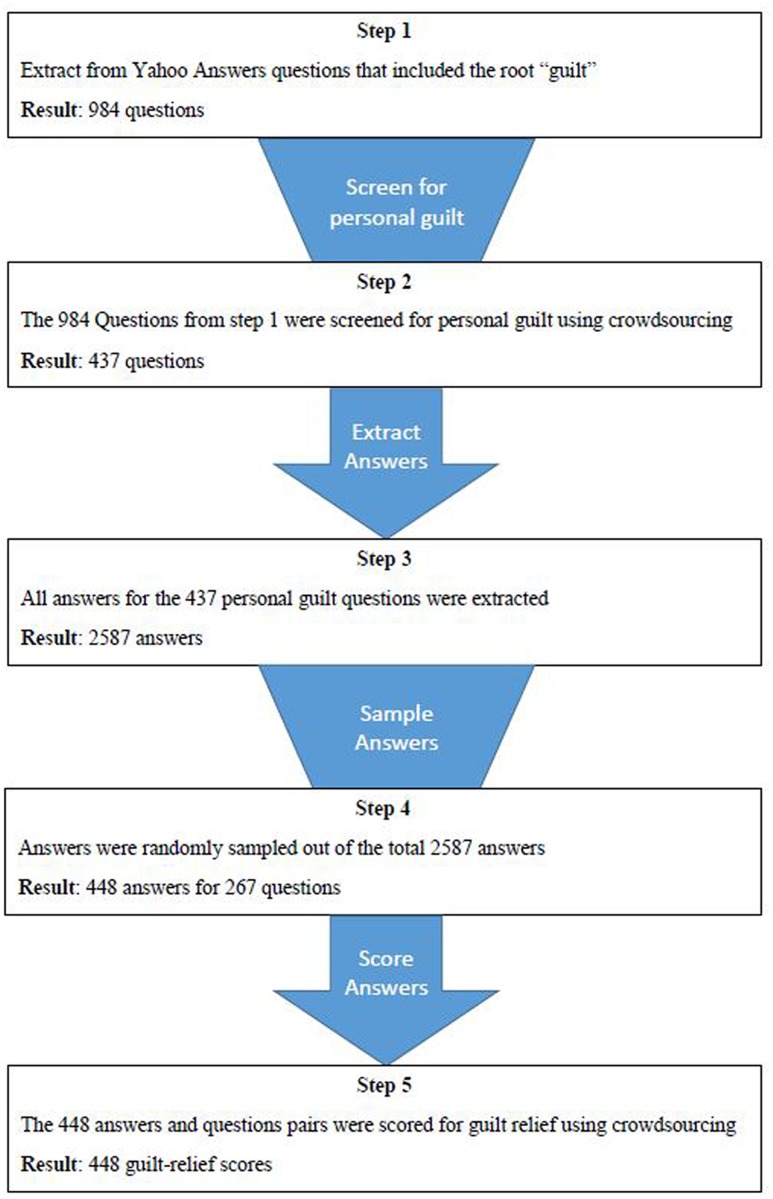
In this paper, we suggest people use anonymous online forums as platforms for self-disclosing actions they feel guilty about-such as transgressions and unethical behaviors-with the goal of achieving guilt relief through others' reactions. We support this proposition by analyzing field data extracted from Yahoo Answers, an online question-and-answer website. Our analysis shows the level of guilt relief an answer is expected to offer the "asker" (the self-disclosing person) is positively associated with the asker's likelihood of selecting that answer as the "best" response to the self-disclosure. Furthermore, following receipt of a guilt-relieving answer, an asker becomes less likely to engage in prosocial behavior, which is another type of guilt-relieving action.

摘要

在本文中,我们建议人们利用匿名在线论坛作为平台,来自我披露他们感到内疚的行为,比如违规行为和不道德行为,目的是通过他人的反应来减轻内疚感。我们通过分析从在线问答网站雅虎问答中提取的实地数据来支持这一观点。我们的分析表明,一个答案预期能为“提问者”(自我披露者)提供的内疚减轻程度,与提问者将该答案选为对自我披露的“最佳”回应的可能性呈正相关。此外,在收到能减轻内疚的答案后,提问者参与亲社会行为的可能性会降低,亲社会行为是另一种减轻内疚的行为。
https://cdn.ncbi.nlm.nih.gov/pmc/blobs/5a74/5487427/de520d18b634/fpsyg-08-01068-g001.jpg

相似文献

1
Negative Self-Disclosure on the Web: The Role of Guilt Relief.网络上的负面自我表露:减轻内疚感的作用。
Front Psychol. 2017 Jun 28;8:1068. doi: 10.3389/fpsyg.2017.01068. eCollection 2017.
2
Guilt and Proneness to Shame: Unethical Behaviour in Vulnerable and Grandiose Narcissism.内疚与易羞耻倾向:脆弱型与夸大型自恋中的不道德行为
Eur J Psychol. 2018 Mar 12;14(1):28-43. doi: 10.5964/ejop.v14i1.1355. eCollection 2018 Mar.
3
Introducing the GASP scale: a new measure of guilt and shame proneness.引入 GASP 量表:一种新的内疚和羞耻倾向度量。
J Pers Soc Psychol. 2011 May;100(5):947-66. doi: 10.1037/a0022641.
4
The Role of Guilt and Empathy on Prosocial Behavior.内疚与同理心在亲社会行为中的作用。
Behav Sci (Basel). 2022 Mar 1;12(3):64. doi: 10.3390/bs12030064.
5
Sweetened blood sweetens behavior. Ego depletion, glucose, guilt, and prosocial behavior.含糖血液会使行为变得温和。自我损耗、葡萄糖、内疚与亲社会行为。
Appetite. 2014 Oct;81:8-11. doi: 10.1016/j.appet.2014.05.023. Epub 2014 May 29.
6
Why do people (not) share guilt with others?为什么人们(不)与他人分担罪责?
Cogn Emot. 2023 Aug-Sep;37(5):927-941. doi: 10.1080/02699931.2023.2221425. Epub 2023 Jun 9.
7
Confession and self-control: A prelude to repentance or relapse?忏悔与自我控制:是悔改的前奏还是复吸的先兆?
J Pers Soc Psychol. 2019 Apr;116(4):563-581. doi: 10.1037/pspi0000152. Epub 2018 Oct 15.
8
You and me: Investigating the role of self-evaluative emotion in preschool prosociality.你和我:探究自我评价情绪在学前儿童亲社会行为中的作用。
J Exp Child Psychol. 2017 Mar;155:67-83. doi: 10.1016/j.jecp.2016.11.001. Epub 2016 Dec 2.
9
Threat to the Group's Image Can Motivate High Identifiers to Take Action Against In-group Transgressions.群体形象威胁能激励高认同者对群体内违规行为采取行动。
Pers Soc Psychol Bull. 2018 Nov;44(11):1523-1544. doi: 10.1177/0146167218768800. Epub 2018 May 13.
10
Honesty-humility and prosocial behavior: The mediating roles of perspective taking and guilt-proneness.诚实-谦逊与亲社会行为:换位思考和内疚倾向的中介作用。
Scand J Psychol. 2019 Aug;60(4):386-393. doi: 10.1111/sjop.12551. Epub 2019 May 26.

引用本文的文献

1
Adolescent sadfishing on social media: anxiety, depression, attention seeking, and lack of perceived social support as potential contributors.社交媒体上青少年的自伤行为:焦虑、抑郁、寻求关注和缺乏感知到的社会支持可能是潜在的诱因。
BMC Psychol. 2023 Nov 7;11(1):378. doi: 10.1186/s40359-023-01420-y.
2
Identifiability, Risk, and Information Credibility in Discussions on Moral/Ethical Violation Topics on Chinese Social Networking Sites.中国社交网站上道德/伦理违规话题讨论中的可识别性、风险与信息可信度
Front Psychol. 2020 Oct 23;11:535605. doi: 10.3389/fpsyg.2020.535605. eCollection 2020.
3
Information-Sharing Behavior on WeChat Moments: The Role of Anonymity, Familiarity, and Intrinsic Motivation.

本文引用的文献

1
The effects of feelings of guilt on the behaviour of uncooperative individuals in repeated social bargaining games: An affect-as-information interpretation of the role of emotion in social interaction.内疚感对重复社会讨价还价博弈中不合作个体行为的影响:情感在社会互动中作用的情感即信息解读
Cogn Emot. 2003 May;17(3):429-453. doi: 10.1080/02699930143000662.
2
The Psychology of Confessions: A Review of the Literature and Issues.《供认的心理学:文献回顾与问题探讨》。
Psychol Sci Public Interest. 2004 Nov;5(2):33-67. doi: 10.1111/j.1529-1006.2004.00016.x. Epub 2004 Nov 1.
3
Why Do People Regulate Their Emotions? A Taxonomy of Motives in Emotion Regulation.
微信朋友圈中的信息分享行为:匿名性、熟悉度和内在动机的作用。
Front Psychol. 2019 Nov 14;10:2540. doi: 10.3389/fpsyg.2019.02540. eCollection 2019.
人们为什么要调节情绪?情绪调节动机的分类学。
Pers Soc Psychol Rev. 2016 Aug;20(3):199-222. doi: 10.1177/1088868315586325. Epub 2015 May 26.
4
"I cheated, but only a little": partial confessions to unethical behavior.“我作弊了,但只是一点点”:对不道德行为的部分坦白。
J Pers Soc Psychol. 2014 Feb;106(2):202-17. doi: 10.1037/a0035392.
5
Guilty feelings, targeted actions.内疚感,针对性行动。
Pers Soc Psychol Bull. 2012 May;38(5):607-18. doi: 10.1177/0146167211435796. Epub 2012 Feb 14.
6
When social networking is not working: individuals with low self-esteem recognize but do not reap the benefits of self-disclosure on Facebook.当社交网络不起作用时:自尊心低的个体认识到但没有从 Facebook 上的自我表露中获益。
Psychol Sci. 2012 Mar;23(3):295-302. doi: 10.1177/0956797611429709. Epub 2012 Feb 7.
7
Introducing the GASP scale: a new measure of guilt and shame proneness.引入 GASP 量表:一种新的内疚和羞耻倾向度量。
J Pers Soc Psychol. 2011 May;100(5):947-66. doi: 10.1037/a0022641.
8
Cleansing the soul by hurting the flesh: the guilt-reducing effect of pain.通过伤害肉体来净化灵魂:疼痛减轻罪恶感的作用。
Psychol Sci. 2011 Mar;22(3):334-5. doi: 10.1177/0956797610397058. Epub 2011 Jan 18.
9
What is moral about guilt? Acting "prosocially" at the disadvantage of others.内疚感有何道德可言?以牺牲他人为代价而“亲社会”地行事。
J Pers Soc Psychol. 2011 Mar;100(3):462-73. doi: 10.1037/a0021459.
10
Suppressing secrecy through metacognitive ease: cognitive fluency encourages self-disclosure.通过元认知流畅来抑制秘密:认知流畅度鼓励自我表露。
Psychol Sci. 2009 Nov;20(11):1414-20. doi: 10.1111/j.1467-9280.2009.02461.x. Epub 2009 Oct 21.