Ricchi Matteo, Bertasio Cristina, Boniotti Maria B, Vicari Nadia, Russo Simone, Tilola Michela, Bellotti Marco A, Bertasi Barbara
Istituto Zooprofilattico Sperimentale della Lombardia e dell'Emilia Romagna "Bruno Ubertini," National Reference Centre for ParatuberculosisPodenzano, Italy.
Istituto Zooprofilattico Sperimentale della Lombardia e dell'Emilia Romagna "Bruno Ubertini," National Reference Centre for Tuberculosis from M. bovisBrescia, Italy.
Front Microbiol. 2017 Jun 28;8:1174. doi: 10.3389/fmicb.2017.01174. eCollection 2017.
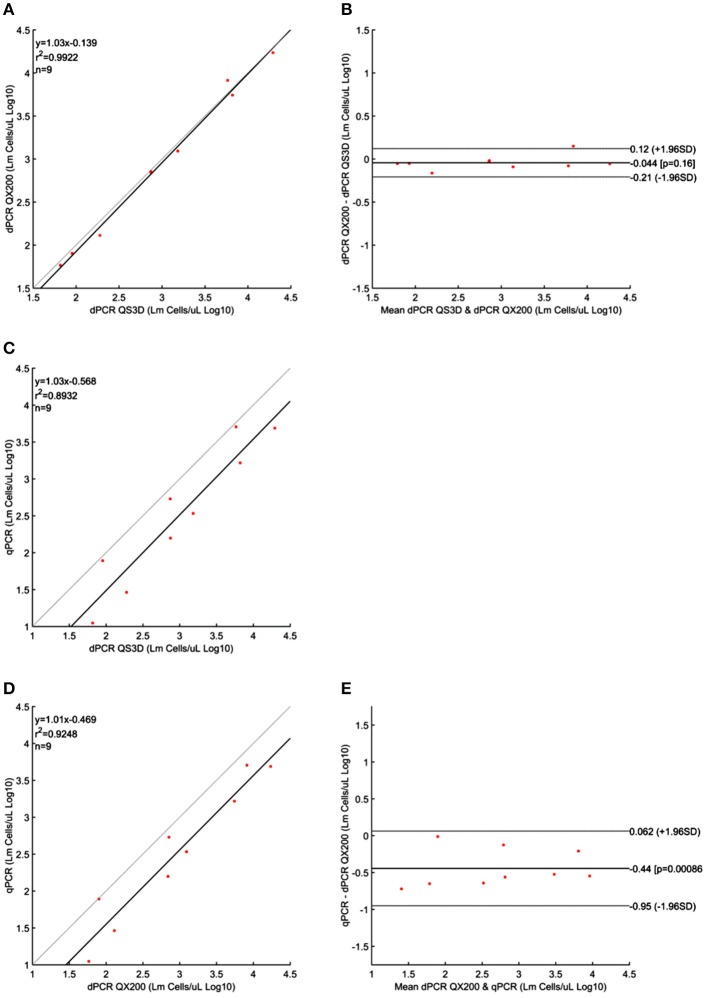
The demand for rapid methods for the quantification of pathogens is increasing. Among these methods, those based on nucleic acids amplification (quantitative PCRs) are the most widespread worldwide. Together with the qPCR, a new approach named digital PCR (dPCR), has rapidly gained importance. The aim of our study was to compare the results obtained using two different dPCR systems and one qPCR in the quantification of three different bacterial pathogens: , and subsp. . For this purpose, three pre-existing qPCRs were used, while the same primers and probes, as well as PCR conditions, were transferred to two different dPCR systems: the QX200 (Bio-Rad) and the Quant Studio 3D (Applied Biosystems). The limits of detection and limits of quantification for all pathogens, and all PCR approaches applied, were determined using genomic pure DNAs. The quantification of unknown decimal suspensions of the three bacteria obtained by the three different PCR approaches was compared through the Linear Regression and Bland and Altman analyses. Our results suggest that, both dPCRs are able to quantify the same amount of bacteria, while the comparison among dPCRs and qPCRs, showed both over and under-estimation of the bacteria present in the unknown suspensions. Our results showed qPCR over-estimated the amount of subsp. and cells. On the contrary, qPCR, compared to QX200 dPCR, under-estimated the amount of cells. However, the maximum difference among PCRs approaches was <0.5 Log, while cultural methods underestimated the number of bacteria by one to two Log for and subsp. . On the other hand, cultural and PCRs methods quantified the same amount of bacteria for , suggesting for this last pathogen, PCRs approaches can be considered as a valid alternative to the cultural ones.
对病原体进行快速定量方法的需求正在增加。在这些方法中,基于核酸扩增的方法(定量PCR)在全球最为广泛使用。与定量PCR一起,一种名为数字PCR(dPCR)的新方法迅速变得重要起来。我们研究的目的是比较使用两种不同的dPCR系统和一种定量PCR对三种不同细菌病原体([具体病原体名称1]、[具体病原体名称2]和[具体病原体名称3]亚种)进行定量时所获得的结果。为此,使用了三种预先存在的定量PCR,同时将相同的引物和探针以及PCR条件转移到两种不同的dPCR系统:QX200(伯乐公司)和Quant Studio 3D(应用生物系统公司)。使用基因组纯DNA确定了所有病原体以及所有应用的PCR方法的检测限和定量限。通过线性回归以及布兰德-奥特曼分析比较了三种不同PCR方法对三种细菌未知十进制悬浮液的定量结果。我们的结果表明,两种dPCR都能够对相同数量的细菌进行定量,而dPCR和定量PCR之间的比较显示,未知悬浮液中存在的细菌数量既有高估也有低估。我们的结果表明,定量PCR高估了[具体病原体名称3]亚种和[具体病原体名称2]细胞的数量。相反,与QX200 dPCR相比,定量PCR低估了[具体病原体名称1]细胞的数量。然而,PCR方法之间的最大差异<0.5个对数,而培养方法对[具体病原体名称1]和[具体病原体名称3]亚种的细菌数量低估了一到两个对数。另一方面,培养法和PCR方法对[具体病原体名称2]的细菌定量数量相同,这表明对于最后这种病原体,PCR方法可被视为培养法的有效替代方法。