Mailankody Sharada, Dangeti Gurukiran V, Soundravally Rajendiran, Joseph Noyal M, Mandal Jharna, Dutta Tarun K, Kadhiravan Tamilarasu
Department of Medicine, Jawaharlal Institute of Postgraduate Medical Education and Research, Puducherry, India.
Department of Biochemistry, Jawaharlal Institute of Postgraduate Medical Education and Research, Puducherry, India.
PLoS One. 2017 Jul 12;12(7):e0181262. doi: 10.1371/journal.pone.0181262. eCollection 2017.
Tuberculous meningitis is characterized by elevated levels of matrix metalloproteinase 9 (MMP9) in the cerebrospinal fluid (CSF). However, it is unclear whether elevated MMP9 levels are associated with poor treatment outcome. We tested the hypothesis that pretreatment MMP9 levels in the CSF would be higher in tuberculous meningitis patients experiencing a poor treatment outcome.
We prospectively assessed the treatment outcome in a consecutive sample of human immunodeficiency virus-negative patients with tuberculous meningitis. We defined good outcome as survival without severe neurological disability (modified Rankin scale scores 0-2). We estimated levels of MMP9 and its tissue inhibitor (TIMP1) on pretreatment CSF samples. We used albumin index to assess blood-brain barrier permeability.
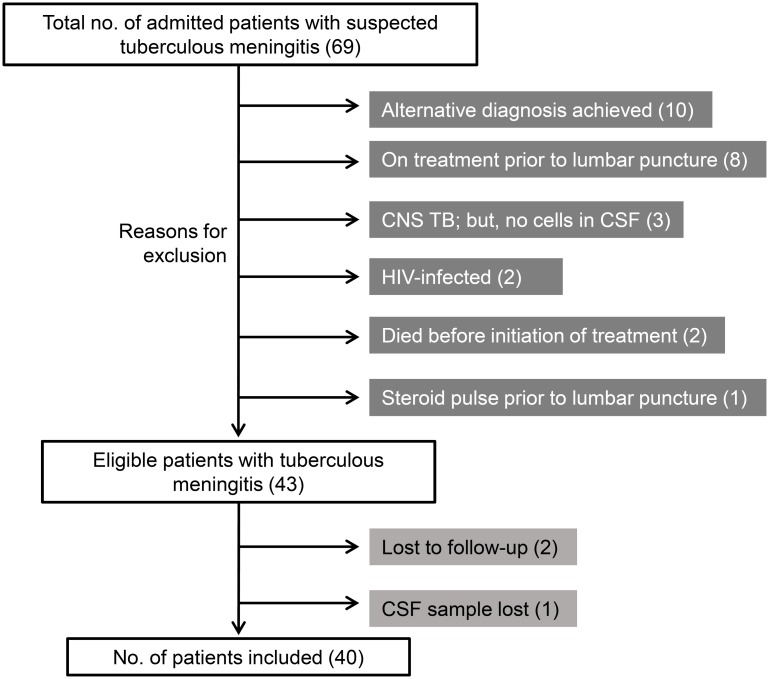
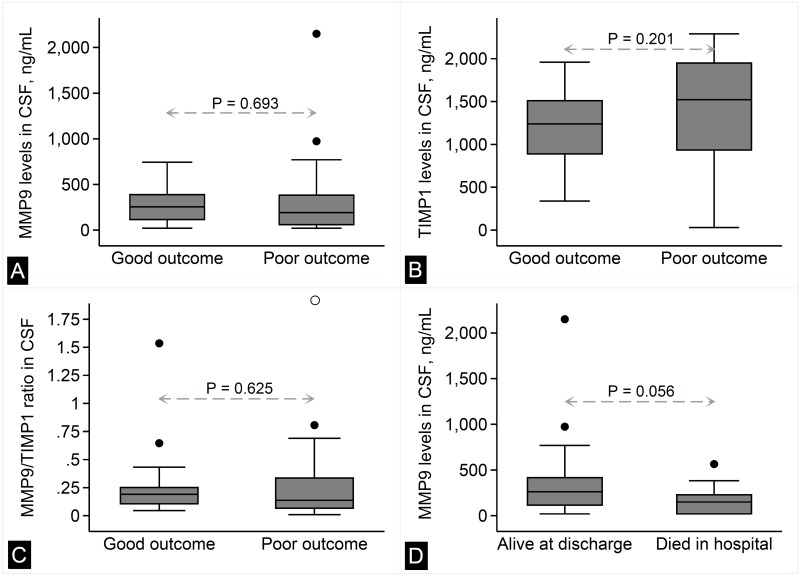
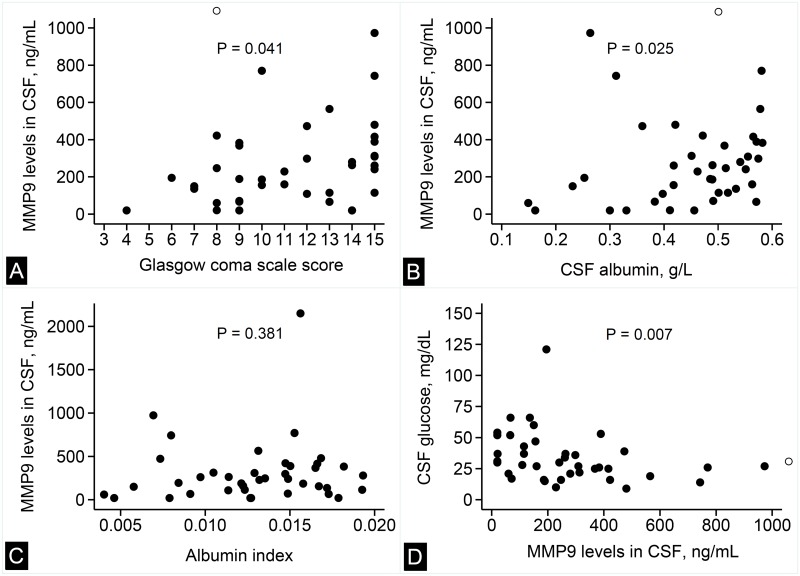
We studied 40 patients (23 males [58%]) with tuberculous meningitis. Sixteen patients (40%) had stage 3 disease. On follow-up, 18 (45%) patients had a poor treatment outcome-15 patients died and 3 had severe neurological disability. Pretreatment MMP9 levels were not associated with treatment outcome (median [interquartile range], 254 [115-389] vs. 192 [60-383] ng/mL in good vs. poor outcome groups; P = 0.693). MMP9 levels did not correlate with the albumin index (Spearman's rho = 0.142; P = 0.381). However, MMP9 levels significantly correlated with CSF glucose levels (rho = -0.419; P = 0.007) and admission Glasgow coma scale score (rho = 0.324; P = 0.032). Likewise, TIMP1 levels also did not differ by treatment outcome (1239 [889-1511] vs. 1522 [934-1949] ng/mL; P = 0.201). MMP9/TIMP1 ratio that reflects net proteolytic activity was also not different between the two groups (0.191 [0.107-0.250] vs. 0.163 [0.067-0.34]; P = 0.625).
Our findings do not support the hypothesis that pretreatment levels of MMP9 would be higher in tuberculous meningitis patients experiencing a poor treatment outcome. Further, MMP9 levels in the CSF did not correlate with blood-brain barrier permeability in patients with tuberculous meningitis.
结核性脑膜炎的特征是脑脊液(CSF)中基质金属蛋白酶9(MMP9)水平升高。然而,MMP9水平升高是否与治疗效果不佳相关尚不清楚。我们检验了这样一个假设,即治疗效果不佳的结核性脑膜炎患者脑脊液中MMP9的预处理水平会更高。
我们前瞻性评估了连续样本中人类免疫缺陷病毒阴性的结核性脑膜炎患者的治疗效果。我们将良好结局定义为存活且无严重神经功能残疾(改良Rankin量表评分0 - 2)。我们估计了预处理脑脊液样本中MMP9及其组织抑制剂(TIMP1)的水平。我们使用白蛋白指数评估血脑屏障通透性。
我们研究了40例结核性脑膜炎患者(23例男性[58%])。16例患者(40%)处于3期疾病。随访时,18例(45%)患者治疗效果不佳——15例患者死亡,3例有严重神经功能残疾。预处理MMP9水平与治疗效果无关(良好结局组与不佳结局组的中位数[四分位间距]分别为254[115 - 389] ng/mL和192[60 - 383] ng/mL;P = 0.693)。MMP9水平与白蛋白指数无相关性(Spearman相关系数rho = 0.142;P = 0.381)。然而,MMP9水平与脑脊液葡萄糖水平显著相关(rho = -0.419;P = 0.007)以及入院时格拉斯哥昏迷量表评分相关(rho = 0.324;P = 0.032)。同样,TIMP1水平在不同治疗结局组中也无差异(分别为1239[889 - 1511] ng/mL和1522[934 - 1949] ng/mL;P = 0.201)。反映净蛋白水解活性的MMP9/TIMP1比值在两组之间也无差异(分别为0.191[0.107 - 0.250]和0.163[0.067 - 0.34];P = 0.625)。
我们的研究结果不支持这样的假设,即治疗效果不佳的结核性脑膜炎患者MMP9的预处理水平会更高。此外,结核性脑膜炎患者脑脊液中的MMP9水平与血脑屏障通透性无关。