Kim Youn-Jung, Seo Dong-Woo, Lee Jae-Ho, Lee Yoon-Seon, Oh Bum-Jin, Lim Kyoung-Soo, Kim Won Young
Department of Emergency Medicine, University of Ulsan College of Medicine, Asan Medical Center, Seoul, Korea.
PLoS One. 2017 Jul 13;12(7):e0181362. doi: 10.1371/journal.pone.0181362. eCollection 2017.
This study aimed to examine trends in the incidence and outcomes of bicycle-related injuries in emergency departments (ED) in South Korea.
We analysed data from the National Emergency Department Information System database for adult patients (≥20 years) with bicycle-related injuries presenting to EDs in South Korea between January 2012 and December 2014. Riders and bicycle passengers whose injuries were associated with bicycle use were included. Serious outcomes were defined as death at the ED, need for emergency operation, or intensive care unit admission.
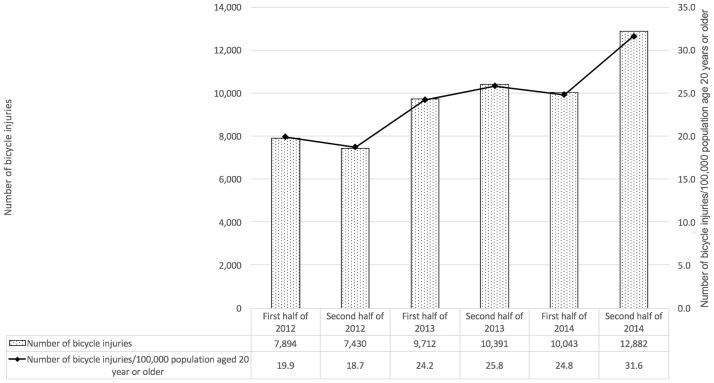
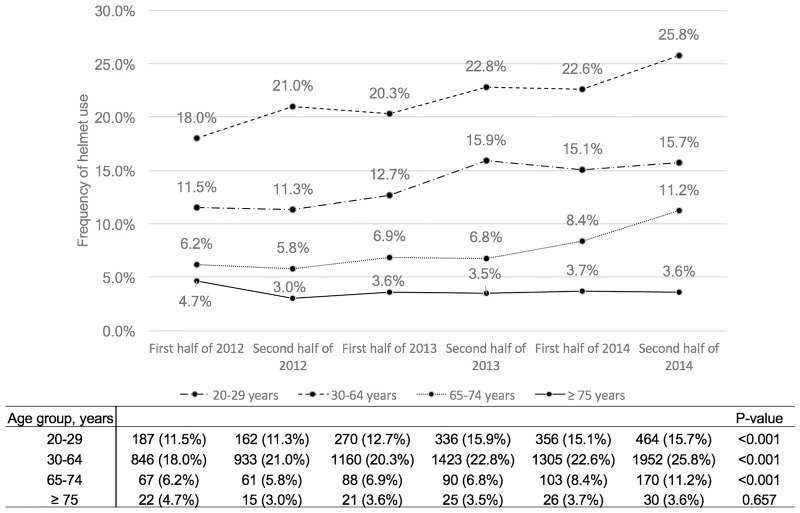
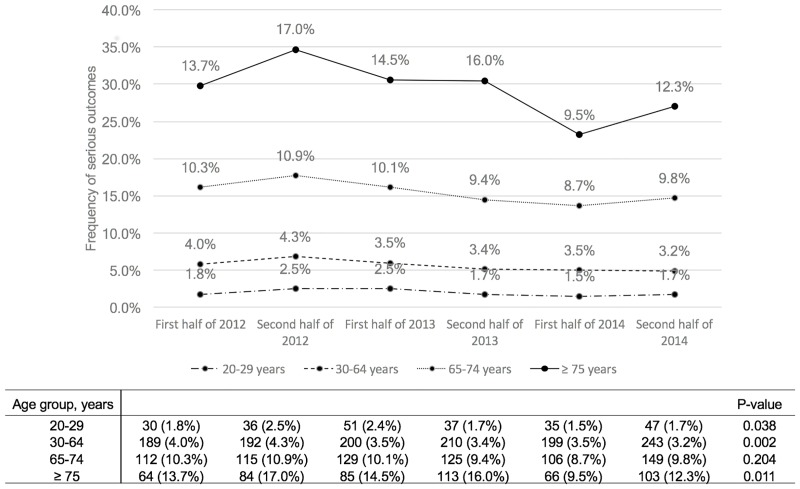
The number of people who commute to work by bicycle increased by 36% from 205,100 in 2005 to 279,544 in 2015. Of 529,278 traffic-related trauma cases, 58,352 (11.0%) were bicycle-related, which increased from 7,894 (10.2%) in the first half of 2012 to 12,882 (12.2%) in the second half of 2014 (p < 0.001). However, the proportion of serious outcomes decreased from 5.0% to 4.2% during the study period (p < 0.001). Serious outcomes were most frequent in the elderly (65-74 years) and older elderly (≥75 years) groups and decreased for all but the elderly age group from 10.3% to 9.8% (p = 0.204). The helmet use rate increased from 14.2% to 20.3% (p < 0.001) but was the lowest in the older elderly group (3.6%) without change during the study period (from 4.7% to 3.7%, p = 0.656). A lack of helmet use was significantly associated with serious outcomes (odds ratio, 1.811; 95% confidence interval, 1.576-2.082).
Although the incidence of bicycle-related injuries increased, the proportion of serious outcomes decreased, possibly due to increased helmet use. Public education on safety equipment use is required, especially in elderly populations.
本研究旨在调查韩国急诊科与自行车相关损伤的发生率及转归趋势。
我们分析了韩国国家急诊科信息系统数据库中2012年1月至2014年12月期间因自行车相关损伤就诊于急诊科的成年患者(≥20岁)的数据。纳入了与自行车使用相关损伤的骑车者和自行车乘客。严重转归定义为在急诊科死亡、需要急诊手术或入住重症监护病房。
骑自行车通勤的人数从2005年的205,100人增加了36%,至2015年达到279,544人。在529,278例与交通相关的创伤病例中,58,352例(11.0%)与自行车相关,这一比例从2012年上半年的7,894例(10.2%)增至2014年下半年的12,882例(12.2%)(p<0.001)。然而,在研究期间,严重转归的比例从5.0%降至4.2%(p<0.001)。严重转归在老年(65 - 74岁)和高龄老年(≥75岁)组中最为常见,除老年组外,所有年龄组的严重转归比例从10.3%降至9.8%(p = 0.204)。头盔使用率从14.2%增至20.3%(p<0.001),但在高龄老年组中最低(3.6%),在研究期间无变化(从4.7%降至3.7%,p = 0.656)。未使用头盔与严重转归显著相关(比值比,1.811;95%置信区间,1.576 - 2.082)。
尽管与自行车相关损伤的发生率有所增加,但严重转归的比例有所下降,这可能归因于头盔使用率的提高。需要开展关于安全设备使用的公众教育,尤其是针对老年人群体。