Lädermann Alexandre, Denard Patrick Joel, Tirefort Jérome, Collin Philippe, Nowak Alexandra, Schwitzguebel Adrien Jean-Pierre
Division of Orthopaedics and Trauma Surgery, La Tour Hospital, Rue J.-D. Maillard 3, 1217, Meyrin, Switzerland.
Faculty of Medicine, University of Geneva, Rue Michel-Servet 1, 1211, Geneva 4, Switzerland.
J Orthop Surg Res. 2017 Jul 14;12(1):112. doi: 10.1186/s13018-017-0617-9.
With the growth of reverse shoulder arthroplasty (RSA), it is becoming increasingly necessary to establish the most cost-effective methods for the procedure. The surgical approach is one factor that may influence the cost and outcome of RSA. The purpose of this study was to compare the clinical results of a subscapularis- and deltoid-sparing (SSCS) approach to a traditional deltopectoral (TDP) approach for RSA. The hypothesis was that the SSCS approach would be associated with decreased length of stay (LOS), equal complication rate, and better short-term outcomes compared to the TDP approach.
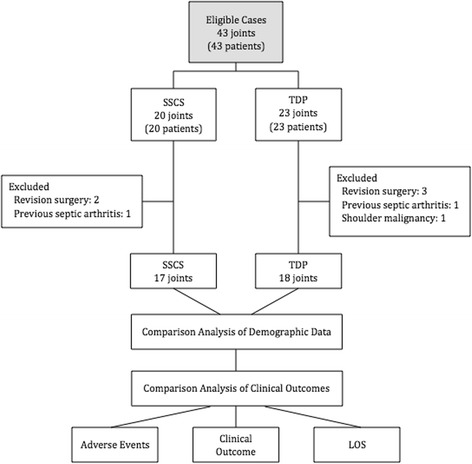
A prospective evaluation was performed on patients undergoing RSA over a 2-year period. A deltopectoral incision was used followed by either an SSCS approach or a traditional tenotomy of the subscapularis (TDP). LOS, adverse events, physical therapy utilization, and patient satisfaction were collected in the 12 months following RSA.
LOS was shorter with the SSCS approach compared to the TDP approach (from 8.2 ± 6.4 days to 15.2 ± 11.9 days; P = 0.04). At 3 months postoperative, the single assessment numeric evaluation score (80 ± 11% vs 70 ± 6%; P = 0.04) and active elevation (130 ± 22° vs 109 ± 24°; P = 0.01) were higher in the SSCS group. The SSCS approach resulted in a net cost savings of $5900 per patient. Postoperative physical therapy, pain levels, and patient satisfaction were comparable in both groups. No immediate intraoperative complications were noted.
Using a SSCS approach is an option for patients requiring RSA. Overall LOS is minimized compared to a TDP approach with subscapularis tenotomy. The SSCS approach may provide substantial healthcare cost savings, without increasing complication rate or decreasing patient satisfaction.
随着反肩关节置换术(RSA)的发展,越来越有必要建立该手术最具成本效益的方法。手术入路是可能影响RSA成本和结果的一个因素。本研究的目的是比较保留肩胛下肌和三角肌(SSCS)入路与传统胸大肌三角肌(TDP)入路行RSA的临床结果。假设是与TDP入路相比,SSCS入路将与住院时间(LOS)缩短、并发症发生率相同以及更好的短期结果相关。
对2年内接受RSA的患者进行前瞻性评估。采用胸大肌三角肌切口,随后采用SSCS入路或传统的肩胛下肌肌腱切断术(TDP)。在RSA后的12个月内收集LOS、不良事件、物理治疗使用情况和患者满意度。
与TDP入路相比,SSCS入路的LOS更短(从8.2±6.4天降至15.2±11.9天;P=0.04)。术后3个月,SSCS组的单项评估数字评分(80±11%对70±6%;P=0.04)和主动抬高(130±22°对109±24°;P=0.01)更高。SSCS入路使每位患者净节省成本5900美元。两组术后物理治疗、疼痛程度和患者满意度相当。未发现术中即刻并发症。
对于需要RSA的患者,使用SSCS入路是一种选择。与肩胛下肌肌腱切断术的TDP入路相比,总体LOS最小化。SSCS入路可能大幅节省医疗成本,而不增加并发症发生率或降低患者满意度。