Beaghton Andrea, Beaghton Pantelis John, Burt Austin
Life Sciences, Imperial College, Silwood Park, Ascot, Berkshire, SL5 7PY, UK.
Malar J. 2017 Jul 14;16(1):286. doi: 10.1186/s12936-017-1932-7.
The introduction of new malaria control interventions has often led to the evolution of resistance, both of the parasite to new drugs and of the mosquito vector to new insecticides, compromising the efficacy of the interventions. Recent progress in molecular and population biology raises the possibility of new genetic-based interventions, and the potential for resistance to evolve against these should be considered. Here, population modelling is used to determine the main factors affecting the likelihood that resistance will evolve against a synthetic, nuclease-based driving Y chromosome that produces a male-biased sex ratio.
A combination of deterministic differential equation models and stochastic analyses involving branching processes and Gillespie simulations is utilized to assess the probability that resistance evolves against a driving Y that otherwise is strong enough to eliminate the target population. The model considers resistance due to changes at the target site such that they are no longer cleaved by the nuclease, and due to trans-acting autosomal suppressor alleles.
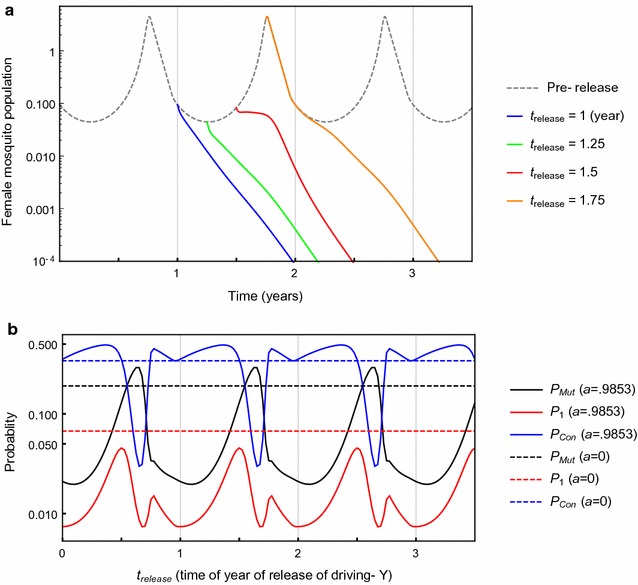
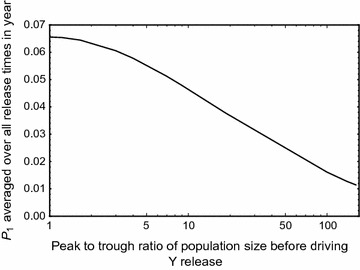
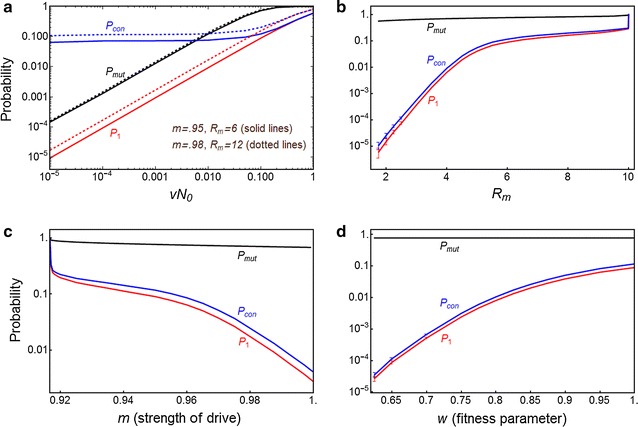
The probability that resistance evolves increases with the mutation rate and the intrinsic rate of increase of the population, and decreases with the strength of drive and any pleiotropic fitness costs of the resistant allele. In seasonally varying environments, the time of release can also affect the probability of resistance evolving. Trans-acting suppressor alleles are more likely to suffer stochastic loss at low frequencies than target site resistant alleles.
As with any other intervention, there is a risk that resistance will evolve to new genetic approaches to vector control, and steps should be taken to minimize this probability. Two design features that should help in this regard are to reduce the rate at which resistant mutations arise, and to target sequences such that if they do arise, they impose a significant fitness cost on the mosquito.
新的疟疾控制干预措施的引入常常导致耐药性的演变,包括疟原虫对新药的耐药性以及蚊媒对新杀虫剂的耐药性,从而损害了干预措施的效果。分子生物学和群体生物学的最新进展增加了基于新基因的干预措施的可能性,同时也应考虑对这些措施产生耐药性演变的可能性。在此,利用群体建模来确定影响对一种合成的、基于核酸酶的驱动Y染色体产生耐药性演变可能性的主要因素,该染色体可产生偏雄的性别比例。
采用确定性微分方程模型与涉及分支过程和 Gillespie 模拟的随机分析相结合的方法,评估对一种驱动Y染色体产生耐药性演变的概率,否则该驱动Y染色体强大到足以消灭目标种群。该模型考虑了由于靶位点变化导致不再被核酸酶切割而产生的耐药性,以及由于反式作用常染色体抑制等位基因产生的耐药性。
耐药性演变的概率随突变率和种群的内在增长率增加而增加,随驱动强度和耐药等位基因的任何多效性适合度代价降低而降低。在季节性变化的环境中,释放时间也会影响耐药性演变的概率。与靶位点耐药等位基因相比,反式作用抑制等位基因在低频时更有可能随机丢失。
与任何其他干预措施一样,对新的基因媒介控制方法存在产生耐药性演变的风险,应采取措施将这种概率降至最低。在这方面有帮助的两个设计特点是降低耐药突变出现的速率,以及靶向特定序列,使得如果它们出现,会给蚊子带来显著的适合度代价。