Department of Zoology, University of Oxford, South Parks Road, Oxford, OX1 3PS, UK.
Department of Infectious Disease Epidemiology, School of Public Health, Faculty of Medicine, Imperial College London, St. Mary's Campus, Norfolk Place, London, W2 1PG, UK.
Malar J. 2018 Apr 4;17(1):154. doi: 10.1186/s12936-018-2259-8.
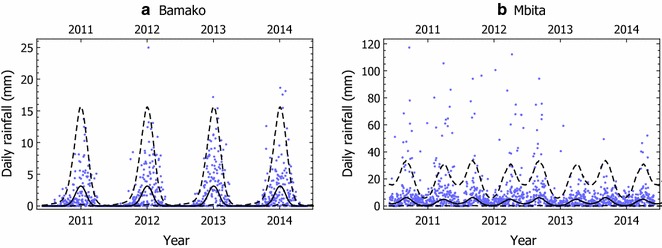
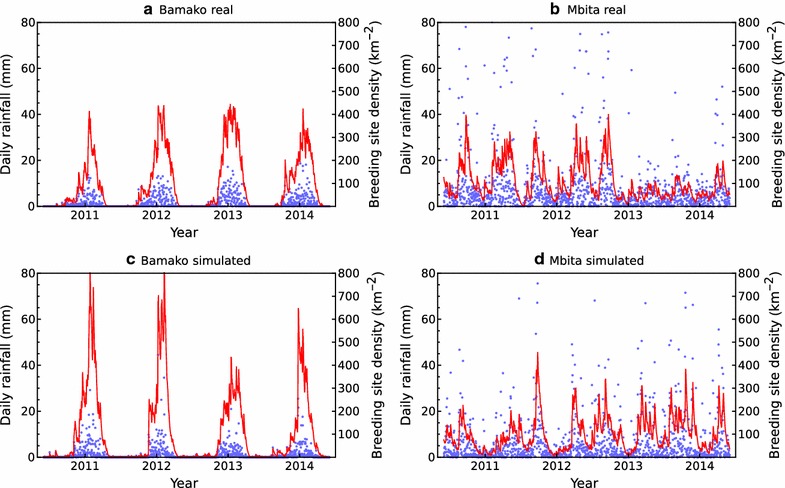
The use of gene drive systems to manipulate populations of malaria vectors is currently being investigated as a method of malaria control. One potential system uses driving endonuclease genes (DEGs) to spread genes that impose a genetic load. Previously, models have shown that the introduction of DEG-bearing mosquitoes could suppress or even extinguish vector populations in spatially-heterogeneous environments which were constant over time. In this study, a stochastic spatially-explicit model of mosquito ecology is combined with a rainfall model which enables the generation of a variety of daily precipitation patterns. The model is then used to investigate how releases of a DEG that cause a bias in population sex ratios towards males are affected by seasonal or random rainfall patterns. The parameters of the rainfall model are then fitted using data from Bamako, Mali, and Mbita, Kenya, to evaluate release strategies in similar climatic conditions.
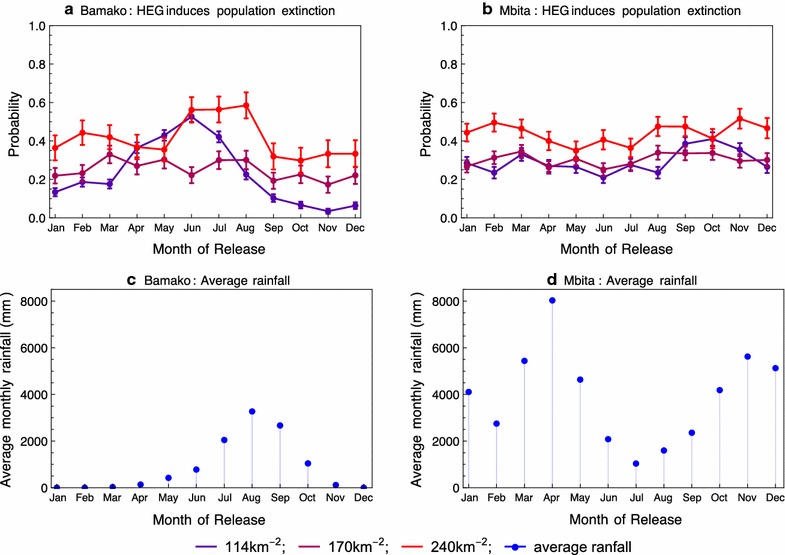
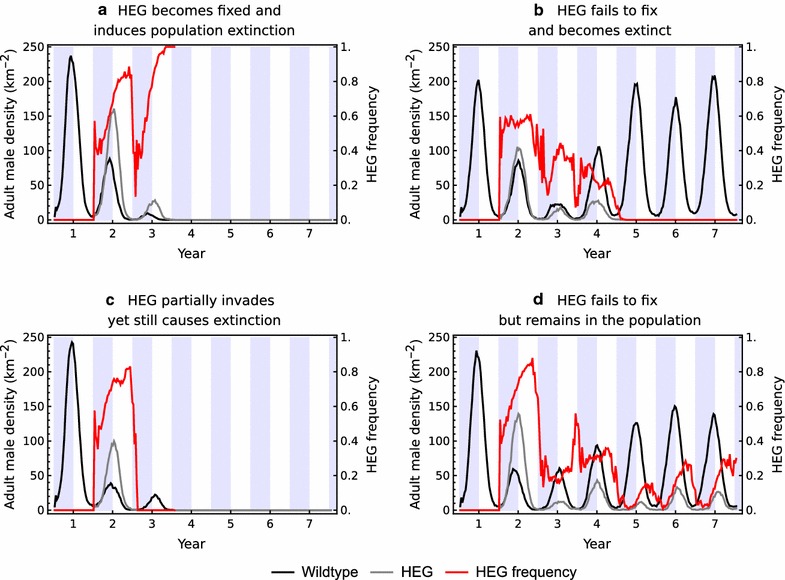
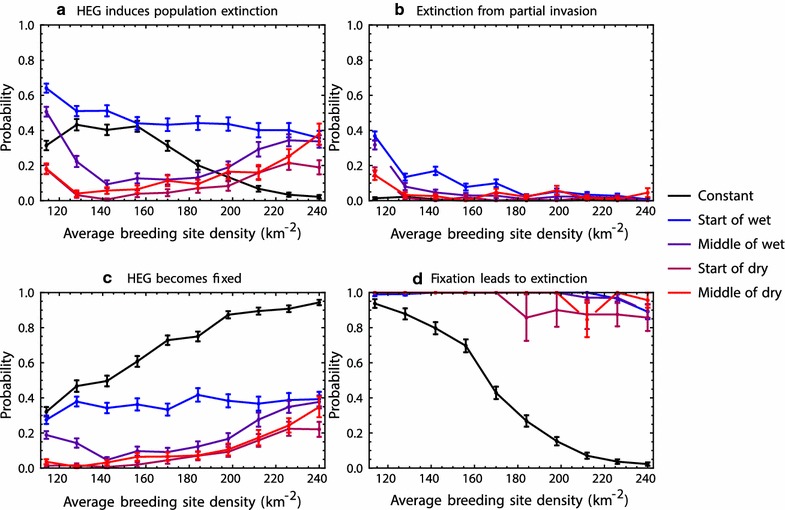
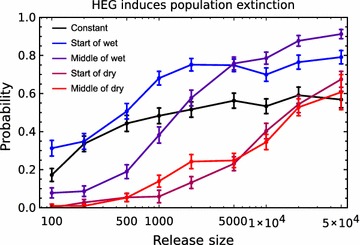
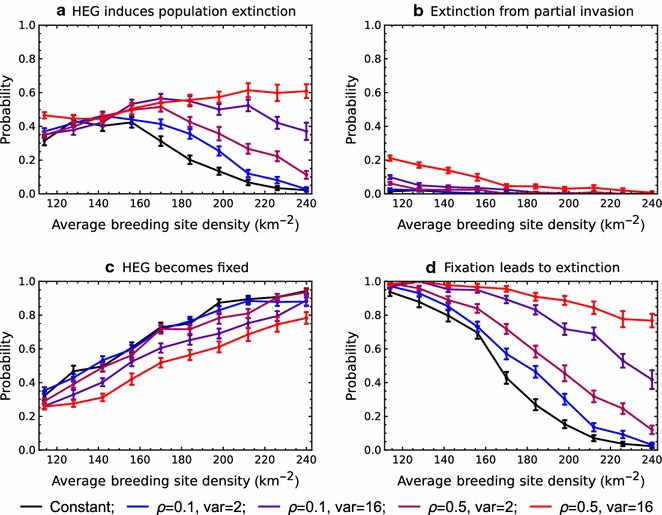
In landscapes with abundant resources and large mosquito populations the spread of a DEG is reliable, irrespective of variability in rainfall. This study thus focuses mainly on landscapes with low density mosquito populations where the spread of a DEG may be sensitive to variation in rainfall. It is found that an introduced DEG will spread into its target population more reliably in wet conditions, yet an established DEG will have more impact in dry conditions. In strongly seasonal environments, it is thus preferable to release DEGs at the onset of a wet season to maximize their spread before the following dry season. If the variability in rainfall has a substantial random component, there is a net increase in the probability that a DEG release will lead to population extinction, due to the increased impact of a DEG which manages to establish in these conditions. For Bamako, where annual rainfall patterns are characterized by a long dry season, it is optimal to release a DEG at the start of the wet season, where the population is growing fastest. By contrast release timing is of lower importance for the less seasonal Mbita.
This analysis suggests that DEG based methods of malaria vector control can be effective in a wide range of climates. In environments with substantial temporal variation in rainfall, careful timing of releases which accounts for the temporal variation in population density can substantially improve the probability of mosquito suppression or extinction.
利用基因驱动系统来操纵疟疾传播媒介的种群,目前正被作为一种疟疾控制方法进行研究。一种潜在的系统是使用驱动内切酶基因(DEG)来传播施加遗传负荷的基因。此前,模型表明,在时空异质且随时间不变的环境中,引入携带 DEG 的蚊子可以抑制甚至消灭媒介种群。在这项研究中,我们结合了一个降雨模型的随机空间显式蚊子生态学模型,该模型可以生成各种日常降水模式。然后,该模型被用于研究导致种群性别比例向雄性倾斜的 DEG 释放如何受到季节性或随机降雨模式的影响。然后,使用来自马里巴马科和肯尼亚姆比塔的数据来拟合降雨模型的参数,以评估在类似气候条件下的释放策略。
在资源丰富且蚊子种群庞大的景观中,DEG 的传播是可靠的,而与降雨的可变性无关。因此,本研究主要集中在蚊子种群密度低的景观中,在这些景观中,DEG 的传播可能对降雨的变化敏感。研究发现,在潮湿条件下,引入的 DEG 更可靠地传播到目标种群中,而在干燥条件下,已建立的 DEG 则具有更大的影响。因此,在强季节性环境中,最好在湿季开始时释放 DEG,以便在随后的旱季之前最大限度地扩大其传播范围。如果降雨的可变性具有大量的随机成分,由于在这些条件下建立的 DEG 的影响增加,DEG 释放导致种群灭绝的可能性会有净增加。对于巴马科来说,由于其年度降雨模式的特点是长旱季,因此在湿季开始时释放 DEG 是最佳的,因为此时种群增长最快。相比之下,季节性较弱的姆比塔的释放时间则不太重要。
这项分析表明,基于 DEG 的疟疾媒介控制方法可以在广泛的气候条件下有效。在降雨时间变化较大的环境中,仔细考虑释放时间,以适应种群密度的时间变化,可以大大提高蚊子抑制或灭绝的可能性。