Ionică Angela Monica, Matei Ioana Adriana, D'Amico Gianluca, Ababii Jana, Daskalaki Aikaterini Alexandra, Sándor Attila D, Enache Dorin Valter, Gherman Călin Mircea, Mihalca Andrei Daniel
Department of Parasitology and Parasitic Diseases, Faculty ofVeterinary Medicine, University of Agricultural Sciences and Veterinary Medicine Cluj-Napoca, Calea Mănăștur 3-5, 400372, Cluj-Napoca, Romania.
Department of Engineering and Food and Tourism Management, Faculty of Food and Tourism, Transilvania University, Castelului Street, 500014, Braşov, Romania.
Parasit Vectors. 2017 Jul 13;10(1):332. doi: 10.1186/s13071-017-2269-3.
Filarioids are vector-borne parasitic nematodes of vertebrates. In Europe, eight species of filarioids, including zoonotic species, have been reported mainly in domestic dogs, and occasionally in wild carnivores. In Romania, infections with Dirofilaria spp. and Acanthocheilonema reconditum are endemic in domestic dogs. Despite the abundant populations of wild carnivores in the country, their role in the epidemiology of filarioid parasites remains largely unknown. The aim of the present study was to assess the host range, prevalence and distribution of filarioid infections in wild carnivores present in Romania.
Between May 2014 and February 2016, 432 spleen samples originating from 14 species of wild carnivores have been tested for the presence of DNA of three species of filarioids (D. immitis, D. repens and A. reconditum).
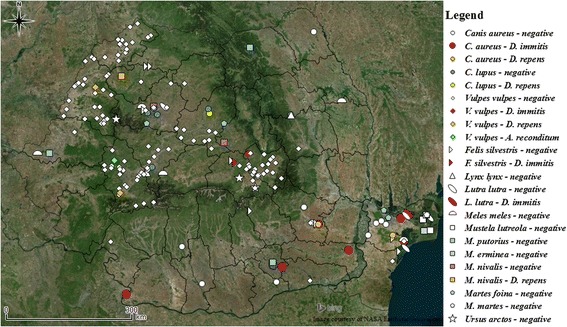
Overall 14 samples (3.24%) were molecularly positive. The most prevalent species was D. immitis (1.62%), accounting for 50% (n = 7) of the positive animals. The prevalence of D. repens was 1.39%, while that of A. reconditum was 0.23%. No co-infections were detected. Dirofilaria immitis DNA was detected in five golden jackals, Canis aureus (7.58%), one red fox, Vulpes vulpes (0.33%), and one wildcat, Felis silvestris (10%). The presence of D. repens DNA was detected in two red foxes (0.66%), two golden jackals (3.03%), one grey wolf (7.14%), and one least weasel, Mustela nivalis (33.33%). Acanthocheilonema reconditum DNA was found only in one red fox (0.33%).
The present study provides molecular evidence of filarial infections in wild carnivore species in Romania, suggesting their potential epidemiological role and reports a new host species for D. repens.
丝虫类是由媒介传播的脊椎动物寄生线虫。在欧洲,已报道了8种丝虫类,包括人畜共患种类,主要见于家犬,偶尔见于野生食肉动物。在罗马尼亚,犬恶丝虫属和隐匿棘唇线虫感染在家犬中呈地方性流行。尽管该国野生食肉动物数量众多,但其在丝虫类寄生虫流行病学中的作用仍 largely unknown。本研究的目的是评估罗马尼亚野生食肉动物中丝虫类感染的宿主范围、患病率和分布情况。
在2014年5月至2016年2月期间,对来自14种野生食肉动物的432份脾脏样本进行了三种丝虫类(犬恶丝虫、匐行恶丝虫和隐匿棘唇线虫)DNA检测。
总体上14份样本(3.24%)分子检测呈阳性。最常见的种类是犬恶丝虫(1.62%),占阳性动物的50%(n = 7)。匐行恶丝虫的患病率为1.39%,而隐匿棘唇线虫的患病率为0.23%。未检测到混合感染。在5只金豺(金豺属)(7.58%)、1只赤狐(赤狐属)(0.33%)和1只野猫(森林猫属)(10%)中检测到犬恶丝虫DNA。在2只赤狐(0.66%)、2只金豺(3.03%)、1只灰狼(7.14%)和1只伶鼬(伶鼬属)(33.33%)中检测到匐行恶丝虫DNA。仅在1只赤狐(0.33%)中发现隐匿棘唇线虫DNA。
本研究提供了罗马尼亚野生食肉动物丝虫感染的分子证据,表明了它们潜在的流行病学作用,并报告了匐行恶丝虫的一种新宿主物种。