SDU NanoSYD, Mads Clausen Institute, University of Southern Denmark, Alsion 2, Sønderborg, DK-6400, Denmark.
Department of Electrical and Computer Engineering, Institute for Nanoelectronics, Technical University of Munich, Arcisstr, 21 80333, Munich, Germany.
Sci Rep. 2017 Jul 13;7(1):5300. doi: 10.1038/s41598-017-05591-8.
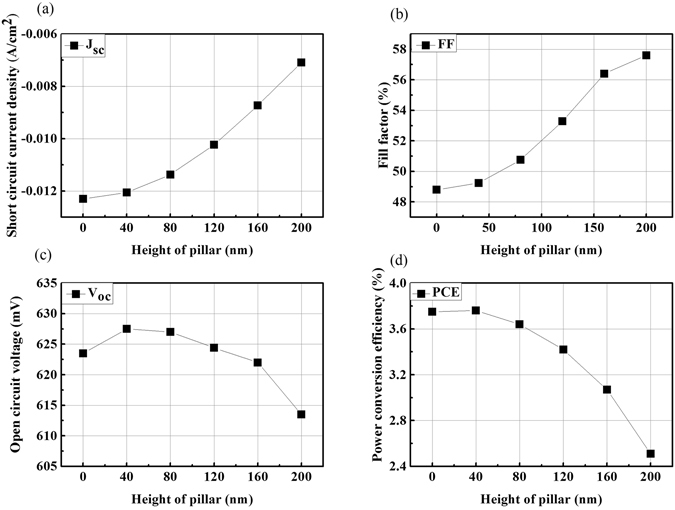
Integration of light-trapping features and exploitation of metal nanostructure plasmonic effects are promising approaches for enhancing the power conversion efficiency of organic solar cells. These approaches' effects on the light absorption enhancement have been widely studied, especially in inorganic devices. While this light-trapping concept can be transferred to organic devices, one has to also consider nanostructure-induced electrical effects on the device performance, due to the fundamental difference in the organic semiconducting material properties compared to their inorganic counterparts. In this contribution, we exemplarily model the electrical properties of organic solar cells with rectangular-grating structures, as compared to planar reference devices. Based on our numeric results, we demonstrate that, beyond an optical absorption enhancement, the device fill factor improves significantly by introducing the grating structures. From the simulations we conclude that enhanced carrier collection efficiency is the main reason for the increased solar cell fill factor. This work contributes towards a more fundamental understanding of the effect of nanostructured electrodes on the electrical properties of organic solar cells.
将陷光结构与金属纳米结构的等离子体激元效应相结合是提高有机太阳能电池光电转换效率的一种很有前途的方法。这些方法对光吸收增强的影响已得到广泛研究,特别是在无机器件中。虽然这种陷光概念可以转移到有机器件中,但由于有机半导体材料的性质与无机材料有根本的不同,因此还必须考虑纳米结构对器件性能的电效应。在本研究中,我们以矩形光栅结构为例,对具有这种陷光结构的有机太阳能电池的电学性能进行了建模,并与平面参考器件进行了比较。基于我们的数值结果,我们证明了与光学吸收增强相比,通过引入光栅结构,器件的填充因子显著提高。从模拟中我们得出结论,增加的载流子收集效率是提高太阳能电池填充因子的主要原因。这项工作有助于更深入地了解纳米结构电极对有机太阳能电池电学性能的影响。