Woehrle Holger, Ficker Joachim H, Graml Andrea, Fietze Ingo, Young Peter, Teschler Helmut, Arzt Michael
Sleep and Ventilation Center Blaubeuren, Respiratory Center Ulm, Olgastr. 83, 89073 Ulm, Germany.
ResMed Science Center, ResMed Germany, Martinsried, Germany.
Somnologie (Berl). 2017;21(2):121-127. doi: 10.1007/s11818-016-0098-9. Epub 2017 Jan 23.
Adherence to positive airway pressure (PAP) therapy is essential for the benefits of therapy to be realised. Telemedicine-based strategies provide a new option for enhanced monitoring and intervention to promote adherence during PAP. This study investigated the impact of telemedicine-based proactive patient management on PAP therapy termination rates versus standard care.
Observational data were obtained from ResMed Germany Healthcare, a German homecare provider. Patients were undergoing routine homecare using either a standard or proactive management strategy. The proactive strategy used data from AirView™, a cloud-based remote monitoring system, to prompt patient contact and information sharing/education. Patients receiving their first PAP therapy were included and analysed in matched pairs.
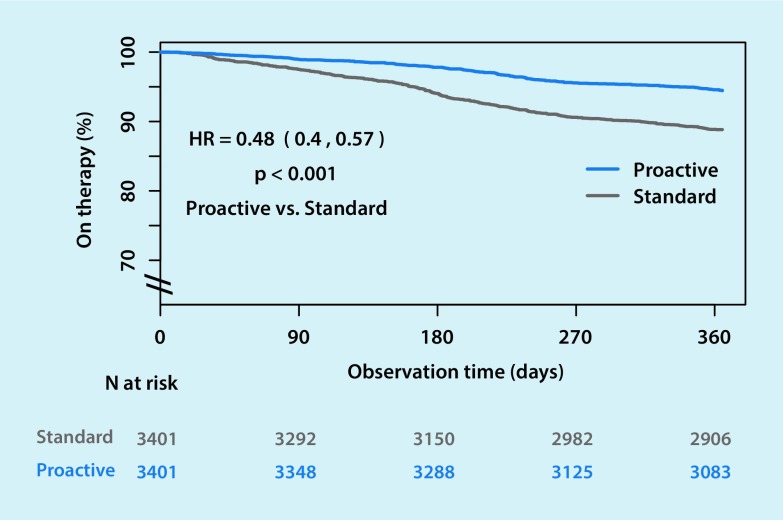
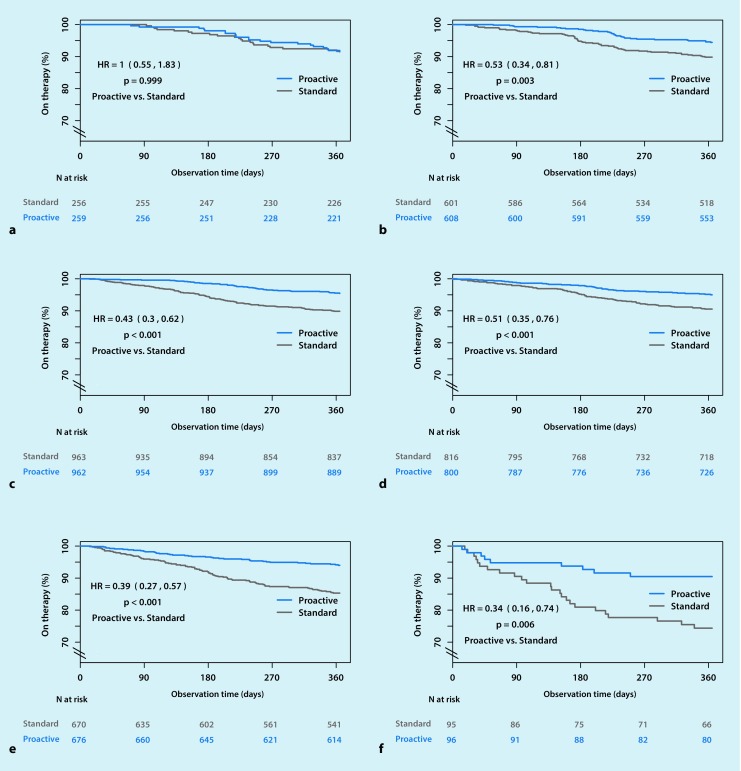
In all, 3401 patients were included in each group. In the first year of PAP therapy, overall therapy termination rate was significantly lower (5.4% vs 11.0%; < 0.001) and time to therapy termination was significantly longer (348 ± 58 vs 337 ± 76 days; < 0.05) in the proactive versus standard care group. Cox proportional hazard analysis revealed a significantly reduced risk of PAP termination in the proactive versus the standard care group (hazard ratio 0.48, 95% confidence interval 0.4-0.57). Findings were consistent in subanalyses according to gender, type of device and insurance status, and in patients aged ≥40 years. However, in the subgroup of patients aged younger than 40 years, the risk of PAP termination was similar in the proactive and standard groups.
A telemedicine-based proactive management strategy compared with standard care of PAP patients was associated with a lower long-term therapy termination rate.
坚持气道正压通气(PAP)治疗对于实现治疗益处至关重要。基于远程医疗的策略为加强监测和干预提供了新选择,以促进PAP治疗期间的依从性。本研究调查了基于远程医疗的主动患者管理对PAP治疗终止率与标准护理的影响。
观察性数据来自德国瑞思迈医疗保健公司,这是一家德国家庭护理提供商。患者正在使用标准或主动管理策略接受常规家庭护理。主动策略使用基于云的远程监测系统AirView™的数据来促进患者联系以及信息共享/教育。纳入接受首次PAP治疗的患者并进行配对分析。
每组共纳入3401例患者。在PAP治疗的第一年,主动护理组的总体治疗终止率显著更低(5.4%对11.0%;<0.001),且治疗终止时间显著更长(348±58天对337±76天;<0.05)。Cox比例风险分析显示,与标准护理组相比,主动护理组PAP治疗终止风险显著降低(风险比0.48,95%置信区间0.4 - 0.57)。根据性别、设备类型和保险状况进行的亚组分析以及在年龄≥40岁的患者中,结果一致。然而,在年龄小于40岁的患者亚组中,主动护理组和标准护理组的PAP治疗终止风险相似。
与PAP患者的标准护理相比,基于远程医疗的主动管理策略与更低的长期治疗终止率相关。