Häuslein Ina, Cantet Franck, Reschke Sarah, Chen Fan, Bonazzi Matteo, Eisenreich Wolfgang
Department of Chemistry, Chair of Biochemistry, Technische Universität MünchenGarching, Germany.
IRIM-UMR 9004, Infectious Disease Research Institute of Montpellier, Université de Montpellier, Centre National de la Recherche ScientifiqueMontpellier, France.
Front Cell Infect Microbiol. 2017 Jun 29;7:285. doi: 10.3389/fcimb.2017.00285. eCollection 2017.
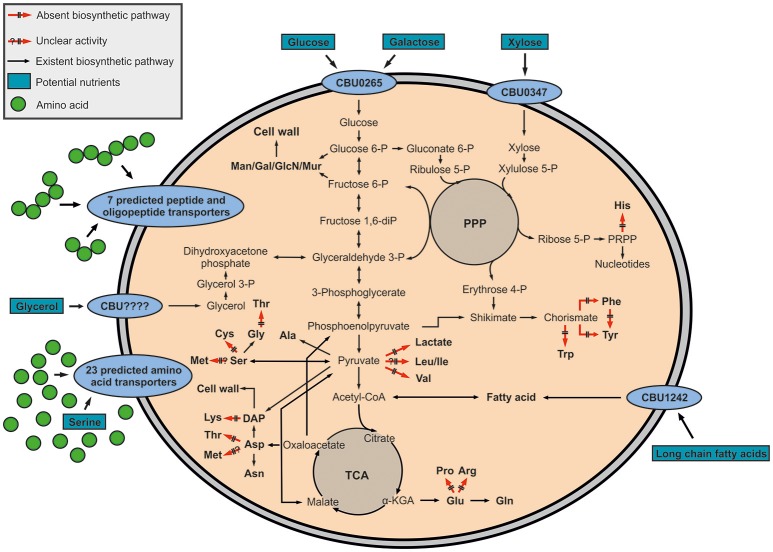
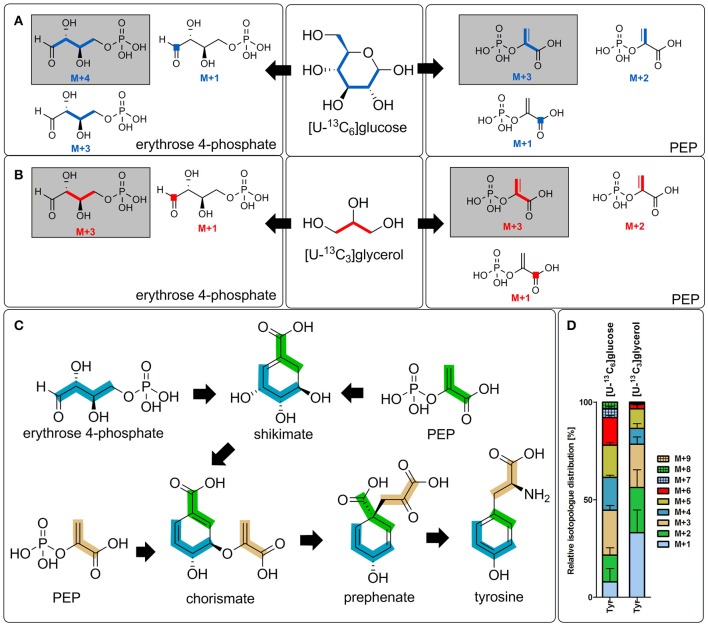
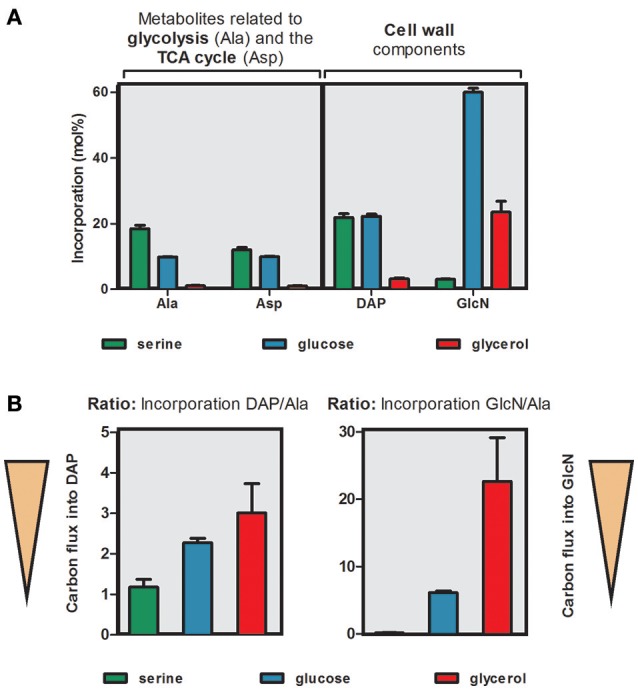
The human pathogen causes Q-fever and is classified as a category B bio-weapon. Exploiting the development of the axenic growth medium ACCM-2, we have now used C-labeling experiments and isotopolog profiling to investigate the highly diverse metabolic network of . To this aim, RSA 439 NMII was cultured in ACCM-2 containing 5 mM of either [U-C]serine, [U-C]glucose, or [U-C]glycerol until the late-logarithmic phase. GC/MS-based isotopolog profiling of protein-derived amino acids, methanol-soluble polar metabolites, fatty acids, and cell wall components (e.g., diaminopimelate and sugars) from the labeled bacteria revealed differential incorporation rates and isotopolog profiles. These data served to decipher the diverse usages of the labeled substrates and the relative carbon fluxes into the core metabolism of the pathogen. Whereas, biosynthesis from any of these substrates could not be found for histidine, isoleucine, leucine, lysine, phenylalanine, proline and valine, the other amino acids and metabolites under study acquired C-label at specific rates depending on the nature of the tracer compound. Glucose was directly used for cell wall biosynthesis, but was also converted into pyruvate (and its downstream metabolites) through the glycolytic pathway or into erythrose 4-phosphate (e.g., for the biosynthesis of tyrosine) via the non-oxidative pentose phosphate pathway. Glycerol efficiently served as a gluconeogenetic substrate and could also be used via phosphoenolpyruvate and diaminopimelate as a major carbon source for cell wall biosynthesis. In contrast, exogenous serine was mainly utilized in downstream metabolic processes, e.g., via acetyl-CoA in a complete citrate cycle with fluxes in the oxidative direction and as a carbon feed for fatty acid biosynthesis. In summary, the data reflect multiple and differential substrate usages by in a bipartite-type metabolic network, resembling the overall topology of the related pathogen . These strategies could benefit the metabolic capacities of the pathogens also as a trait to adapt for replication under intracellular conditions.
这种人类病原体可引发Q热,被归类为B类生物武器。利用无细胞生长培养基ACCM - 2的研发成果,我们现在通过碳标记实验和同位素异构体分析来研究该病原体高度多样化的代谢网络。为此,将RSA 439 NMII在含有5 mM [U - C]丝氨酸、[U - C]葡萄糖或[U - C]甘油的ACCM - 2中培养至对数后期。基于气相色谱/质谱的对标记细菌中蛋白质衍生氨基酸、甲醇可溶性极性代谢物、脂肪酸和细胞壁成分(如二氨基庚二酸和糖类)的同位素异构体分析揭示了不同的掺入率和同位素异构体谱。这些数据有助于解读标记底物的多种用途以及进入病原体核心代谢的相对碳通量。虽然未发现组氨酸、异亮氨酸、亮氨酸、赖氨酸、苯丙氨酸、脯氨酸和缬氨酸可由这些底物中的任何一种进行生物合成,但所研究的其他氨基酸和代谢物根据示踪化合物的性质以特定速率获得碳标记。葡萄糖直接用于细胞壁生物合成,但也可通过糖酵解途径转化为丙酮酸(及其下游代谢物),或通过非氧化戊糖磷酸途径转化为赤藓糖 - 4 - 磷酸(例如用于酪氨酸的生物合成)。甘油有效地作为糖异生底物,也可通过磷酸烯醇丙酮酸和二氨基庚二酸用作细胞壁生物合成的主要碳源。相比之下,外源性丝氨酸主要用于下游代谢过程,例如在完整的柠檬酸循环中通过乙酰辅酶A以氧化方向的通量参与,以及作为脂肪酸生物合成的碳源。总之,这些数据反映了该病原体在二分体类型代谢网络中对底物的多种不同利用方式,类似于相关病原体的整体拓扑结构。这些策略也可能有益于病原体的代谢能力,作为其在细胞内条件下适应复制的一种特性。