Lüder Carsten G K, Rahman Taibur
Institute for Medical Microbiology, University Medical Center Goettingen, Goettingen, Germany.
Microb Cell. 2017 Jun 22;4(7):203-211. doi: 10.15698/mic2017.07.579.
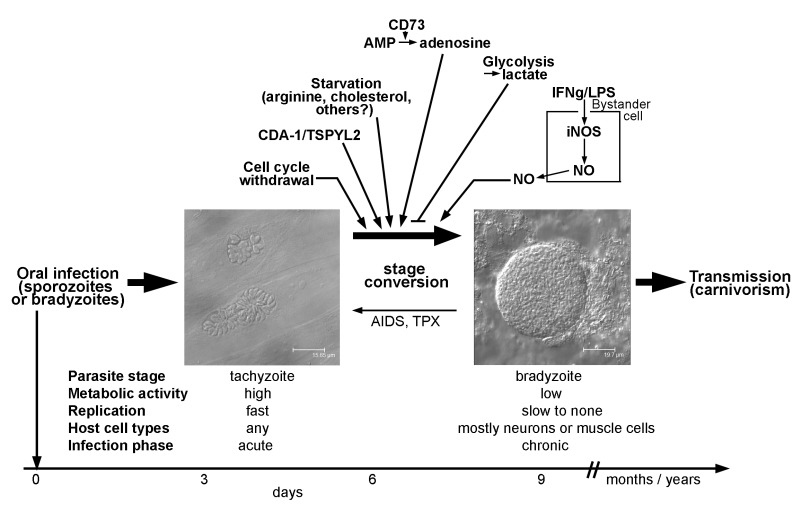
The unicellular parasite infects warm-blooded animals and humans, and it is highly prevalent throughout the world. Infection of immunocompetent hosts is usually asymptomatic or benign but leads to long-term parasite persistence mainly within neural and muscular tissues. The transition from acute primary infection towards chronic toxoplasmosis is accompanied by a developmental switch from fast replicating and metabolically highly active tachyzoites to slow replicating and largely dormant bradyzoites within tissue cysts. Such developmental differentiation is critical for in order to complete its life cycle and for pathogenesis. Herein, we summarize accumulating evidence indicating a major impact of the host cell physiology on stage conversion between the tachyzoite and the bradyzoite stage of the parasite. Withdrawal from cell cycle progression, proinflammatory responses, reduced availability of nutrients and extracellular adenosine can indeed induce tachyzoite-to-bradyzoite differentiation and tissue cyst formation. In contrast, high glycolytic activity as indicated by increased lactate secretion can inhibit bradyzoite formation. These examples argue for the intriguing possibility that after dissemination within its host, can sense its cellular microenvironment to initiate the developmental program towards the bradyzoite stage in distinct cells. This may also explain the predominant localization of in neural and muscular tissues during chronic toxoplasmosis.
这种单细胞寄生虫感染温血动物和人类,在全球范围内高度流行。免疫功能正常的宿主感染通常无症状或症状轻微,但会导致寄生虫长期存在,主要在神经和肌肉组织中。从急性初次感染向慢性弓形虫病的转变伴随着发育转变,即从快速复制和代谢高度活跃的速殖子转变为在组织囊肿中缓慢复制且大多处于休眠状态的缓殖子。这种发育分化对于完成其生命周期和发病机制至关重要。在此,我们总结了越来越多的证据,表明宿主细胞生理学对寄生虫速殖子和缓殖子阶段之间的阶段转换有重大影响。退出细胞周期进程、促炎反应、营养物质和细胞外腺苷可用性降低确实可诱导速殖子向缓殖子分化和组织囊肿形成。相反,乳酸分泌增加所表明的高糖酵解活性可抑制缓殖子形成。这些例子支持了一种有趣的可能性,即寄生虫在宿主体内传播后,能够感知其细胞微环境,从而在不同细胞中启动向缓殖子阶段的发育程序。这也可能解释了慢性弓形虫病期间寄生虫在神经和肌肉组织中的主要定位。