School of Pharmacy, Pharmacy Australia Centre of Excellence, University of Queensland, Brisbane, QLD 4102, Australia.
Molecules. 2017 Jul 14;22(7):1186. doi: 10.3390/molecules22071186.
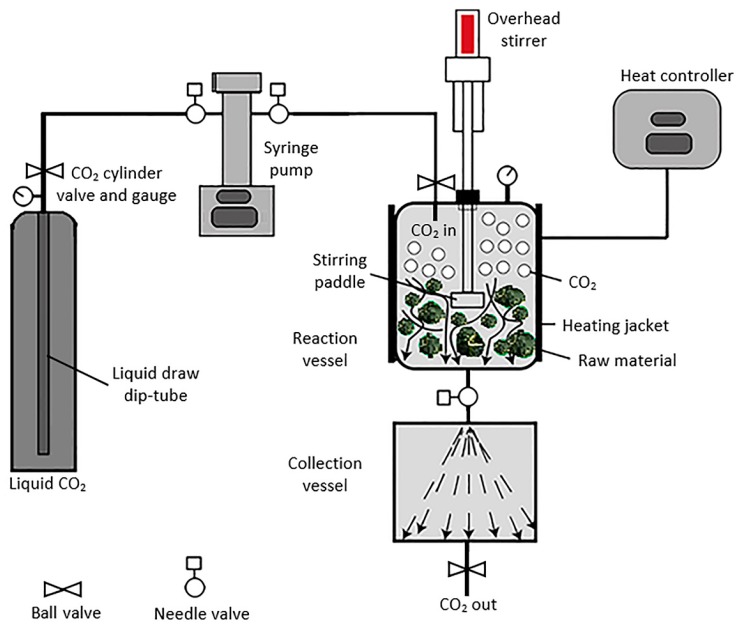
Supercritical fluid technologies offer a propitious method for drug discovery from natural sources. Such methods require relatively short processing times, produce extracts with little or no organic co-solvent, and are able to extract bioactive molecules whilst minimising degradation. Supercritical fluid extraction (SFE) provides a range of benefits, as well as offering routes to overcome some of the limitations that exist with the conventional methods of extraction. Unfortunately, SFE-based methods are not without their own shortcomings; two major ones being: (1) the high establishment cost; and (2) the selective solvent nature of CO₂, i.e., that CO₂ only dissolves small non-polar molecules, although this can be viewed as a positive outcome provided bioactive molecules are extracted during solvent-based SFE. This review provides an update of SFE methods for natural products and outlines the main operating parameters for extract recovery. Selected processing considerations are presented regarding supercritical fluids and the development and application of ultrasonic-assisted SFE methods, as well as providing some of the key aspects of SFE scalability.
超临界流体技术为从天然资源中发现药物提供了一种有利的方法。这种方法需要相对较短的处理时间,产生的提取物几乎或根本没有有机溶剂共溶剂,并且能够在最小化降解的同时提取生物活性分子。超临界流体萃取(SFE)提供了一系列好处,同时也提供了克服传统萃取方法存在的一些限制的途径。不幸的是,基于 SFE 的方法并非没有自己的缺点;其中两个主要缺点是:(1)高建立成本;(2)CO₂ 的选择性溶剂性质,即 CO₂ 仅溶解小的非极性分子,尽管如果在基于溶剂的 SFE 期间提取了生物活性分子,则可以将其视为积极的结果。本文综述了天然产物的 SFE 方法,并概述了提取回收的主要操作参数。针对超临界流体以及超声辅助 SFE 方法的开发和应用,提出了一些加工方面的考虑因素,并提供了 SFE 可扩展性的一些关键方面。