Leeds Beckett University, School of Clinical and Applied Sciences, Musculoskeletal Health Research Group, Leeds, United Kingdom; University of Limerick, Faculty of Education and Health Sciences, Department of Physical Education and Sport Sciences, Limerick, Ireland.
University of Limerick, Faculty of Education and Health Sciences, Department of Physical Education and Sport Sciences, Limerick, Ireland.
Braz J Phys Ther. 2017 Nov-Dec;21(6):457-464. doi: 10.1016/j.bjpt.2017.06.013. Epub 2017 Jul 3.
It is not known which laboratory indices of muscle mass, strength or quality can distinguish functional performance in healthy middle aged women. The aim of this study was to (a) examine the association between upper leg lean tissue mass, knee extensor strength, muscle quality (strength per unit lean tissue mass) and functional performance and (b) to determine the utility of tertiles of muscle strength and muscle quality to distinguish gradations of functional capacity in healthy 50-70y women.
Using a cross-sectional study design, one hundred and twenty-eight healthy 50-70y women (mean age: 60.4, SD=5.1y) underwent body composition assessment (dual X-ray absorptiometry) and performed maximal voluntary isometric contractions of the knee extensors (Con-Trex Dynamometer). Functional performance was assessed using a 5 repetition and 30s chair rise test and 900m gait speed test.
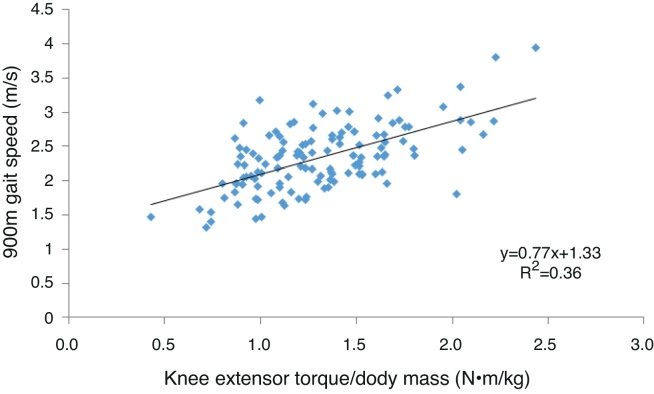
Ordered by muscle strength or muscle quality, those in the highest tertile (T1) demonstrated greater functional performance than those in lowest tertile (T3). There was no association between upper leg lean tissue mass and functional performance (r=≤0.06). Muscle strength explained a greater proportion of the variance in all functional performance measures relative to muscle quality (R=0.13-0.36 vs. R=0.11-0.16).
Upper leg lean tissue mass is not associated with physical performance in healthy 50-70y women. These results suggest strength relative to the body mass being accelerated distinguishes gradations in functional performance better than muscle quality healthy 50-70y women.
目前尚不清楚哪些肌肉质量、力量或功能的实验室指标可以区分健康中年女性的身体机能表现。本研究的目的是:(a)研究大腿瘦体重、膝关节伸肌力量、肌肉质量(单位瘦体重的力量)与身体机能表现之间的关系;(b)确定肌肉力量和肌肉质量的三分位数是否可以区分健康 50-70 岁女性的不同功能能力等级。
采用横断面研究设计,对 128 名健康的 50-70 岁女性(平均年龄:60.4±5.1 岁)进行身体成分评估(双能 X 线吸收法)和膝关节伸肌最大等长收缩力测试(Con-Trex 测力计)。使用 5 次重复和 30 秒椅子站起试验和 900 米步行速度试验评估身体机能。
按肌肉力量或肌肉质量顺序,最高三分位(T1)的人比最低三分位(T3)的人表现出更好的功能表现。大腿瘦体重与功能表现之间没有相关性(r=≤0.06)。与肌肉质量(R=0.11-0.16)相比,肌肉力量对所有功能表现指标的变异解释比例更大(R=0.13-0.36)。
大腿瘦体重与健康 50-70 岁女性的身体机能表现无关。这些结果表明,与身体质量相比,力量的增加可以更好地区分健康 50-70 岁女性的功能表现等级,而不是肌肉质量。