Alfieri Annalisa, Sorokina Oksana, Adrait Annie, Angelini Costanza, Russo Isabella, Morellato Alessandro, Matteoli Michela, Menna Elisabetta, Boeri Erba Elisabetta, McLean Colin, Armstrong J Douglas, Ala Ugo, Buxbaum Joseph D, Brusco Alfredo, Couté Yohann, De Rubeis Silvia, Turco Emilia, Defilippi Paola
Department of Molecular Biotechnology and Health Sciences, Molecular Biotechnology Center, Università di TorinoTorino, Italy.
The Institute for Adaptive and Neural Computation, School of Informatics, University of EdinburghEdinburgh, United Kingdom.
Front Mol Neurosci. 2017 Jun 30;10:212. doi: 10.3389/fnmol.2017.00212. eCollection 2017.
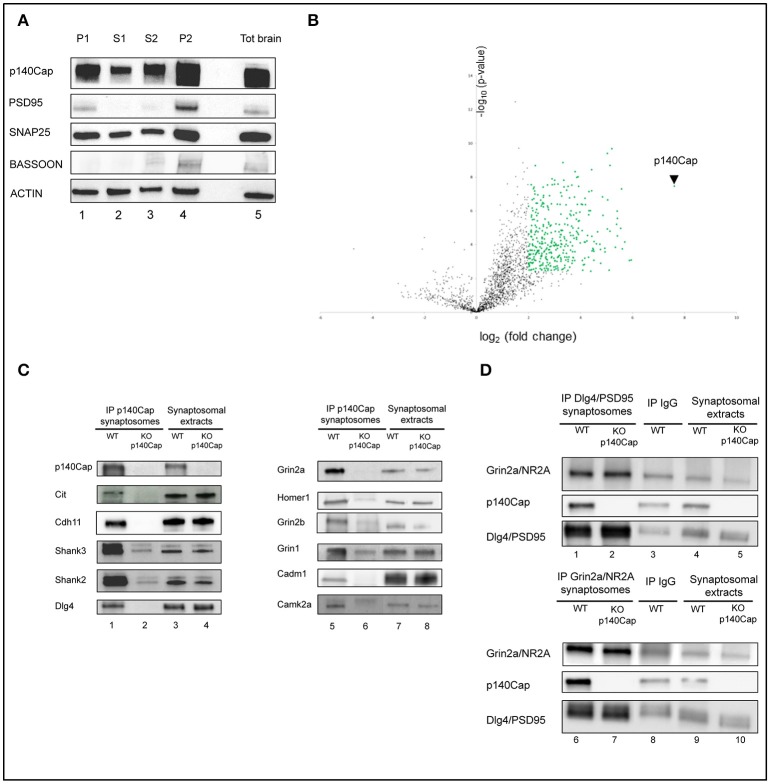
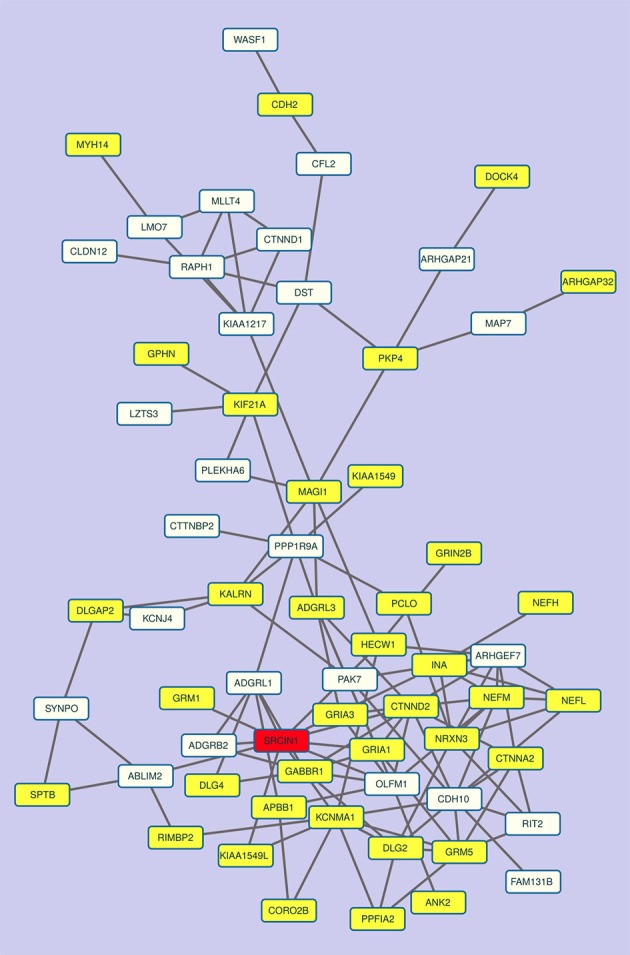
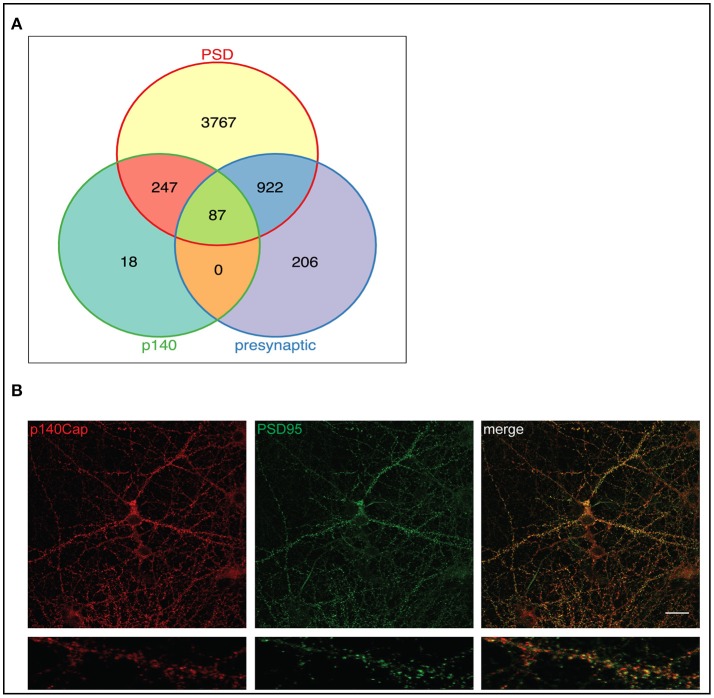
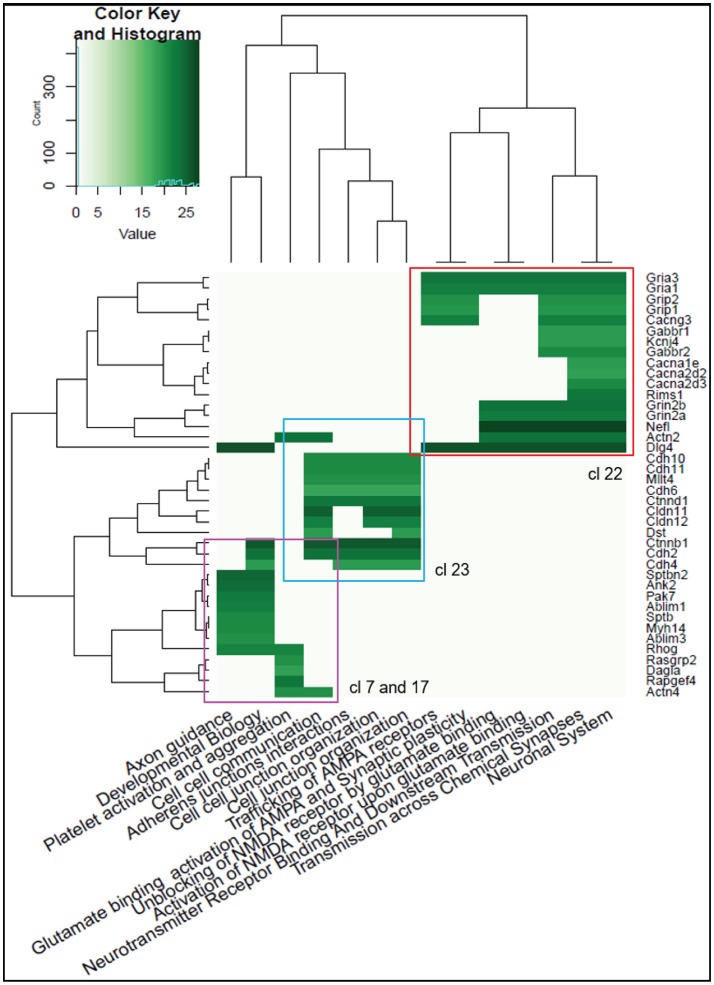
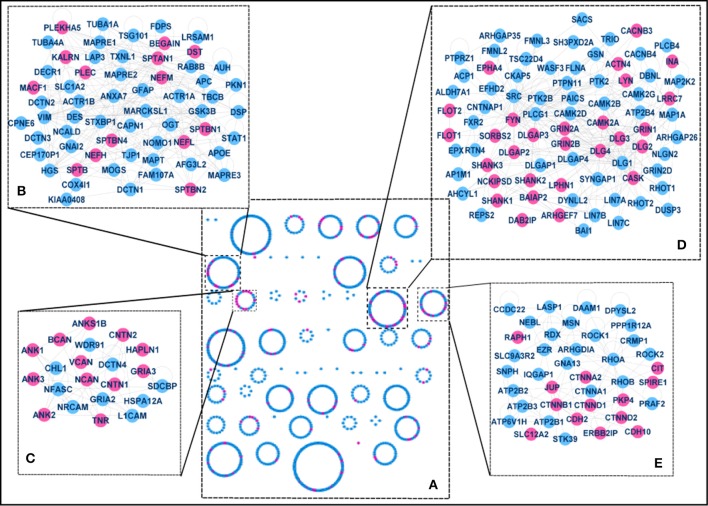
Altered synaptic function has been associated with neurological and psychiatric conditions including intellectual disability, schizophrenia and autism spectrum disorder (ASD). Amongst the recently discovered synaptic proteins is p140Cap, an adaptor that localizes at dendritic spines and regulates their maturation and physiology. We recently showed that p140Cap knockout mice have cognitive deficits, impaired long-term potentiation (LTP) and long-term depression (LTD), and immature, filopodia-like dendritic spines. Only a few p140Cap interacting proteins have been identified in the brain and the molecular complexes and pathways underlying p140Cap synaptic function are largely unknown. Here, we isolated and characterized the p140Cap synaptic interactome by co-immunoprecipitation from crude mouse synaptosomes, followed by mass spectrometry-based proteomics. We identified 351 p140Cap interactors and found that they cluster to sub complexes mostly located in the postsynaptic density (PSD). p140Cap interactors converge on key synaptic processes, including transmission across chemical synapses, actin cytoskeleton remodeling and cell-cell junction organization. Gene co-expression data further support convergent functions: the p140Cap interactors are tightly co-expressed with each other and with p140Cap. Importantly, the p140Cap interactome and its co-expression network show strong enrichment in genes associated with schizophrenia, autism, bipolar disorder, intellectual disability and epilepsy, supporting synaptic dysfunction as a shared biological feature in brain diseases. Overall, our data provide novel insights into the molecular organization of the synapse and indicate that p140Cap acts as a hub for postsynaptic complexes relevant to psychiatric and neurological disorders.
突触功能改变与多种神经和精神疾病相关,包括智力残疾、精神分裂症和自闭症谱系障碍(ASD)。最近发现的突触蛋白中有p140Cap,它是一种衔接蛋白,定位于树突棘并调节其成熟和生理功能。我们最近发现,p140Cap基因敲除小鼠存在认知缺陷、长时程增强(LTP)和长时程抑制(LTD)受损,以及不成熟的丝状伪足样树突棘。在大脑中仅鉴定出少数几种与p140Cap相互作用的蛋白,而p140Cap突触功能背后的分子复合物和信号通路在很大程度上仍不清楚。在这里,我们通过从小鼠粗制突触体中进行免疫共沉淀,随后基于质谱的蛋白质组学方法,分离并鉴定了p140Cap突触相互作用组。我们鉴定出351种与p140Cap相互作用的蛋白,并发现它们聚集成主要位于突触后致密区(PSD)的亚复合物。与p140Cap相互作用的蛋白汇聚于关键的突触过程,包括化学突触传递、肌动蛋白细胞骨架重塑和细胞间连接组织。基因共表达数据进一步支持了这些汇聚的功能:与p140Cap相互作用的蛋白彼此之间以及与p140Cap紧密共表达。重要的是,p140Cap相互作用组及其共表达网络在与精神分裂症、自闭症、双相情感障碍、智力残疾和癫痫相关的基因中表现出强烈富集,支持突触功能障碍是脑部疾病的共同生物学特征。总体而言,我们的数据为突触的分子组织提供了新的见解,并表明p140Cap作为与精神和神经疾病相关的突触后复合物的枢纽发挥作用。