Clausen M B, Witten A, Holm K, Christensen K B, Attrup M L, Hölmich P, Thorborg K
Department of Physiotherapy and Occupational Therapy, Faculty of Health and Technology, Metropolitan University College, Sigurdsgade 26, DK-2200, Copenhagen, Denmark.
Sports Orthopedic Research Center - Copenhagen, Department of Orthopedic Surgery, Copenhagen University Hospital, Amager-Hvidovre, Denmark.
BMC Musculoskelet Disord. 2017 Jul 17;18(1):302. doi: 10.1186/s12891-017-1667-1.
Pain and loss of function are cardinal symptoms associated with Subacromial impingement syndrome (SIS), while the presence and magnitude of deficits in strength and range of motion (ROM) are largely undescribed in non-athletic patients with SIS. Moreover, the relevance of impairments in strength and ROM to patient-reported shoulder function is not well described, even though testing of strength is recommended in clinical guidelines. The purpose of this study was, first, to investigate impairments in glenohumeral and scapulothoracic strength and in abduction and internal rotation ROM in patients with SIS. Secondly, to investigate the influence of these impairments on patient-reported shoulder function.
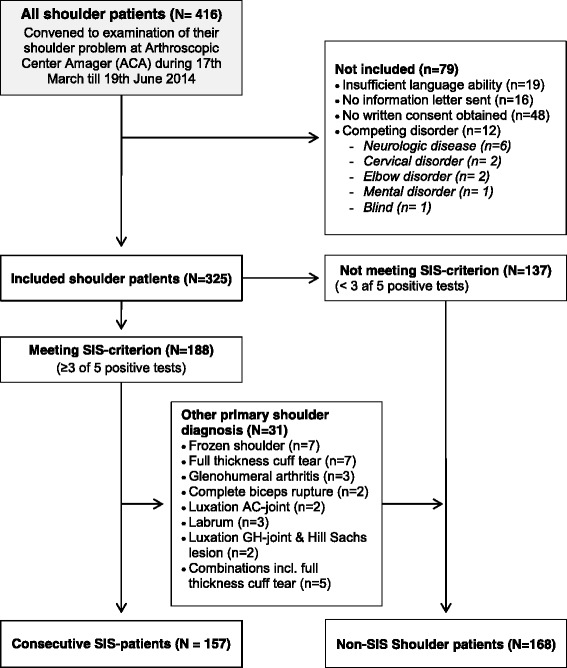
Cross-sectional study based on a consecutive cohort of 157 patients referred to specialist examination and diagnosed with shoulder impingement (SIS) using predefined validated diagnostic criteria. Prior to specialist examination, questionnaires regarding shoulder function (Shoulder Pain And Disability Index, SPADI) demographics and kinesiophobia (TSK-11) were collected, and shoulder strength and ROM was measured by trained testers, with the patient reporting pain levels during testing and for the last week. Impairments in strength (abduction, external-rotation, (protraction and horizontal-extension) and ROM (abduction and internal rotation) were investigated in patients with unilateral shoulder pain, using one-sample t-tests. SPADI total score (SPADI) and SPADI function score (SPADI-F), were chosen as dependent variables in multiple regressions to investigate the influence of impairments on patient-reported shoulder function. Independent variables of interest were; strength in abduction and external rotation, abduction ROM, pain-during-tests, pain-last-week and kinesiophobia.
Significant impairments were found for all impairment tests, but most pronounced for glenohumeral strength and abduction ROM (29-33% deficits), and less for scapulothoracic strength and internal rotation ROM (8-18% deficits). Pain variables influenced SPADI and SPADI-F score to a high degree (R = 23.4-31.6%, p < 0.001), while strength and ROM did not.
Substantial strength and ROM impairments were found in patients with SIS. Only pain significantly influenced patient-reported function, while impairments did not. As SPADI score does not reflect the substantial strength and ROM impairments in external rotation and abduction observed in patients with SIS, supplemental assessment of these impairments seems important.
疼痛和功能丧失是肩峰下撞击综合征(SIS)的主要症状,然而,在非运动员SIS患者中,力量和活动范围(ROM)的缺损情况及程度在很大程度上尚未得到描述。此外,尽管临床指南推荐进行力量测试,但力量和ROM损伤与患者报告的肩部功能之间的相关性尚未得到充分描述。本研究的目的,首先是调查SIS患者的盂肱关节和肩胛胸壁力量以及外展和内旋ROM的损伤情况。其次,调查这些损伤对患者报告的肩部功能的影响。
基于连续队列的157例患者进行横断面研究,这些患者被转介进行专科检查,并使用预先定义的有效诊断标准诊断为肩部撞击(SIS)。在专科检查之前,收集有关肩部功能(肩部疼痛和残疾指数,SPADI)、人口统计学和运动恐惧(TSK-11)的问卷,并由经过培训的测试人员测量肩部力量和ROM,患者报告测试期间以及过去一周的疼痛程度。使用单样本t检验,对单侧肩部疼痛患者的力量(外展、外旋、(前伸和水平伸展))和ROM(外展和内旋)损伤进行调查。在多元回归中,选择SPADI总分(SPADI)和SPADI功能评分(SPADI-F)作为因变量,以研究损伤对患者报告的肩部功能的影响。感兴趣的自变量为:外展和外旋力量、外展ROM、测试期间疼痛、上周疼痛和运动恐惧。
所有损伤测试均发现显著损伤,但盂肱关节力量和外展ROM损伤最为明显(缺损29%-33%),肩胛胸壁力量和内旋ROM损伤较小(缺损8%-18%)。疼痛变量对SPADI和SPADI-F评分有高度影响(R = 23.4%-31.6%,p < 0.001),而力量和ROM则没有。
在SIS患者中发现了明显的力量和ROM损伤。只有疼痛对患者报告的功能有显著影响,而损伤则没有。由于SPADI评分不能反映SIS患者在外旋和外展中观察到的明显力量和ROM损伤,因此对这些损伤进行补充评估似乎很重要。