Renuka Pichili, Madhav Maganti S, Padmakumari Ayyagari Phani, Barbadikar Kalyani M, Mangrauthia Satendra K, Vijaya Sudhakara Rao Kola, Marla Soma S, Ravindra Babu Vemuri
Department of Biotechnology, ICAR-Indian Institute of Rice Research, Hyderabad, Telangana 500030, India.
Department of Biotechnology, ICAR-Indian Institute of Rice Research, Hyderabad, Telangana 500030, India
G3 (Bethesda). 2017 Sep 7;7(9):3031-3045. doi: 10.1534/g3.117.043737.
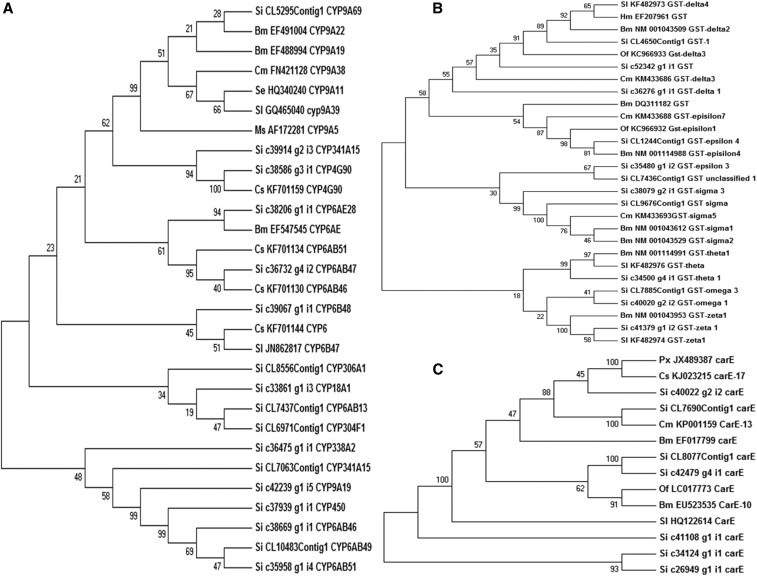
The yellow stem borer (YSB), , is a prominent pest in rice cultivation causing serious yield losses. The larval stage is an important stage in YSB, responsible for maximum infestation. However, limited knowledge exists on the biology and mechanisms underlying the growth and differentiation of YSB. To understand and identify the genes involved in YSB development and infestation, so as to design pest control strategies, we performed transcriptome analysis at the first, third, fifth, and seventh larval developmental stages employing Illumina Hi-seq. High-quality reads (HQR) of ∼229 Mb were assembled into 24,775 transcripts with an average size of 1485 bp. Genes associated with various metabolic processes, , detoxification mechanism [CYP450, GSTs, and carboxylesterases (CarEs)], RNA interference (RNAi) machinery (, , , , , , , and -related gene), chemoreception (CSPs, GRs, OBPs, and ORs), and regulators [transcription factors (TFs) and hormones] were differentially regulated during the developmental stages. Identification of stage-specific transcripts made it possible to determine the essential processes of larval development. Comparative transcriptome analysis revealed that YSB has not evolved much with respect to the detoxification mechanism, but showed the presence of distinct RNAi machinery. The presence of strong specific visual recognition coupled with chemosensory mechanisms supports the monophagous nature of YSB. Designed expressed sequenced tags-simple-sequence repeats (EST-SSRs) will facilitate accurate estimation of the genetic diversity of YSB. This is the first report on characterization of the YSB transcriptome and the identification of genes involved in key processes, which will help researchers and industry to devise novel pest control strategies. This study also opens up a new avenue to develop next-generation resistant rice using RNAi or genome editing approaches.
二化螟是水稻种植中的一种主要害虫,会造成严重的产量损失。幼虫期是二化螟的一个重要阶段,造成的侵害最为严重。然而,关于二化螟生长和分化的生物学及潜在机制,人们了解有限。为了理解和鉴定参与二化螟发育和侵害的基因,以便设计害虫控制策略,我们利用Illumina Hi-seq技术在幼虫发育的第一、第三、第五和第七阶段进行了转录组分析。约229 Mb的高质量 reads 被组装成24,775个转录本,平均大小为1485 bp。与各种代谢过程、解毒机制[细胞色素P450、谷胱甘肽S-转移酶和羧酸酯酶(CarEs)]、RNA干扰(RNAi)机制(、、、、、、和相关基因)、化学感受(化学感受蛋白、味觉受体、气味结合蛋白和嗅觉受体)以及调节因子[转录因子(TFs)和激素]相关的基因在发育阶段受到差异调节。阶段特异性转录本的鉴定使得确定幼虫发育的基本过程成为可能。比较转录组分析表明,二化螟在解毒机制方面进化不多,但显示出独特的RNAi机制。强烈的特异性视觉识别与化学感应机制的存在支持了二化螟的单食性。设计的表达序列标签-简单序列重复(EST-SSRs)将有助于准确估计二化螟的遗传多样性。这是关于二化螟转录组特征及关键过程相关基因鉴定的首次报道,将有助于研究人员和行业制定新的害虫控制策略。本研究还开辟了一条利用RNAi或基因组编辑方法培育下一代抗水稻的新途径。