Wang Jing, Lesko Melissa, Badri Michelle H, Kapoor Bianca C, Wu Benjamin G, Li Yonghua, Smaldone Gerald C, Bonneau Richard, Kurtz Zachary D, Condos Rany, Segal Leopoldo N
Division of Pulmonary and Critical Care Medicine, Beijing Chaoyang Hospital, The Capital University of Medicine, Beijing, China.
Division of Pulmonary, Critical Care and Sleep Medicine, New York University School of Medicine, New York, NY, USA.
ERJ Open Res. 2017 Jul 12;3(3). doi: 10.1183/23120541.00008-2017. eCollection 2017 Jul.
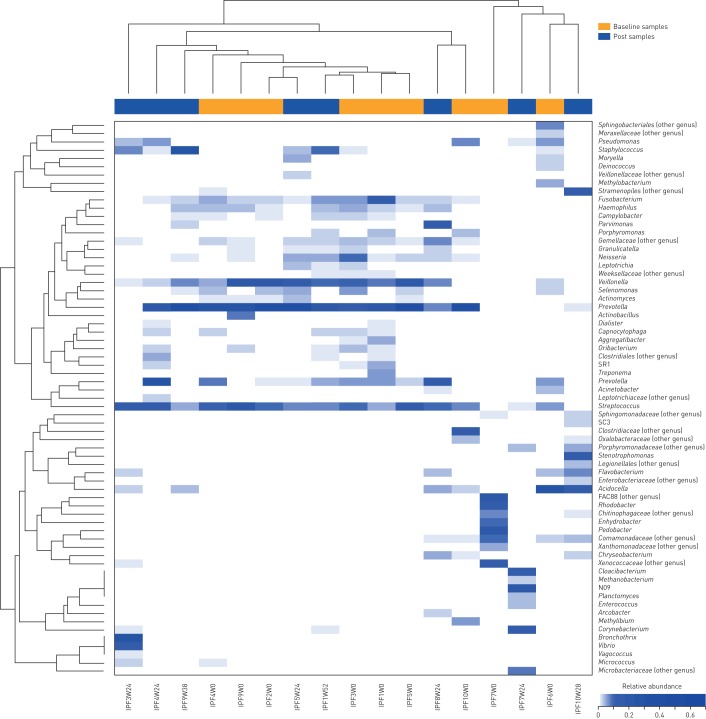
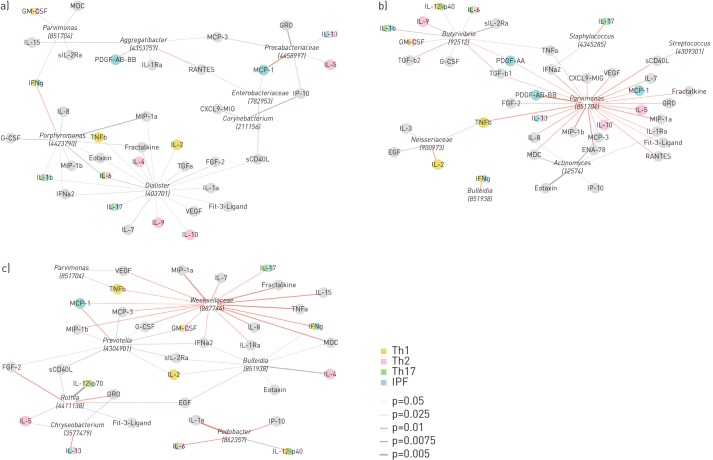
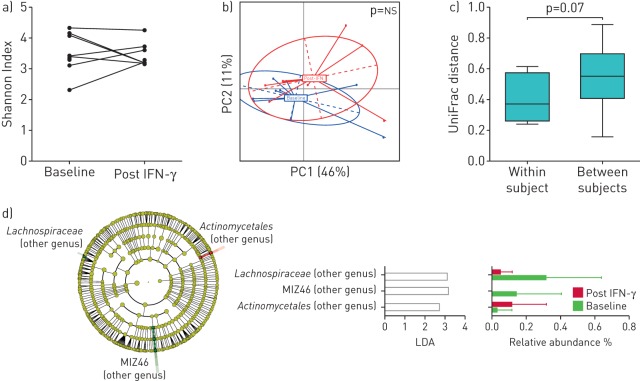
Therapies targeting inflammation reveal inconsistent results in idiopathic pulmonary fibrosis (IPF). Aerosolised interferon (IFN)-γ has been proposed as a novel therapy. Changes in the host airway microbiome are associated with the inflammatory milieu and may be associated with disease progression. Here, we evaluate whether treatment with aerosolised IFN-γ in IPF impacts either the lower airway microbiome or the host immune phenotype. Patients with IPF who enrolled in an aerosolised IFN-γ trial underwent bronchoscopy at baseline and after 6 months. 16S rRNA sequencing of bronchoalveolar lavage fluid (BALF) was used to evaluate the lung microbiome. Biomarkers were measured by Luminex assay in plasma, BALF and BAL cell supernatant. The compPLS framework was used to evaluate associations between taxa and biomarkers. IFN-γ treatment did not change α or β diversity of the lung microbiome and few taxonomic changes occurred. While none of the biomarkers changed in plasma, there was an increase in IFN-γ and a decrease in Fit-3 ligand, IFN-α2 and interleukin-5 in BAL cell supernatant, and a decrease in tumour necrosis factor-β in BALF. Multiple correlations between microbial taxa common to the oral mucosa and host inflammatory biomarkers were found. These data suggest that the lung microbiome is independently associated with the host immune tone and may have a potential mechanistic role in IPF.
针对炎症的疗法在特发性肺纤维化(IPF)中的结果并不一致。雾化干扰素(IFN)-γ已被提议作为一种新的治疗方法。宿主气道微生物群的变化与炎症环境相关,可能与疾病进展有关。在此,我们评估IPF患者雾化IFN-γ治疗是否会影响下呼吸道微生物群或宿主免疫表型。参加雾化IFN-γ试验的IPF患者在基线和6个月后接受了支气管镜检查。使用支气管肺泡灌洗液(BALF)的16S rRNA测序来评估肺部微生物群。通过Luminex检测法测定血浆、BALF和BAL细胞上清液中的生物标志物。使用compPLS框架评估分类群与生物标志物之间的关联。IFN-γ治疗并未改变肺部微生物群的α或β多样性,且分类学变化很少。虽然血浆中的生物标志物均未改变,但BAL细胞上清液中的IFN-γ增加,Flt-3配体、IFN-α2和白细胞介素-5减少,BALF中的肿瘤坏死因子-β减少。发现口腔黏膜常见的微生物分类群与宿主炎症生物标志物之间存在多重相关性。这些数据表明,肺部微生物群与宿主免疫状态独立相关,可能在IPF中具有潜在的机制作用。