Guan Chunmei, Dang Rui, Cui Yu, Liu Liyan, Chen Xiaobei, Wang Xiaoyu, Zhu Jingli, Li Donggang, Li Junwei, Wang Decai
Department of Nutrition and Food Hygiene, Public Health College, Harbin Medical University, Harbin, Heilongjiang, China.
Hobo college of Xinjiang Medical University, Xinjiang, Kelamayi, China.
PLoS One. 2017 Jul 18;12(7):e0178271. doi: 10.1371/journal.pone.0178271. eCollection 2017.
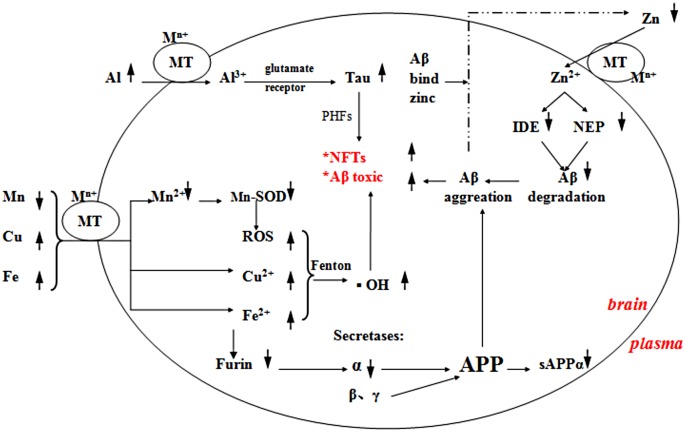
The exact cause of Alzheimer's disease (AD) and the role of metals in its etiology remain unclear. We have used an analytical approach, based on inductively coupled plasma mass spectrometry coupled with multivariate statistical analysis, to study the profiles of a wide range of metals in AD patients and healthy controls. AD cannot be cured and the lack of sensitive biomarkers that can be used in the early stages of the disease may contribute to this treatment failure. In the present study, we measured plasma levels of amyloid-β1-42(0.142±0.029μg/L)and furin(2.292±1.54μg/L), together with those of the metalloproteinases, insulin-degrading enzyme(1.459±1.14μg/L) and neprilysin(0.073±0.015μg/L), in order to develop biomarkers for AD. Partial least squares discriminant analysis models were used to refine intergroup differences and we discovered that four metals(Mn, Al, Li, Cu) in peripheral blood were strongly associated with AD. Aberration in homeostasis of these metals may alter levels of proteinases, such as furin, which are associated with neurodegeneration in AD and can be a used as plasma-based biomarkers.
阿尔茨海默病(AD)的确切病因以及金属在其病因学中的作用仍不清楚。我们采用了一种基于电感耦合等离子体质谱联用多元统计分析的分析方法,来研究AD患者和健康对照者体内多种金属的分布情况。AD无法治愈,而缺乏可用于疾病早期阶段的敏感生物标志物可能是导致治疗失败的原因之一。在本研究中,我们测量了血浆中淀粉样蛋白β1-42(0.142±0.029μg/L)和弗林蛋白酶(2.292±1.54μg/L)的水平,以及金属蛋白酶、胰岛素降解酶(1.459±1.14μg/L)和中性内肽酶(0.073±0.015μg/L)的水平,以便开发AD的生物标志物。使用偏最小二乘判别分析模型来细化组间差异,我们发现外周血中的四种金属(锰、铝、锂、铜)与AD密切相关。这些金属稳态的异常可能会改变蛋白酶的水平,如弗林蛋白酶,其与AD中的神经退行性变有关,并且可作为基于血浆的生物标志物。