Department of Internal Medicine, Seoul National University Bundang Hospital, College of Medicine, Seoul National University, Seongnam, Korea.
Department of Radiology, Seoul National University Bundang Hospital, College of Medicine, Seoul National University, Seongnam, Korea.
Clin Mol Hepatol. 2018 Jun;24(2):163-168. doi: 10.3350/cmh.2017.0002. Epub 2017 Jul 19.
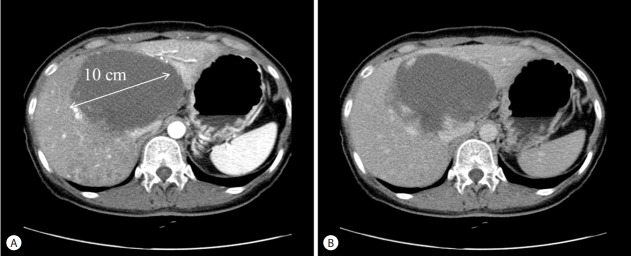
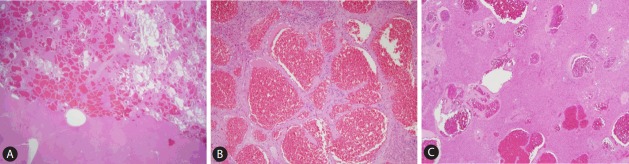
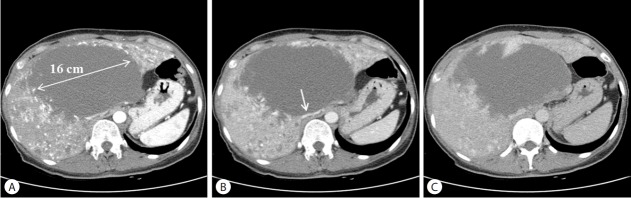
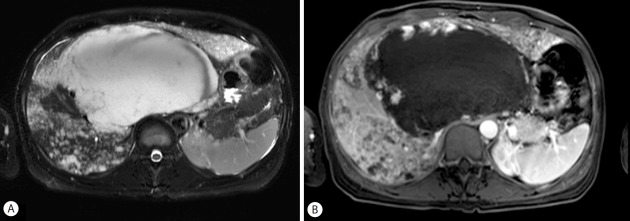
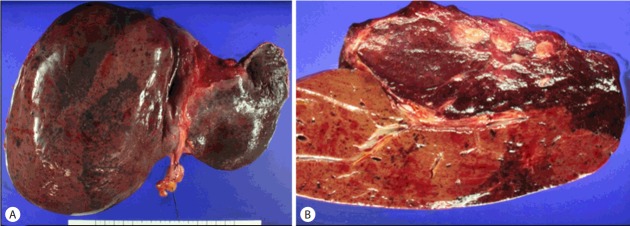
Hepatic hemangioma represents the most common benign primary hepatic neoplasm. Although most such tumors are small and asymptomatic, giant hepatic hemangioma is frequently symptomatic, and requires intervention. Moreover, diffuse multiple hepatic hemangiomatosis occupying almost the entire liver is extremely rare in adults, and the optimal management for this condition is unclear. We report a case of a rapidly growing, symptomatic giant hepatic hemangioma with diffuse hepatic hemangiomatosis in a 50-year-old female patient who was treated by living-donor liver transplantation. This case shows malignant behavior of a benign hemangioma that required liver transplantation. Although this case could not meet the criteria for transplantation according to the MELD (model for end-stage liver disease) score system, it should be considered as an exceptional indication for deceased-donor liver allocation. Further studies of the mechanism underlying hemangioma growth are warranted.
肝血管瘤是最常见的良性原发性肝脏肿瘤。尽管大多数此类肿瘤较小且无症状,但巨大的肝血管瘤常出现症状,需要干预。此外,成人中弥漫性多发肝血管瘤病几乎占据整个肝脏的情况极为罕见,这种情况下的最佳治疗方法尚不清楚。我们报告了一例 50 岁女性患者的快速生长、有症状的巨大肝血管瘤伴弥漫性肝血管瘤病,该患者接受了活体供肝肝移植治疗。该病例显示良性肝血管瘤具有恶性行为,需要进行肝移植。虽然根据 MELD(终末期肝病模型)评分系统,该病例不符合移植标准,但应将其视为已故供肝分配的特殊适应证。有必要进一步研究血管瘤生长的机制。