Thérien Ariane, Bédard Mikaël, Carignan Damien, Rioux Gervais, Gauthier-Landry Louis, Laliberté-Gagné Marie-Ève, Bolduc Marilène, Savard Pierre, Leclerc Denis
Department of Microbiology, Infectiology and Immunology, Infectious Disease Research Center, Laval University, 2705 Boul. Laurier, Quebec City, PQ, G1V 4G2, Canada.
Neurosciences, Laval University, 2705 Boul. Laurier, Québec City, PQ, G1V 4G2, Canada.
J Nanobiotechnology. 2017 Jul 18;15(1):54. doi: 10.1186/s12951-017-0289-y.
Flexuous rod-shaped nanoparticles made of the coat protein (CP) of papaya mosaic virus (PapMV) have been shown to trigger innate immunity through engagement of toll-like receptor 7 (TLR7). PapMV nanoparticles can also serve as a vaccine platform as they can increase the immune response to fused peptide antigens. Although this approach shows great potential, fusion of antigens directly to the CP open reading frame (ORF) is challenging because the fused peptides can alter the structure of the CP and its capacity to self assemble into nanoparticles-a property essential for triggering an efficient immune response to the peptide. This represents a serious limitation to the utility of this approach as fusion of small peptides only is tolerated.
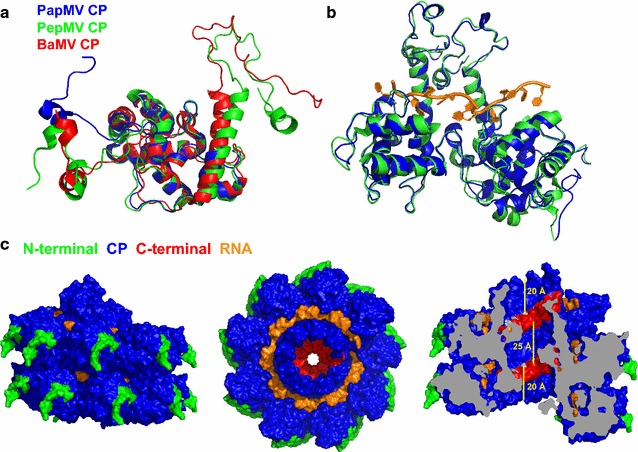
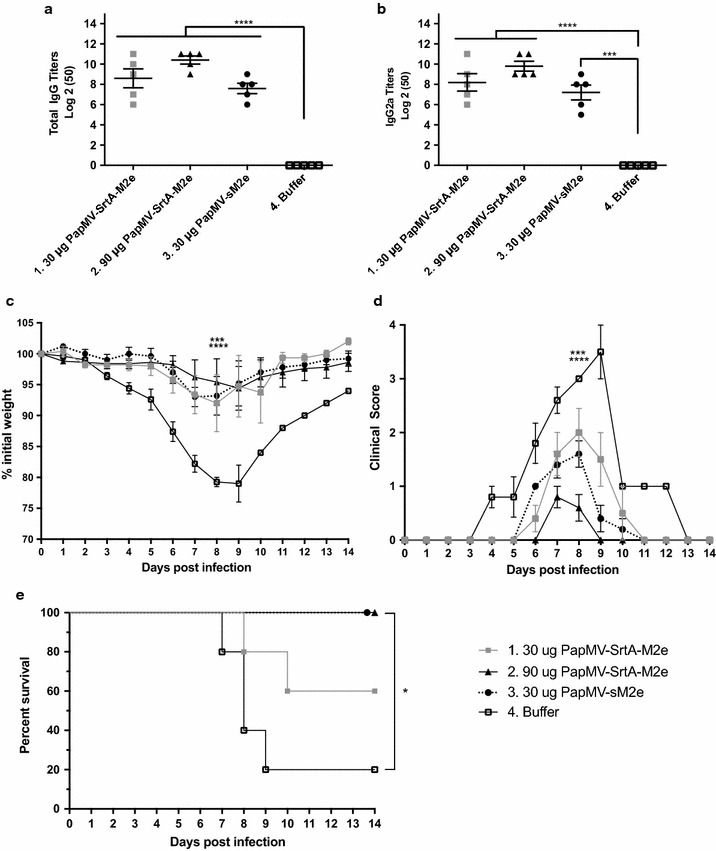
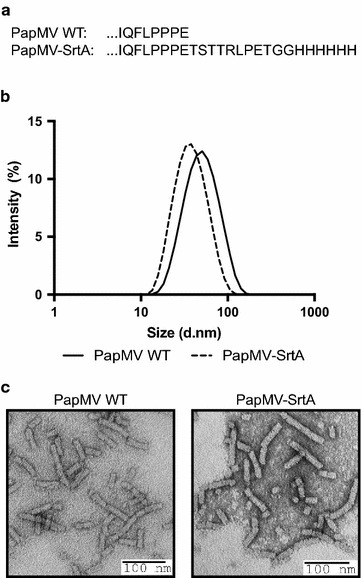
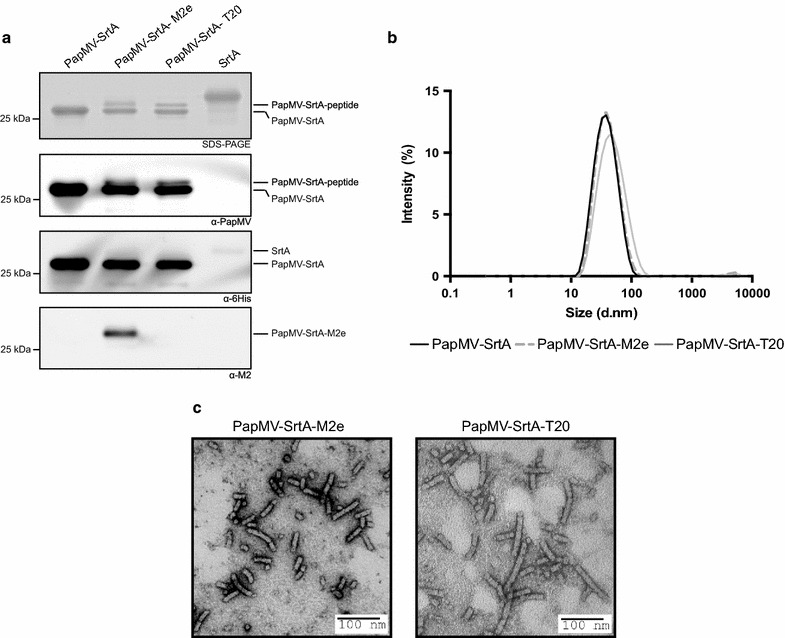
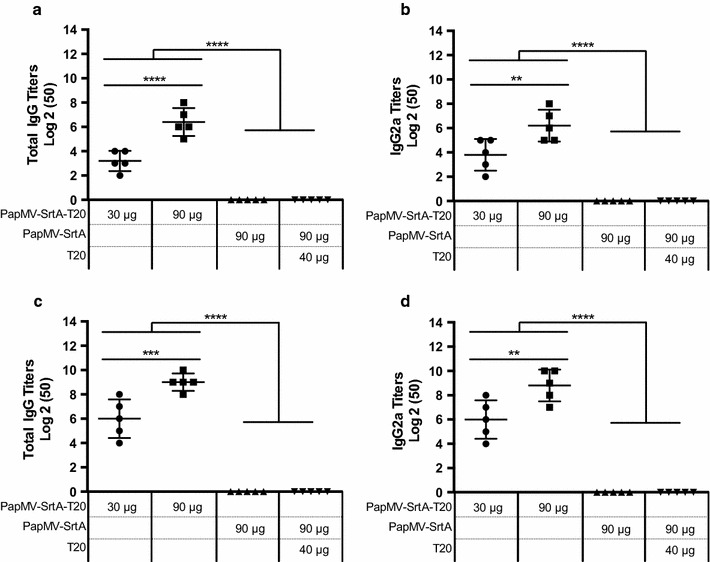
We have developed a novel approach in which peptides are fused directly to pre-formed PapMV nanoparticles. This approach is based on the use of a bacterial transpeptidase (sortase A; SrtA) that can attach the peptide directly to the nanoparticle. An engineered PapMV CP harbouring the SrtA recognition motif allows efficient coupling. To refine our engineering, and to predict the efficacy of coupling with SrtA, we modeled the PapMV structure based on the known structure of PapMV CP and on recent reports revealing the structure of two closely related potexviruses: pepino mosaic virus (PepMV) and bamboo mosaic virus (BaMV). We show that SrtA can allow the attachment of long peptides [Influenza M2e peptide (26 amino acids) and the HIV-1 T20 peptide (39 amino acids)] to PapMV nanoparticles. Consistent with our PapMV structural model, we show that around 30% of PapMV CP subunits in each nanoparticle can be fused to the peptide antigen. As predicted, engineered nanoparticles were capable of inducing a strong antibody response to the fused antigen. Finally, in a challenge study with influenza virus, we show that mice vaccinated with PapMV-M2e are protected from infection.
This technology will allow the development of vaccines harbouring long peptides containing several B and/or T cell epitopes that can contribute to a broad and robust protection from infection. The design can be fast, versatile and can be adapted to the development of vaccines for many infectious diseases as well as cancer vaccines.
由番木瓜花叶病毒(PapMV)的外壳蛋白(CP)制成的弯曲杆状纳米颗粒已被证明可通过与Toll样受体7(TLR7)结合来触发先天免疫。PapMV纳米颗粒还可以作为疫苗平台,因为它们可以增强对融合肽抗原的免疫反应。尽管这种方法显示出巨大潜力,但将抗原直接融合到CP开放阅读框(ORF)具有挑战性,因为融合肽会改变CP的结构及其自组装成纳米颗粒的能力,而这种自组装特性对于引发对该肽的有效免疫反应至关重要。这严重限制了该方法的实用性,因为目前仅能耐受小肽的融合。
我们开发了一种新方法,即将肽直接融合到预先形成的PapMV纳米颗粒上。该方法基于使用一种细菌转肽酶(分选酶A;SrtA),它可以将肽直接连接到纳米颗粒上。带有SrtA识别基序的工程化PapMV CP可实现高效偶联。为了优化我们的工程设计,并预测与SrtA偶联的效果,我们基于PapMV CP的已知结构以及最近揭示两种密切相关的马铃薯X病毒:佩佩诺花叶病毒(PepMV)和竹花叶病毒(BaMV)结构的报道,对PapMV结构进行了建模。我们表明,SrtA可以使长肽[流感M2e肽(26个氨基酸)和HIV-1 T20肽(39个氨基酸)]连接到PapMV纳米颗粒上。与我们的PapMV结构模型一致,我们表明每个纳米颗粒中约30%的PapMV CP亚基可以与肽抗原融合。如预期的那样,工程化纳米颗粒能够诱导对融合抗原产生强烈的抗体反应。最后,在一项流感病毒攻毒研究中,我们表明用PapMV-M2e疫苗接种的小鼠受到感染保护。
这项技术将有助于开发包含多个B和/或T细胞表位的长肽疫苗,从而为感染提供广泛而强大的保护。这种设计可以快速、通用,并且可以适用于多种传染病疫苗以及癌症疫苗的开发。