Graduate Institute of Acupuncture Science, College of Chinese Medicine, China Medical University, Taichung, 40402, Taiwan.
Division of Colorectal Surgery, China Medical University Hospital, Taichung, 40447, Taiwan.
J Biomed Sci. 2017 Jul 19;24(1):47. doi: 10.1186/s12929-017-0355-7.
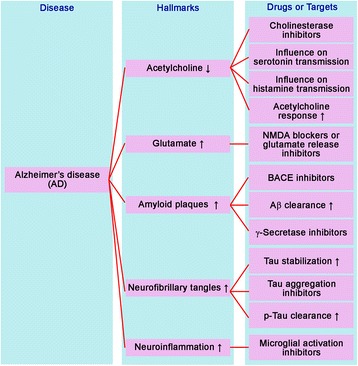
Alzheimer's disease (AD) is a major form of senile dementia, characterized by progressive memory and neuronal loss combined with cognitive impairment. AD is the most common neurodegenerative disease worldwide, affecting one-fifth of those aged over 85 years. Recent therapeutic approaches have been strongly influenced by five neuropathological hallmarks of AD: acetylcholine deficiency, glutamate excitotoxicity, extracellular deposition of amyloid-β (Aβ plague), formation of intraneuronal neurofibrillary tangles (NTFs), and neuroinflammation. The lowered concentrations of acetylcholine (ACh) in AD result in a progressive and significant loss of cognitive and behavioral function. Current AD medications, memantine and acetylcholinesterase inhibitors (AChEIs) alleviate some of these symptoms by enhancing cholinergic signaling, but they are not curative. Since 2003, no new drugs have been approved for the treatment of AD. This article focuses on the current research in clinical trials targeting the neuropathological findings of AD including acetylcholine response, glutamate transmission, Aβ clearance, tau protein deposits, and neuroinflammation. These investigations include acetylcholinesterase inhibitors, agonists and antagonists of neurotransmitter receptors, β-secretase (BACE) or γ-secretase inhibitors, vaccines or antibodies targeting Aβ clearance or tau protein, as well as anti-inflammation compounds. Ongoing Phase III clinical trials via passive immunotherapy against Aβ peptides (crenezumab, gantenerumab, and aducanumab) seem to be promising. Using small molecules blocking 5-HT serotonin receptor (intepirdine), inhibiting BACE activity (E2609, AZD3293, and verubecestat), or reducing tau aggregation (TRx0237) are also currently in Phase III clinical trials. We here systemically review the findings from recent clinical trials to provide a comprehensive review of novel therapeutic compounds in the treatment and prevention of AD.
阿尔茨海默病(AD)是一种主要的老年痴呆症,其特征是进行性记忆和神经元丧失,伴有认知障碍。AD 是全球最常见的神经退行性疾病,影响五分之一的 85 岁以上人群。最近的治疗方法受到 AD 的五个神经病理学特征的强烈影响:乙酰胆碱缺乏、谷氨酸兴奋性毒性、淀粉样β(Aβ 斑块)的细胞外沉积、神经元内神经原纤维缠结(NTFs)的形成以及神经炎症。AD 中乙酰胆碱(ACh)浓度降低导致认知和行为功能逐渐显著丧失。目前的 AD 药物,美金刚和乙酰胆碱酯酶抑制剂(AChEIs)通过增强胆碱能信号来缓解这些症状中的一些,但不能治愈。自 2003 年以来,没有新的药物被批准用于治疗 AD。本文重点介绍了针对 AD 的神经病理学发现的临床试验中的当前研究,包括乙酰胆碱反应、谷氨酸传递、Aβ 清除、tau 蛋白沉积和神经炎症。这些研究包括乙酰胆碱酯酶抑制剂、神经递质受体激动剂和拮抗剂、β-分泌酶(BACE)或γ-分泌酶抑制剂、针对 Aβ 清除或 tau 蛋白的疫苗或抗体,以及抗炎化合物。针对 Aβ 肽的被动免疫疗法(crenezumab、gantenerumab 和 aducanumab)的 III 期临床试验似乎很有前途。使用阻断 5-HT 血清素受体的小分子(intepirdine)、抑制 BACE 活性(E2609、AZD3293 和 verubecestat)或减少 tau 聚集(TRx0237)的方法也正在进行 III 期临床试验。我们在这里系统地回顾了最近临床试验的结果,为 AD 的治疗和预防提供了新型治疗化合物的全面综述。