Smith Megan A, Canfell Karen
School of Public Health, University of Sydney, NSW 2006, Australia; Cancer Research Division, Cancer Council NSW, 153 Dowling St, Woolloomooloo, NSW 2011, Australia.
Papillomavirus Res. 2017 Jun;3:134-141. doi: 10.1016/j.pvr.2017.04.003. Epub 2017 Apr 19.
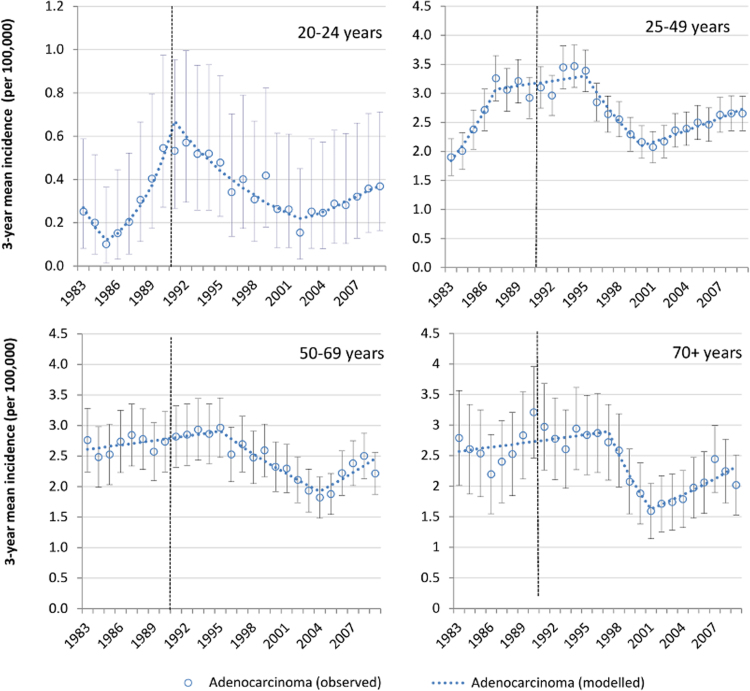
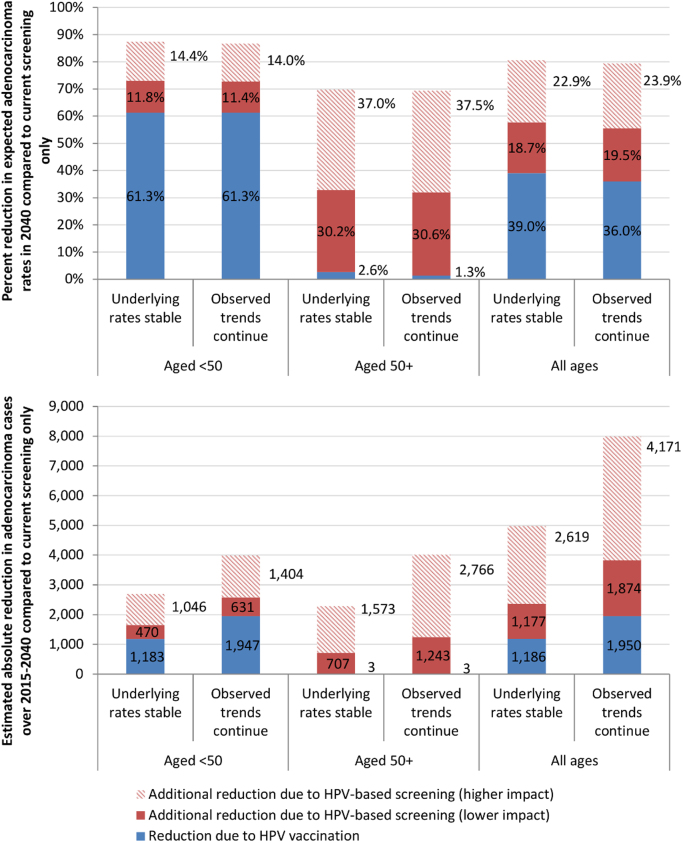
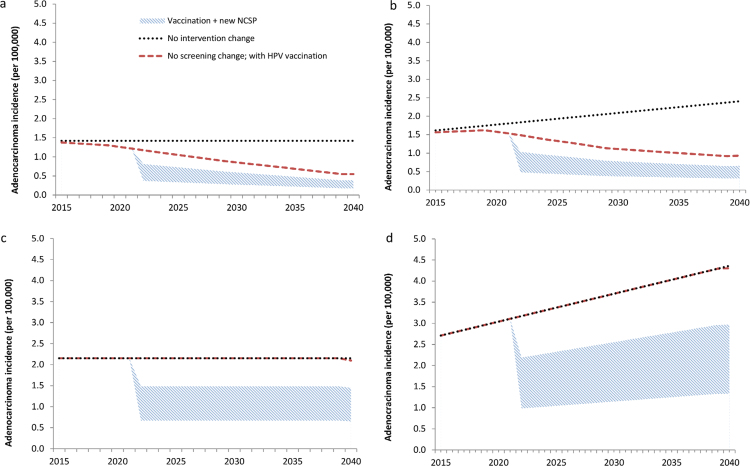
Cytology-based cervical screening appears to have had a limited effect on the incidence of adenocarcinoma, however HPV vaccination and HPV-based screening will likely play a role in reducing future burden. Using Australia as an example, we estimated the future burden (2015-2040) of adenocarcinoma in the absence of other interventions; and the impact of HPV vaccination (introduced 2007) and HPV-based screening (commencing 2017). Future burden was estimated considering underlying trends in adenocarcinoma, using national data (1982-2010). The relative reduction in adenocarcinoma due to HPV vaccination and HPV-based screening was derived from observed clinical data. Adenocarcinoma incidence rates have been increasing since the early-mid 2000s (average annual increases from 3.0%(25-49 years) -8.1%(20-24 years)). If these trends continue, rates would increase from 1.4 to 2.4/100,000 in <50 years and from 2.2 to 4.4/100,000 in 50+ years by 2040. Taking into account coverage, HPV vaccination will reduce 2040 incidence by 36-39%, mainly in women <50 years (61% reduction). Taking into account uncertainties in trends and screening effectiveness, HPV-based screening will reduce incidence by an additional 19-43%, mainly in women 50+ years (additional 30-68% reduction). Together, these interventions will reduce incidence by 55-81%.
基于细胞学的宫颈癌筛查似乎对腺癌发病率的影响有限,然而人乳头瘤病毒(HPV)疫苗接种和基于HPV的筛查可能会在减轻未来负担方面发挥作用。以澳大利亚为例,我们估计了在没有其他干预措施的情况下腺癌未来(2015 - 2040年)的负担;以及HPV疫苗接种(2007年引入)和基于HPV的筛查(2017年开始)的影响。利用国家数据(1982 - 2010年),考虑腺癌的潜在趋势来估计未来负担。HPV疫苗接种和基于HPV的筛查导致的腺癌相对减少率来自观察到的临床数据。自21世纪初至中期以来,腺癌发病率一直在上升(25 - 49岁年龄段年均增长3.0%,20 - 24岁年龄段年均增长8.1%)。如果这些趋势持续下去,到2040年,50岁以下人群的发病率将从每10万人1.4例增至2.4例,50岁及以上人群的发病率将从每10万人2.2例增至4.4例。考虑到疫苗接种覆盖率,HPV疫苗接种将使2040年的发病率降低36% - 39%,主要是在50岁以下女性中(降低61%)。考虑到趋势和筛查效果的不确定性,基于HPV的筛查将使发病率再降低19% - 43%,主要是在50岁及以上女性中(再降低30% - 68%)。综合起来,这些干预措施将使发病率降低55% - 81%。