Zhang Xing, Sun YuYan, Wang Peng, Yang Changfu, Li Shengwei
Department of Urology.
Surgery of Chinese Medicine, Yangzhou TCM Hospital, Nanjing University of Chinese Medicine, Yangzhou, People's Republic of China.
Onco Targets Ther. 2017 Jun 29;10:3225-3232. doi: 10.2147/OTT.S135764. eCollection 2017.
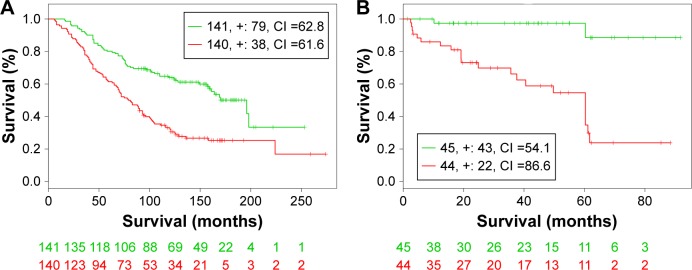
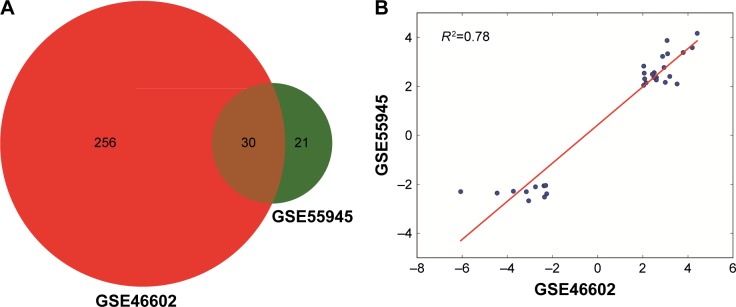
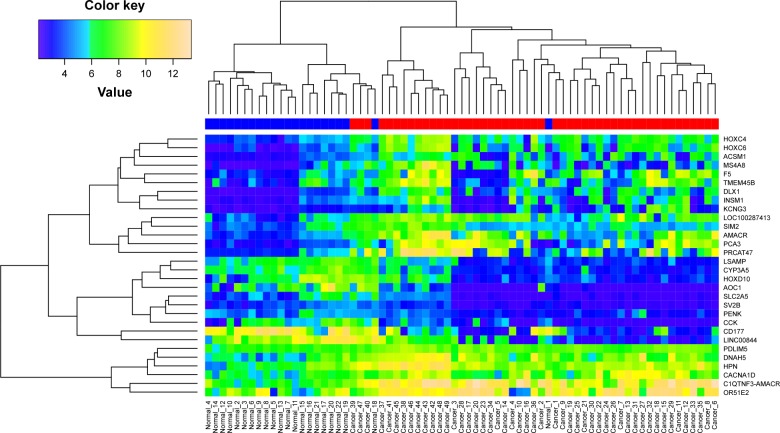
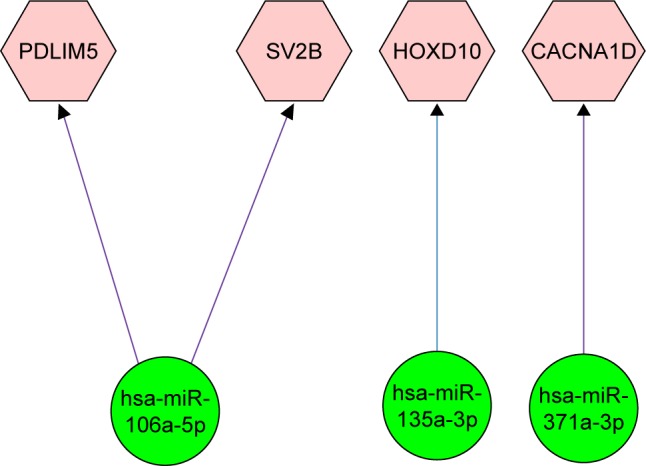
Prostate cancer, the second most common cancer in men, has been rarely explored by integrating mRNA and miRNA expression profiles. In this study, we combined two mRNA expression datasets and six documented miRNAs to uncover the comprehensive molecular mechanism of prostate cancer. Results showed that a total of 30 genes were significantly differentially expressed in 49 tumor samples by comparing with 22 normal samples. Importantly, all samples from the two datasets can be clearly classified into two groups, tumor group and normal group, based on the selected differentially expressed genes (DEGs). The miRNA-mRNA regulation network indicated that 4 out of 30 DEGs can be regulated by three miRNAs. In addition, prognostic performance validation using in silico databases showed that the DEGs can significantly differentiate between low-risk and high-risk prostate cancer. In summary, multiple biological processes are probably involved in the development and progression of prostate cancer. First, dysregulation of SV2 can regulate transporter and transmembrane transporter activity and then provide the necessary nutrients for tumor cell proliferation. Second, HOXD10 can induce cell proliferation via TCF-4. Finally, dysregulation of CACNA1D can further suppress tumor apoptosis in prostate cancer. The identification of critical genes and valuable biological processes can be useful for the understanding of the molecular mechanism of prostate cancer.
前列腺癌是男性中第二常见的癌症,通过整合mRNA和miRNA表达谱对其进行的研究很少。在本研究中,我们结合了两个mRNA表达数据集和六个已记录的miRNA,以揭示前列腺癌的综合分子机制。结果显示,与22个正常样本相比,49个肿瘤样本中共有30个基因存在显著差异表达。重要的是,基于所选的差异表达基因(DEG),来自两个数据集的所有样本都可以清晰地分为两组,即肿瘤组和正常组。miRNA-mRNA调控网络表明,30个DEG中有4个可受三个miRNA调控。此外,使用电子数据库进行的预后性能验证表明,这些DEG可显著区分低风险和高风险前列腺癌。总之,前列腺癌的发生和发展可能涉及多个生物学过程。首先,SV2失调可调节转运体和跨膜转运体活性,进而为肿瘤细胞增殖提供必要的营养物质。其次,HOXD10可通过TCF-4诱导细胞增殖。最后,CACNA1D失调可进一步抑制前列腺癌中的肿瘤细胞凋亡。关键基因和有价值的生物学过程的鉴定有助于理解前列腺癌的分子机制。