Imai Shin-Ichiro, Guarente Leonard
Department of Developmental Biology, Washington University School of Medicine, St Louis, MO, USA.
Department of Biology and Glenn Laboratories for the Science of Aging, Massachusetts Institute of Technology, Cambridge, MA, USA.
NPJ Aging Mech Dis. 2016 Aug 18;2:16017. doi: 10.1038/npjamd.2016.17. eCollection 2016.
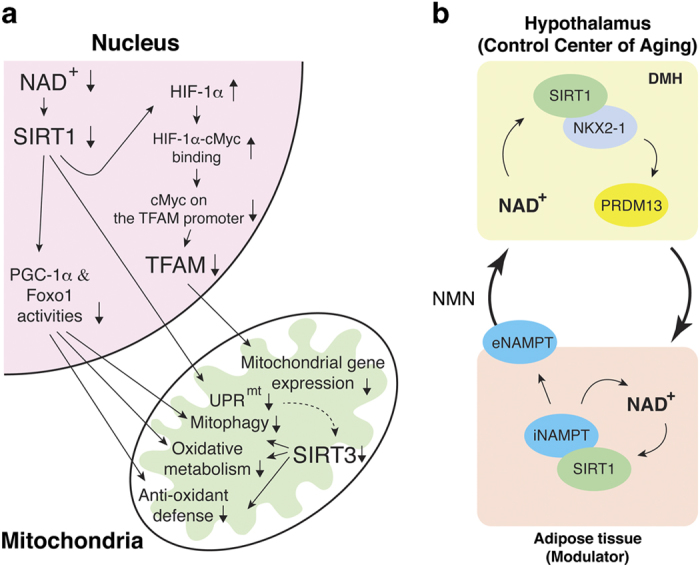
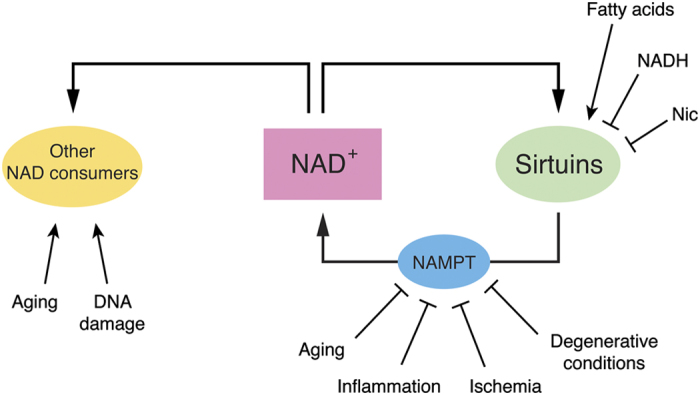
The coupling of nicotinamide adenine dinucleotide (NAD) breakdown and protein deacylation is a unique feature of the family of proteins called 'sirtuins.' This intimate connection between NAD and sirtuins has an ancient origin and provides a mechanistic foundation that translates the regulation of energy metabolism into aging and longevity control in diverse organisms. Although the field of sirtuin research went through intensive controversies, an increasing number of recent studies have put those controversies to rest and fully established the significance of sirtuins as an evolutionarily conserved aging/longevity regulator. The tight connection between NAD and sirtuins is regulated at several different levels, adding further complexity to their coordination in metabolic and aging/longevity control. Interestingly, it has been demonstrated that NAD availability decreases over age, reducing sirtuin activities and affecting the communication between the nucleus and mitochondria at a cellular level and also between the hypothalamus and adipose tissue at a systemic level. These dynamic cellular and systemic processes likely contribute to the development of age-associated functional decline and the pathogenesis of diseases of aging. To mitigate these age-associated problems, supplementation of key NAD intermediates is currently drawing significant attention. In this review article, we will summarize these important aspects of the intimate connection between NAD and sirtuins in aging/longevity control.
烟酰胺腺嘌呤二核苷酸(NAD)分解与蛋白质去酰化的偶联是一类名为“沉默调节蛋白”的蛋白质家族的独特特征。NAD与沉默调节蛋白之间的这种紧密联系有着古老的起源,并提供了一个机制基础,将能量代谢的调节转化为多种生物体中的衰老和寿命控制。尽管沉默调节蛋白的研究领域经历了激烈的争议,但最近越来越多的研究平息了这些争议,并充分确立了沉默调节蛋白作为一种进化上保守的衰老/寿命调节因子的重要性。NAD与沉默调节蛋白之间的紧密联系在几个不同层面受到调控,这进一步增加了它们在代谢以及衰老/寿命控制中协调的复杂性。有趣的是,已有研究表明,NAD的可用性会随着年龄增长而降低,从而降低沉默调节蛋白的活性,并在细胞水平上影响细胞核与线粒体之间的通讯,在全身水平上影响下丘脑与脂肪组织之间的通讯。这些动态的细胞和全身过程可能导致与年龄相关的功能衰退以及衰老相关疾病的发病机制。为了缓解这些与年龄相关的问题,补充关键的NAD中间体目前正受到广泛关注。在这篇综述文章中,我们将总结NAD与沉默调节蛋白在衰老/寿命控制中紧密联系的这些重要方面。