Kleppe Maria, Comen Elizabeth, Wen Hannah Y, Bastian Lennart, Blum Brian, Rapaport Franck T, Keller Matthew, Granot Zvika, Socci Nicolas, Viale Agnès, You Daoqi, Benezra Robert, Weigelt Britta, Brogi Edi, Berger Michael F, Reis-Filho Jorge S, Levine Ross L, Norton Larry
Human Oncology and Pathogenesis Program, Memorial Sloan Kettering Cancer Center, New York, NY, USA.
Breast Cancer Service, Department of Medicine, Memorial Sloan Kettering Cancer Center, New York, NY, USA.
NPJ Breast Cancer. 2015 Jun 10;1:15005. doi: 10.1038/npjbcancer.2015.5. eCollection 2015.
Malignant transformation requires the interaction of cancer cells with their microenvironment, including infiltrating leukocytes. However, somatic mutational studies have focused on alterations in cancer cells, assuming that the microenvironment is genetically normal. Because we hypothesized that this might not be a valid assumption, we performed exome sequencing and targeted sequencing to investigate for the presence of pathogenic mutations in tumor-associated leukocytes in breast cancers.
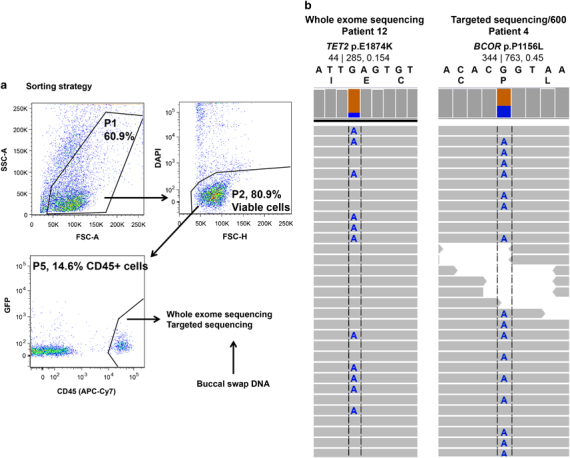
We used targeted sequencing and exome sequencing to evaluate the presence of mutations in sorted tumor-infiltrating CD45-positive cells from primary untreated breast cancers. We used high-depth sequencing to determine the presence/absence of the mutations we identified in breast cancer-infiltrating leukocytes in purified tumor cells and in circulating blood cells.
Capture-based sequencing of 15 paired tumor-infiltrating leukocytes and matched germline DNA identified variants in known cancer genes in all 15 primary breast cancer patients in our cohort. We validated the presence of mutations identified by targeted sequencing in infiltrating leukocytes through orthogonal exome sequencing. Ten patients harbored alterations previously reported as somatically acquired variants, including in known leukemia genes (, , and . One of the mutations observed in the tumor-infiltrating leukocytes was also detected in the circulating leukocytes of the same patients at a lower allele frequency than observed in the tumor-infiltrating cells.
Here we show that somatic mutations, including mutations in known cancer genes, are present in the leukocytes infiltrating a subset of primary breast cancers. This observation allows for the possibility that the cancer cells interact with mutant infiltrating leukocytes, which has many potential clinical implications.
恶性转化需要癌细胞与其微环境相互作用,包括浸润的白细胞。然而,体细胞突变研究主要集中在癌细胞的改变上,假定微环境在基因上是正常的。由于我们推测这可能不是一个有效的假设,因此我们进行了外显子组测序和靶向测序,以研究乳腺癌中肿瘤相关白细胞中致病突变的存在情况。
我们使用靶向测序和外显子组测序来评估原发性未经治疗的乳腺癌中分选的肿瘤浸润性CD45阳性细胞中的突变情况。我们使用深度测序来确定在纯化的肿瘤细胞和循环血细胞中我们在乳腺癌浸润白细胞中鉴定出的突变的有无。
对15对肿瘤浸润白细胞和匹配的种系DNA进行基于捕获的测序,在我们队列中的所有15例原发性乳腺癌患者中均鉴定出已知癌症基因中的变异。我们通过正交外显子组测序验证了靶向测序在浸润白细胞中鉴定出的突变的存在。10名患者携带先前报道为体细胞获得性变异的改变,包括已知的白血病基因(、和)中的变异。在肿瘤浸润白细胞中观察到的一种突变也在同一患者的循环白细胞中以低于在肿瘤浸润细胞中观察到的等位基因频率被检测到。
在这里我们表明,体细胞突变,包括已知癌症基因中的突变,存在于浸润一部分原发性乳腺癌的白细胞中。这一观察结果提示癌细胞可能与突变的浸润白细胞相互作用,这具有许多潜在的临床意义。