Newton Paul K, Mason Jeremy, Venkatappa Neethi, Jochelson Maxine S, Hurt Brian, Nieva Jorge, Comen Elizabeth, Norton Larry, Kuhn Peter
Department of Aerospace and Mechanical Engineering, University of Southern California, Los Angeles, CA, USA.
Department of Mathematics, University of Southern California, Los Angeles, CA, USA.
NPJ Breast Cancer. 2015 Oct 21;1:15018. doi: 10.1038/npjbcancer.2015.18. eCollection 2015.
Cancer cell migration patterns are critical for understanding metastases and clinical evolution. Breast cancer spreads from one organ system to another via hematogenous and lymphatic routes. Although patterns of spread may superficially seem random and unpredictable, we explored the possibility that this is not the case.
Develop a Markov based model of breast cancer progression that has predictive capability.
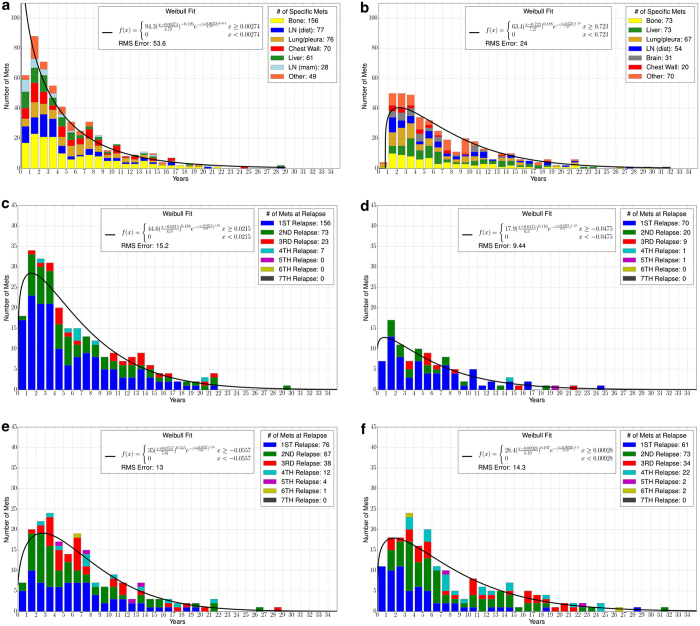
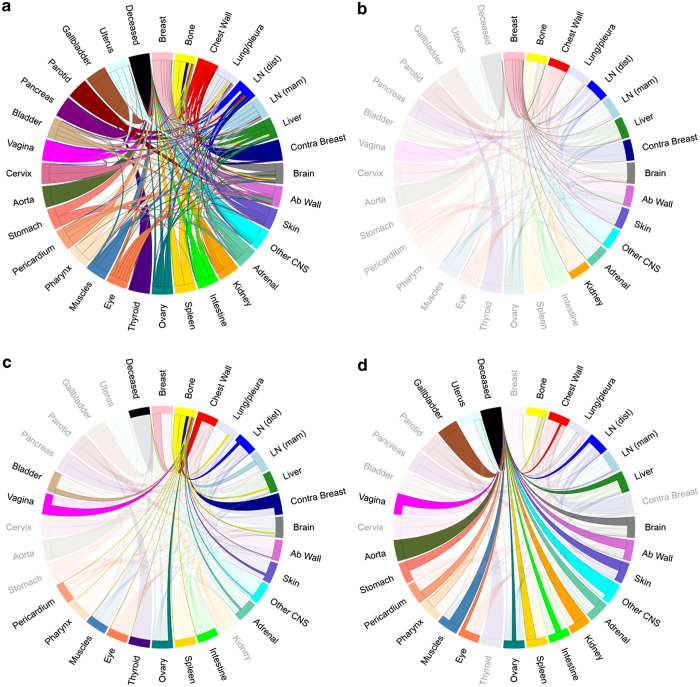
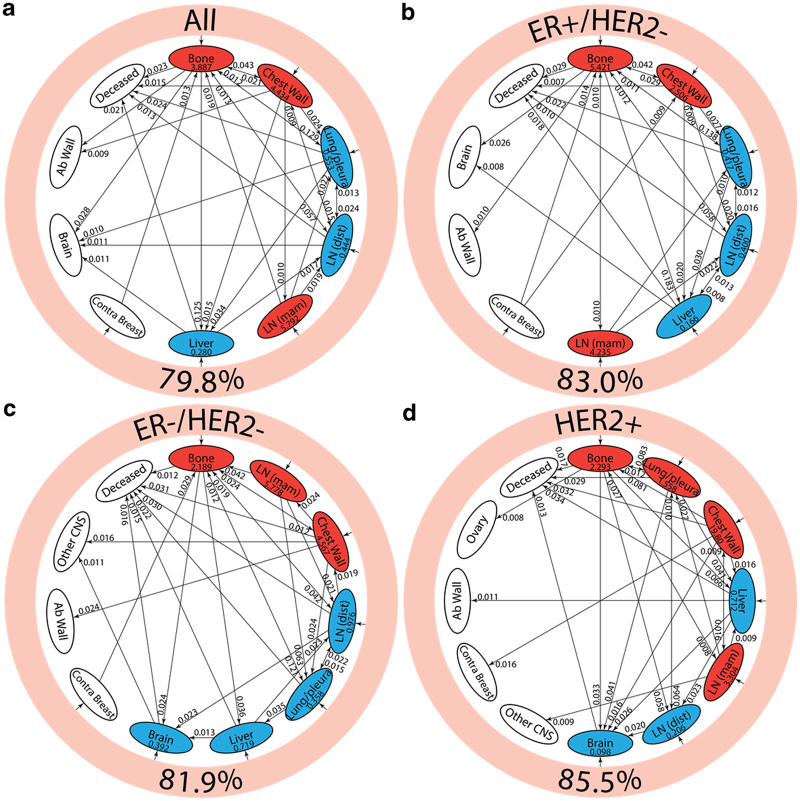
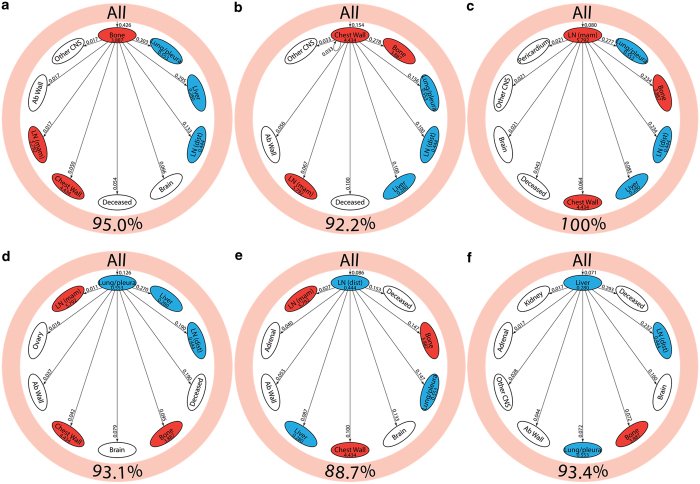
On the basis of a longitudinal data set of 446 breast cancer patients, we created a Markov chain model of metastasis that describes the probabilities of metastasis occurring at a given anatomic site together with the probability of spread to additional sites. Progression is modeled as a random walk on a directed graph, where nodes represent anatomical sites where tumors can develop.
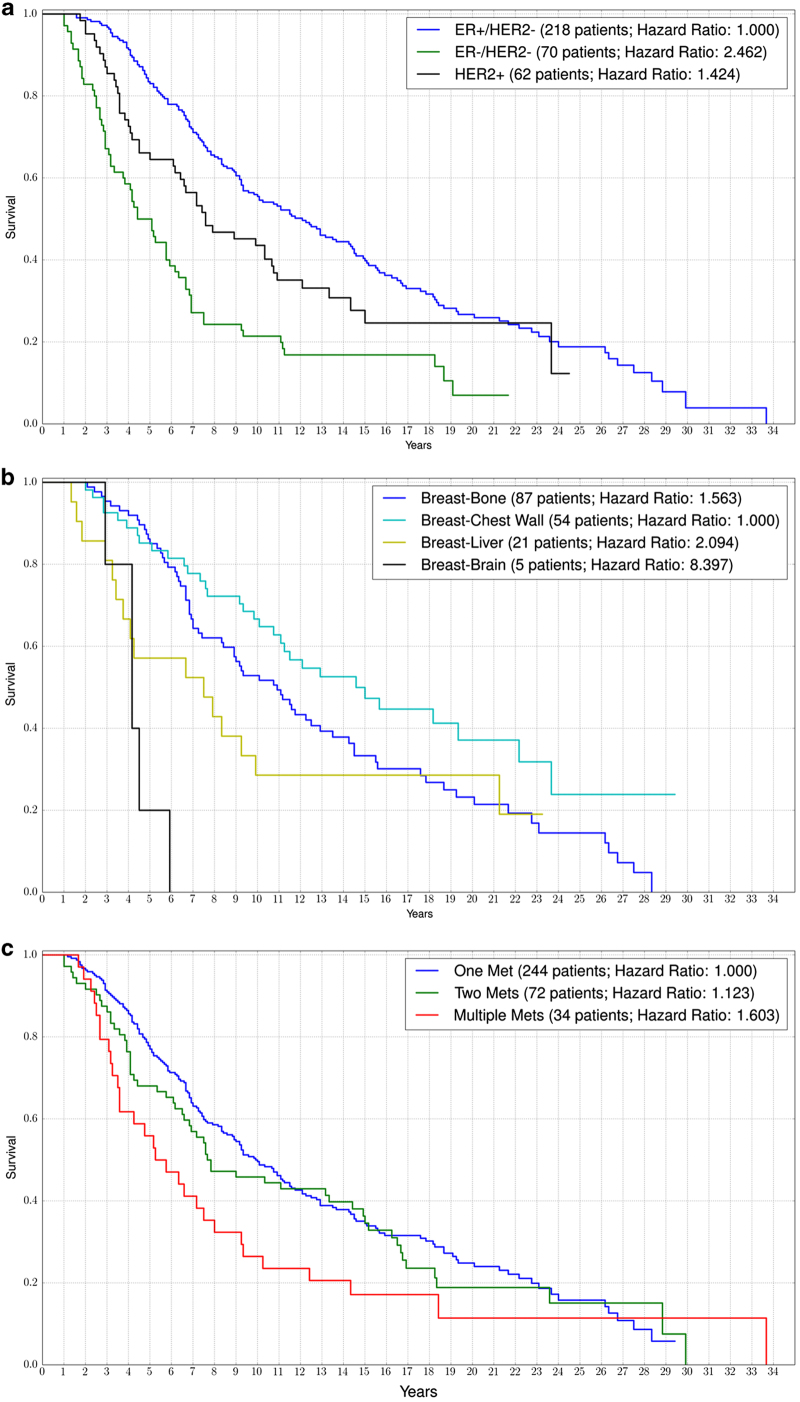
We quantify how survival depends on the location of the first metastatic site for different patient subcategories. In addition, we classify metastatic sites as "sponges" or "spreaders" with implications regarding anatomical pathway prediction and long-term survival. As metastatic tumors to the bone (main spreader) are most prominent, we focus in more detail on differences between groups of patients who form subsequent metastases to the lung as compared with the liver.
We have found that spatiotemporal patterns of metastatic spread in breast cancer are neither random nor unpredictable. Furthermore, the novel concept of classifying organ sites as sponges or spreaders may motivate experiments seeking a biological basis for these phenomena and allow us to quantify the potential consequences of therapeutic targeting of sites in the oligometastatic setting and shed light on organotropic aspects of the disease.
癌细胞迁移模式对于理解转移和临床进展至关重要。乳腺癌通过血行和淋巴途径从一个器官系统扩散到另一个器官系统。尽管扩散模式表面上看似随机且不可预测,但我们探讨了事实并非如此的可能性。
建立一个具有预测能力的基于马尔可夫的乳腺癌进展模型。
基于446例乳腺癌患者的纵向数据集,我们创建了一个转移的马尔可夫链模型,该模型描述了在给定解剖部位发生转移的概率以及扩散到其他部位的概率。进展被建模为在有向图上的随机游走,其中节点代表肿瘤可能发生的解剖部位。
我们量化了不同患者亚组的生存如何取决于首个转移部位的位置。此外,我们将转移部位分为“海绵”或“传播者”,这对解剖途径预测和长期生存具有影响。由于骨转移瘤(主要传播者)最为突出,我们更详细地关注形成后续肺转移与肝转移的患者组之间的差异。
我们发现乳腺癌转移扩散的时空模式既不是随机的也不是不可预测的。此外,将器官部位分类为海绵或传播者的新概念可能会推动寻求这些现象生物学基础的实验,并使我们能够量化在寡转移情况下对部位进行治疗靶向的潜在后果,并阐明该疾病的器官趋向性方面。