Department of Botany, Functional Plant Biology, University of Innsbruck, 6020, Innsbruck, Austria.
Department of Botany, Faculty of Science, Charles University in Prague, Benátská 2, 12801, Prague 2, Czech Republic.
Planta. 2017 Nov;246(5):971-986. doi: 10.1007/s00425-017-2741-5. Epub 2017 Jul 18.
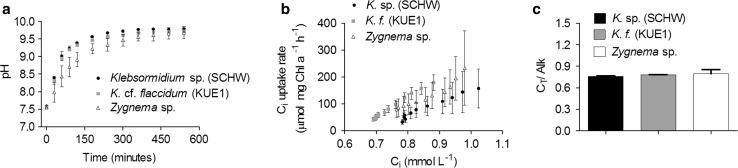
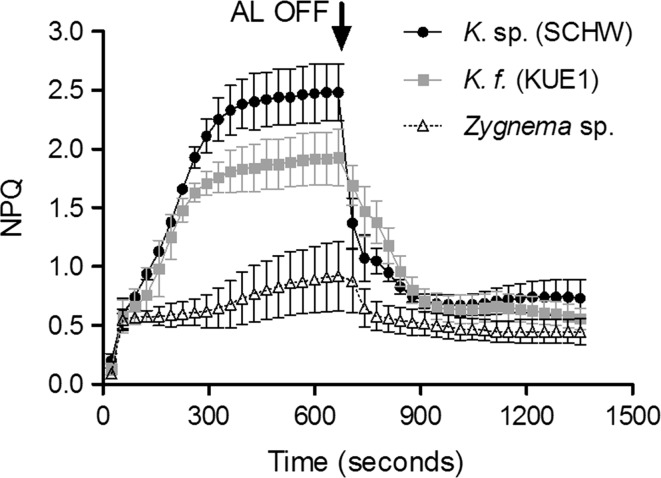
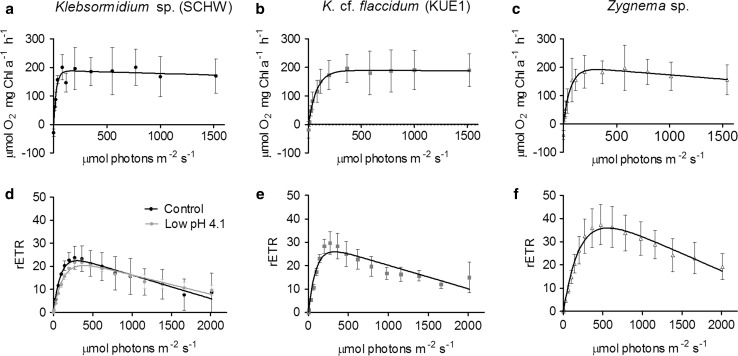
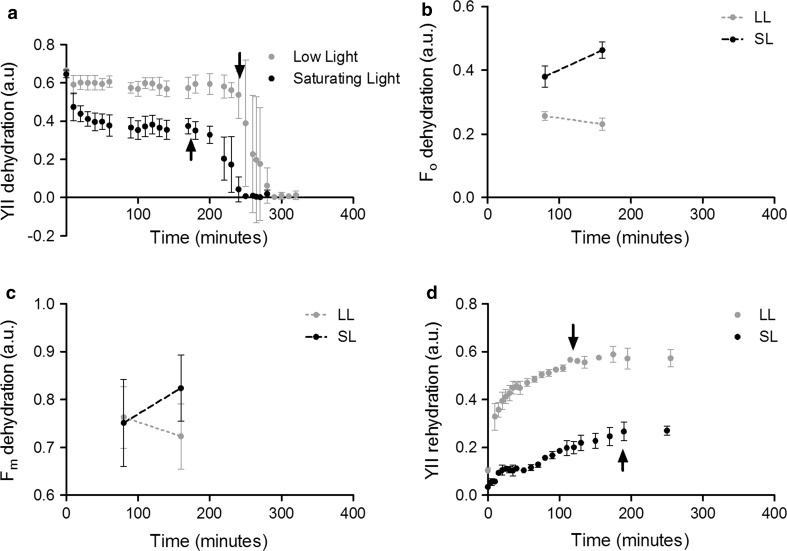
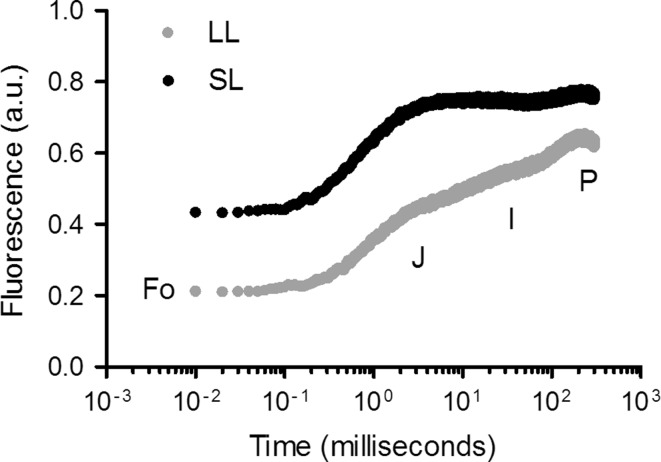
The basal streptophyte Klebsormidium and the advanced Zygnema show adaptation to terrestrialization. Differences are found in photoprotection and resistance to short-term light changes, but not in CO acquisition. Streptophyte green algae colonized land about 450-500 million years ago giving origin to terrestrial plants. We aim to understand how their physiological adaptations are linked to the ecological conditions (light, water and CO) characterizing modern terrestrial habitats. A new Klebsormidium isolate from a strongly acidic environment of a former copper mine (Schwarzwand, Austria) is investigated, in comparison to Klebsormidium cf. flaccidum and Zygnema sp. We show that these genera possess different photosynthetic traits and water requirements. Particularly, the Klebsormidium species displayed a higher photoprotection capacity, concluded from non-photochemical quenching (NPQ) and higher tolerance to high light intensity than Zygnema. However, Klebsormidium suffered from photoinhibition when the light intensity in the environment increased rapidly, indicating that NPQ is involved in photoprotection against strong and stable irradiance. Klebsormidium was also highly resistant to cellular water loss (dehydration) under low light. On the other hand, exposure to relatively high light intensity during dehydration caused a harmful over-reduction of the electron transport chain, leading to PSII damages and impairing the ability to recover after rehydration. Thus, we suggest that dehydration is a selective force shaping the adaptation of this species towards low light. Contrary to the photosynthetic characteristics, the inorganic carbon (C ) acquisition was equivalent between Klebsormidium and Zygnema. Despite their different habitats and restriction to hydro-terrestrial environment, the three organisms showed similar use of CO and HCO as source of C for photosynthesis, pointing out a similar adaptation of their CO-concentrating mechanisms to terrestrial life.
基内丝藻属和真枝藻属等基底绿藻已经适应了陆地化。在光保护和短期光变化抗性方面存在差异,但在 CO 摄取方面没有差异。约 4.5 亿至 5 亿年前,绿藻中的链形绿藻殖民陆地,形成了陆地植物。我们旨在了解它们的生理适应如何与现代陆地栖息地的生态条件(光、水和 CO)相关联。本研究从奥地利一个以前的铜矿(施华茨万德)的强酸性环境中分离到一个新的基内丝藻属菌株,与基内丝藻属 cf. flaccidum 和真枝藻属进行了比较。我们发现这些属具有不同的光合作用特征和水分需求。特别是,该基内丝藻种比真枝藻属具有更高的光保护能力,这可以从非光化学猝灭(NPQ)和更高的高光强度耐受性中得出结论。然而,当环境中的光强度迅速增加时,基内丝藻属会遭受光抑制,表明 NPQ 参与了对强而稳定辐射的光保护。基内丝藻属在低光下也能高度耐受细胞水分流失(脱水)。另一方面,在脱水过程中暴露于相对较高的光强度会导致电子传递链过度还原,从而导致 PSII 损伤,并损害其在再水合后的恢复能力。因此,我们认为脱水是塑造该物种适应低光的选择压力。与光合作用特征相反,基内丝藻属和真枝藻属在无机碳(C )摄取方面相当。尽管它们的栖息地不同且限制在水-陆环境中,但这三种生物表现出对 CO 和 HCO 的类似利用,作为光合作用的 C 源,这表明它们的 CO 浓缩机制对陆地生活具有类似的适应性。