Georg Ingebourg, Hasslocher-Moreno Alejandro Marcel, Xavier Sergio Salles, Holanda Marcelo Teixeira de, Roma Eric Henrique, Bonecini-Almeida Maria da Gloria
Setor de Imunodiagnóstico, Instituto Nacional de Infectologia Evandro Chagas, Fundação Oswaldo Cruz, Rio de Janeiro, Rio de Janeiro, Brazil.
Laboratório de Pesquisa Clínica em Doença de Chagas, Instituto Nacional de Infectologia Evandro Chagas, Fundação Oswaldo Cruz, Rio de Janeiro, Rio de Janeiro, Brazil.
PLoS Negl Trop Dis. 2017 Jul 19;11(7):e0005796. doi: 10.1371/journal.pntd.0005796. eCollection 2017 Jul.
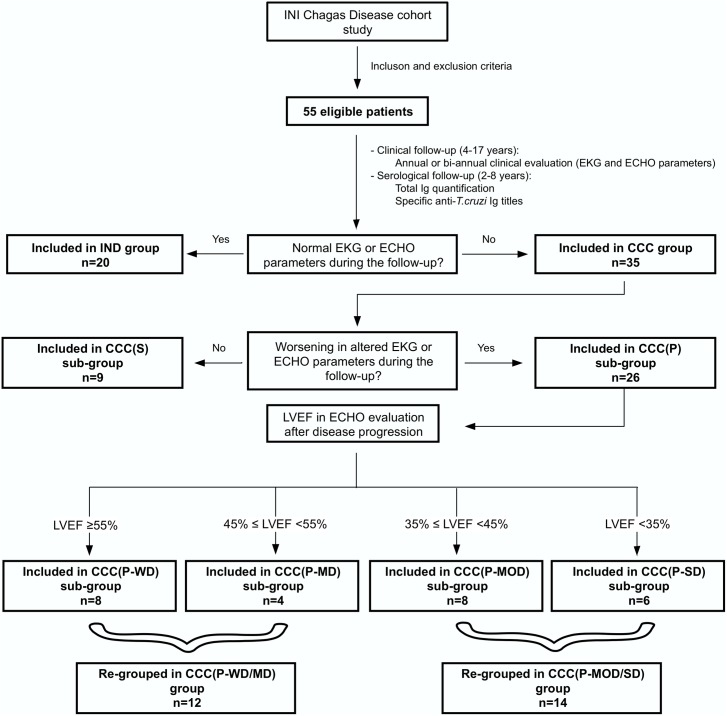
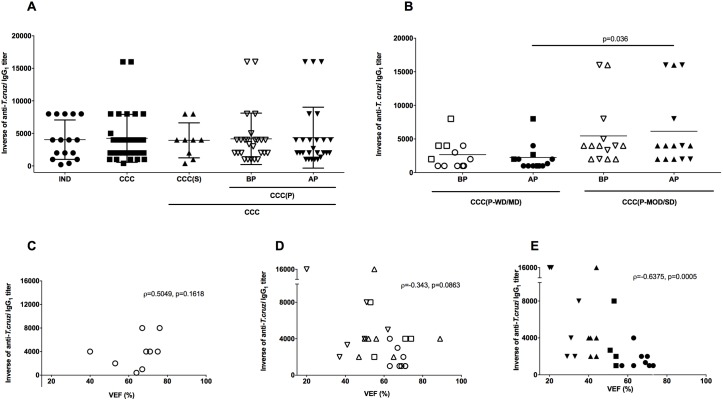
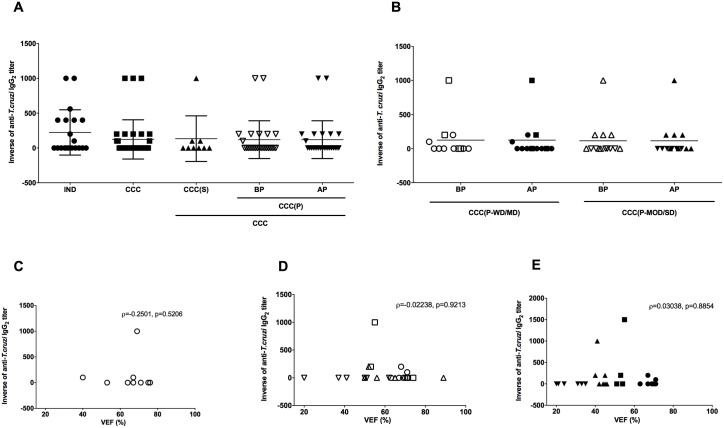
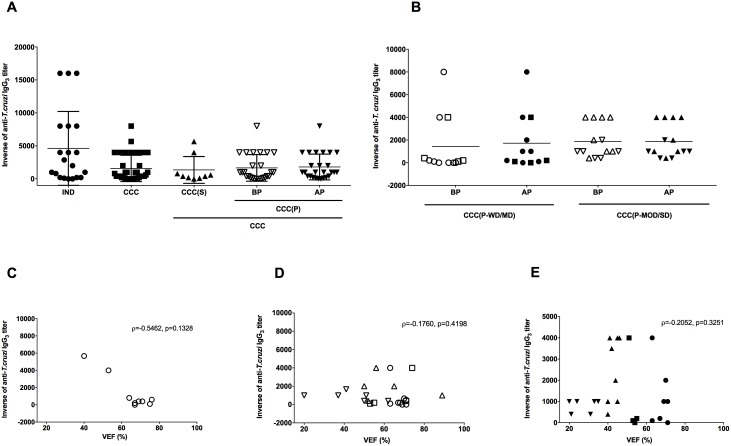
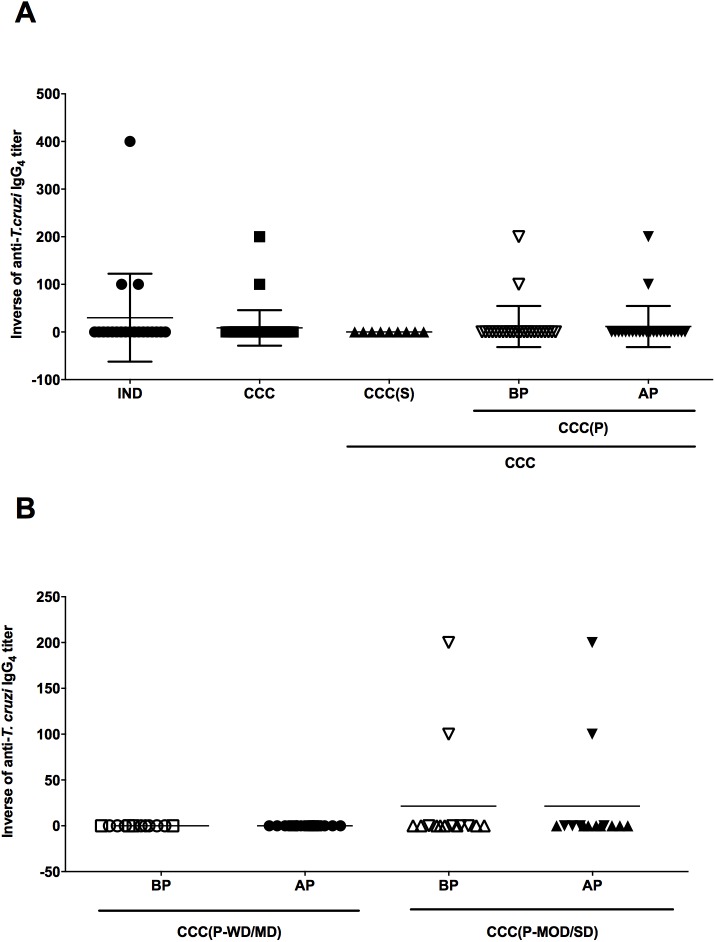
Chagas disease is one of the most important endemic infections in Latin America affecting around 6-7 million people. About 30-50% of patients develop the cardiac form of the disease, which can lead to severe cardiac dysfunction and death. In this scenario, the identification of immunological markers of disease progression would be a valuable tool for early treatment and reduction of death rates. In this observational study, the production of anti-Trypanosoma cruzi antibodies through a retrospective longitudinal follow-up in chronic Chagas disease patients´ cohort and its correlation with disease progression and heart commitment was evaluated. Strong inverse correlation (ρ = -0.6375, p = 0.0005) between anti-T. cruzi IgG1 titers and left ventricular ejection fraction (LVEF) in chronic Chagas cardiomyopathy (CCC) patients were observed after disease progression. Elevated levels of anti-T. cruzi IgG3 titers were detected in all T. cruzi-infected patients, indicating a lack of correlation of this IgG isotype with disease progression. Furthermore, low levels of anti-T. cruzi IgG2, IgG4, and IgA were detected in all patients through the follow-up. Although without statistical significance anti-T. cruzi IgE tends to be more reactive in patients with the indeterminate form (IND) of the disease (p = 0.0637). As this study was conducted in patients with many years of chronic disease no anti-T. cruzi IgM was detected. Taken together, these results indicate that the levels of anti-T. cruzi IgG1 could be considered to seek for promising biomarkers to predict the severity of chronic Chagas disease cardiomyopathy.
恰加斯病是拉丁美洲最重要的地方性感染病之一,影响着约600万至700万人。约30%至50%的患者会发展为该病的心脏型,可导致严重的心功能不全和死亡。在这种情况下,识别疾病进展的免疫标志物将是早期治疗和降低死亡率的宝贵工具。在这项观察性研究中,通过对慢性恰加斯病患者队列进行回顾性纵向随访,评估了抗克氏锥虫抗体的产生及其与疾病进展和心脏受累的相关性。在疾病进展后,观察到慢性恰加斯心肌病(CCC)患者中抗克氏锥虫IgG1滴度与左心室射血分数(LVEF)之间存在强负相关(ρ = -0.6375,p = 0.0005)。在所有克氏锥虫感染患者中均检测到抗克氏锥虫IgG3滴度升高,表明该IgG亚型与疾病进展缺乏相关性。此外,在随访过程中,所有患者的抗克氏锥虫IgG2、IgG4和IgA水平均较低。尽管无统计学意义,但抗克氏锥虫IgE在疾病不确定型(IND)患者中往往反应更强(p = 0.0637)。由于本研究是在患有多年慢性病的患者中进行的,未检测到抗克氏锥虫IgM。综上所述,这些结果表明抗克氏锥虫IgG1水平可被视为寻找预测慢性恰加斯病心肌病严重程度的有前景生物标志物的依据。