Department of Breast Surgical Oncology, The University of Texas MD Anderson Cancer Center, Houston, TX, USA.
Department of Breast Medical Oncology, The University of Texas MD Anderson Cancer Center, Houston, TX, USA.
Ann Surg Oncol. 2017 Nov;24(12):3502-3509. doi: 10.1245/s10434-017-6009-x. Epub 2017 Jul 19.
Biologic factors guide treatment decisions and have a significant impact on prognosis for breast cancer patients. This study was undertaken to develop a staging system incorporating biologic factors in addition to standard anatomic factors in the American Joint Committee on Cancer (AJCC) pathologic stage (PS) to assess disease-specific survival (DSS).
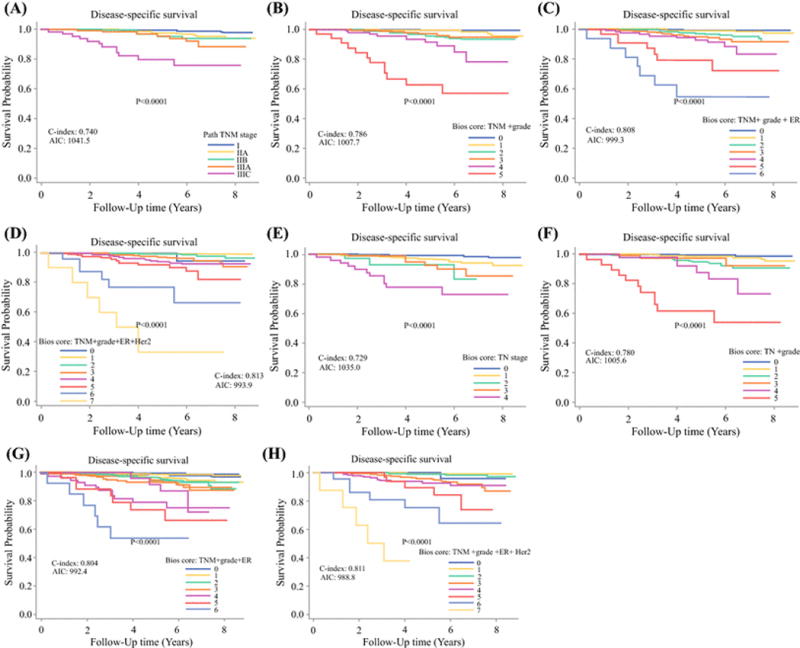
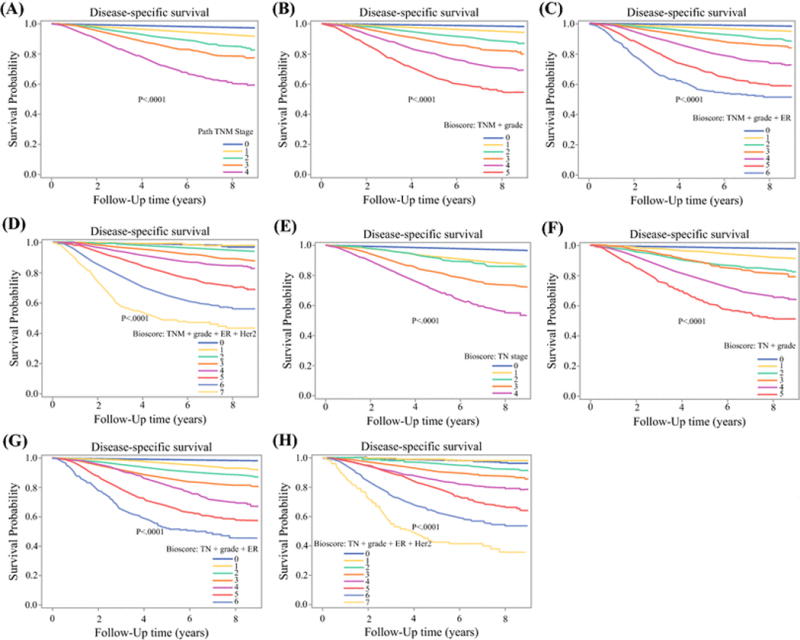
Overall, 3327 patients treated with surgery as an initial intervention at MD Anderson Cancer Center from 2007 to 2013 were identified. Multivariate analyses of factors, including PS, T stage (T), nodal stage (N), grade (G), estrogen receptor (ER) status (E) and human epidermal growth factor receptor (HER2) status (H) were performed to identify associations with DSS. A score of 0-4 was assigned for each factor by considering the hazard ratio magnitude. Multiple staging system models were then constructed: PS, PS + G, PS + G + E, PS + G + E + H, T + N, T + N + G, T + N + G + E, and T + N + G + E + H. Model performance was quantified using Harrell's concordance index, and the Akaike Information Criterion (AIC) was used to compare model fits. Comparable cases from California (n = 67,944) were used for validation.
Median follow-up was 5.0 years (range 0.1-8.8) and 5-year DSS was 97.9% (95% confidence interval 97.3-98.4). Models incorporating grade, ER status, and HER2 status were most precise with identical C-index (0.81) and comparable AIC (994.9 for PS + G + E + H and 987.8 for T + N + G + E + H). Both models were externally validated.
These results confirm the importance of biologic factors in determining prognosis for breast cancer patients. We propose the Bioscore, which incorporates grade, ER and HER2 status with AJCC PS, to provide more refined stratification of breast cancer patients undergoing surgery as an initial intervention with respect to DSS.
生物因素指导治疗决策,并对乳腺癌患者的预后有重大影响。本研究旨在建立一个分期系统,除了美国癌症联合委员会(AJCC)病理分期(PS)中的标准解剖因素外,还纳入生物因素,以评估疾病特异性生存(DSS)。
在 MD 安德森癌症中心,我们从 2007 年至 2013 年期间,对接受手术作为初始治疗的 3327 名患者进行了识别。通过对包括 PS、T 分期(T)、淋巴结分期(N)、分级(G)、雌激素受体(ER)状态(E)和人表皮生长因子受体(HER2)状态(H)等因素的多变量分析,确定与 DSS 的关联。通过考虑危险比的大小,为每个因素分配 0-4 分。然后构建了多个分期系统模型:PS、PS+G、PS+G+E、PS+G+E+H、T+N、T+N+G、T+N+G+E 和 T+N+G+E+H。使用 Harrell 的一致性指数来量化模型性能,并使用 Akaike 信息准则(AIC)来比较模型拟合。使用加利福尼亚州(n=67944)的可比病例进行验证。
中位随访时间为 5.0 年(范围 0.1-8.8),5 年 DSS 为 97.9%(95%置信区间 97.3-98.4)。纳入分级、ER 状态和 HER2 状态的模型最为准确,一致性指数(0.81)相同,AIC(PS+G+E+H 为 994.9,T+N+G+E+H 为 987.8)也相似。两个模型均进行了外部验证。
这些结果证实了生物因素在确定乳腺癌患者预后方面的重要性。我们提出了 Bioscore,它将分级、ER 和 HER2 状态与 AJCC PS 相结合,为接受手术作为初始治疗的乳腺癌患者提供了更精细的 DSS 分层。