Department of Advanced Materials Science, The University of Tokyo, 277-8561 Kashiwa, Japan.
Institute of Advanced Energy, Kyoto University, 611-0011 Uji, Japan.
Nat Commun. 2017 Jul 20;8:16089. doi: 10.1038/ncomms16089.
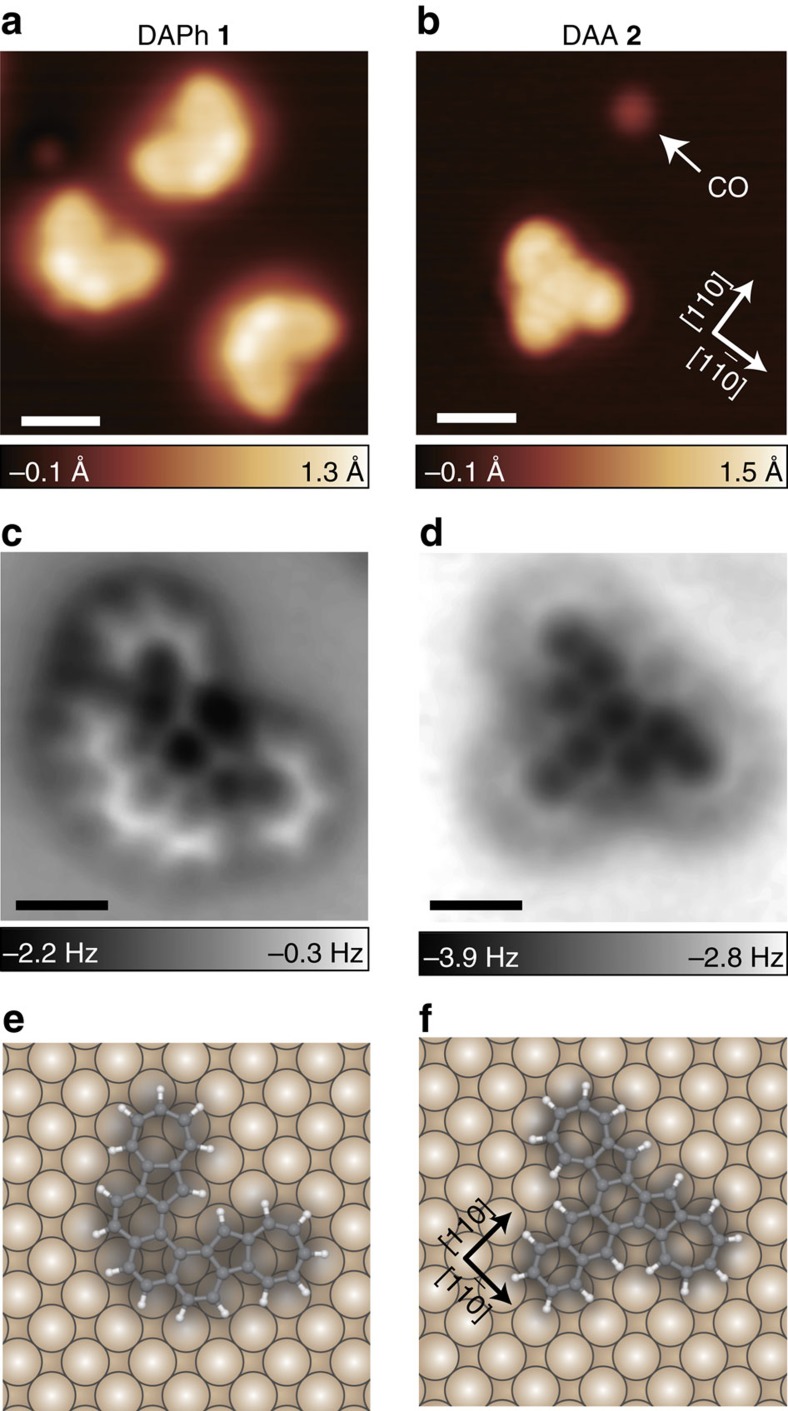
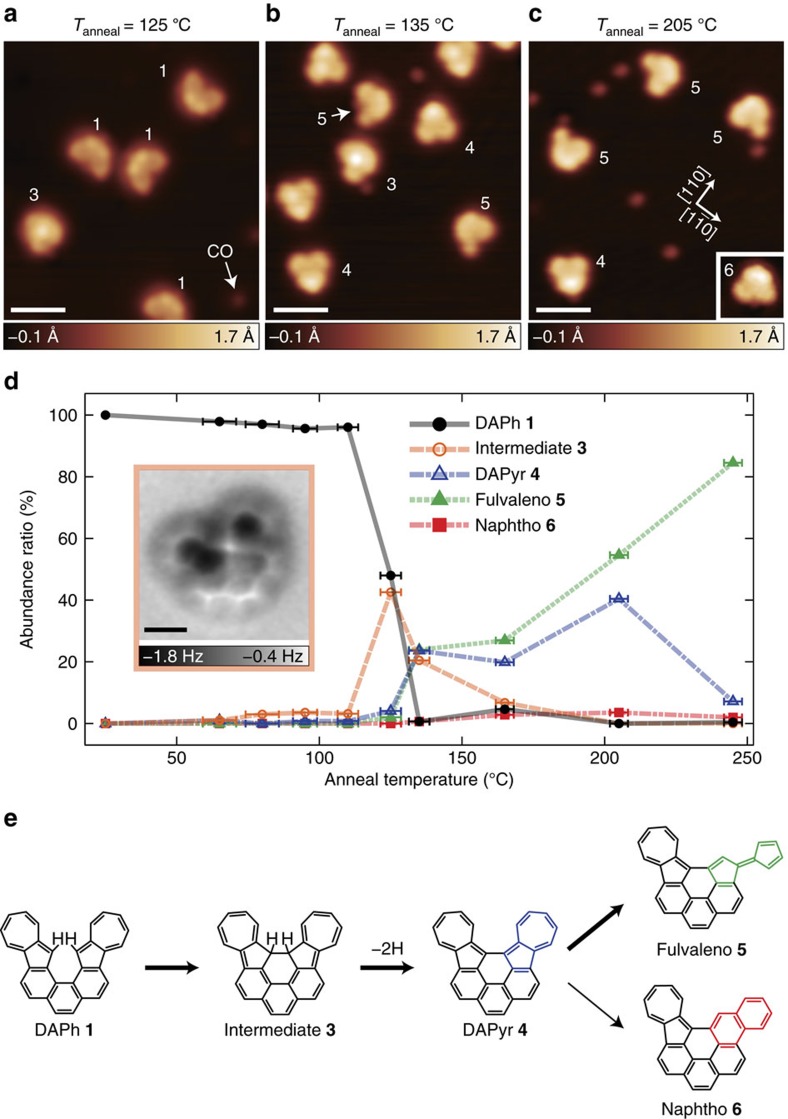
Controlling the structural deformation of organic molecules can drive unique reactions that cannot be induced only by thermal, optical or electrochemical procedures. However, in conventional organic synthesis, including mechanochemical procedures, it is difficult to control skeletal rearrangement in polycyclic aromatic hydrocarbons (PAHs). Here, we demonstrate a reaction scheme for the skeletal rearrangement of PAHs on a metal surface using high-resolution noncontact atomic force microscopy. By a combination of organic synthesis and on-surface cyclodehydrogenation, we produce a well-designed PAH-diazuleno[1,2,3-cd:1',2',3'-fg]pyrene-adsorbed flatly onto Cu(001), in which two azuleno moieties are highly strained by their mutual proximity. This local strain drives the rearrangement of one of the azuleno moieties into a fulvaleno moiety, which has never been reported so far. Our proposed thermally driven, strain-induced synthesis on surfaces will pave the way for the production of a new class of nanocarbon materials that conventional synthetic techniques cannot attain.
控制有机分子的结构变形可以驱动独特的反应,这些反应仅通过热、光或电化学过程是无法诱导的。然而,在传统的有机合成中,包括机械化学过程,很难控制多环芳烃(PAHs)中的骨架重排。在这里,我们使用高分辨率非接触原子力显微镜展示了一种在金属表面上进行 PAHs 骨架重排的反应方案。通过有机合成和表面环脱氢反应的结合,我们在 Cu(001)上制备了一个设计良好的 PAH-二氮杂并[1,2,3-cd:1',2',3'-fg]苝-二氮杂并并吸附在表面上,其中两个氮杂并部分由于彼此靠近而受到高度的应变。这种局部应变促使其中一个氮杂并部分重排为富瓦烯部分,这迄今为止从未有过报道。我们提出的表面上的热驱动、应变诱导合成将为生产传统合成技术无法获得的一类新型纳米碳材料铺平道路。