CIC nanoGUNE, 20018, Donostia-San Sebastián, Spain.
Donostia International Physics Center (DIPC), 20018, Donostia-San Sebastián, Spain.
Nat Commun. 2019 Jan 14;10(1):200. doi: 10.1038/s41467-018-08060-6.
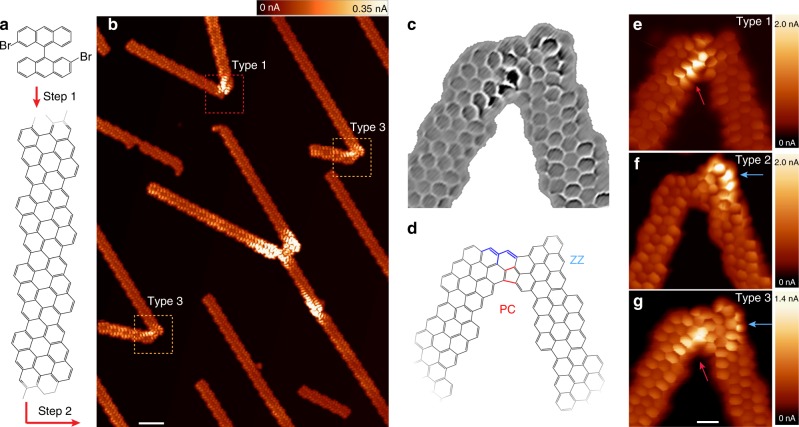
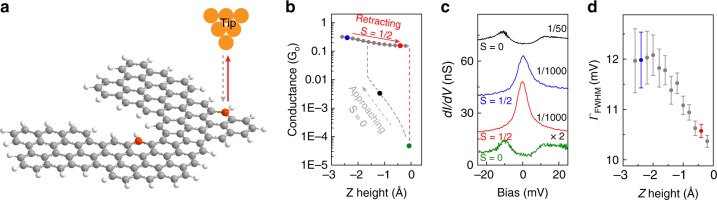
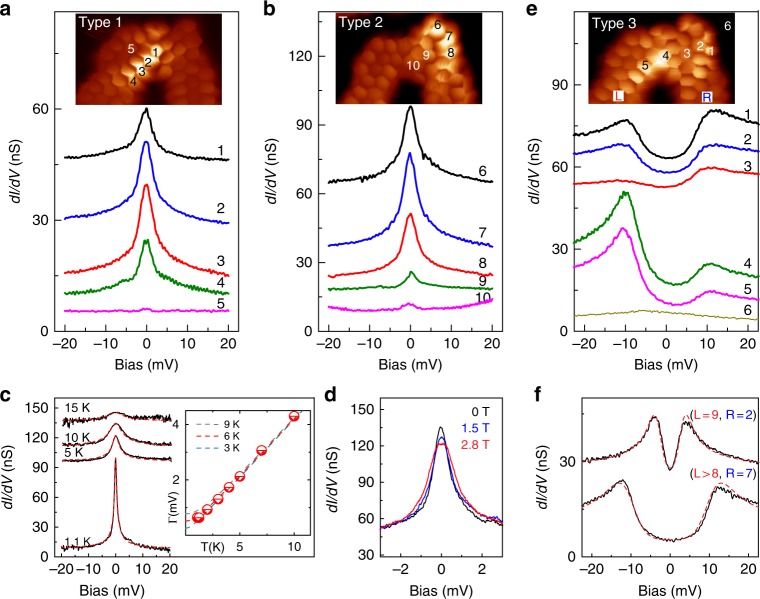
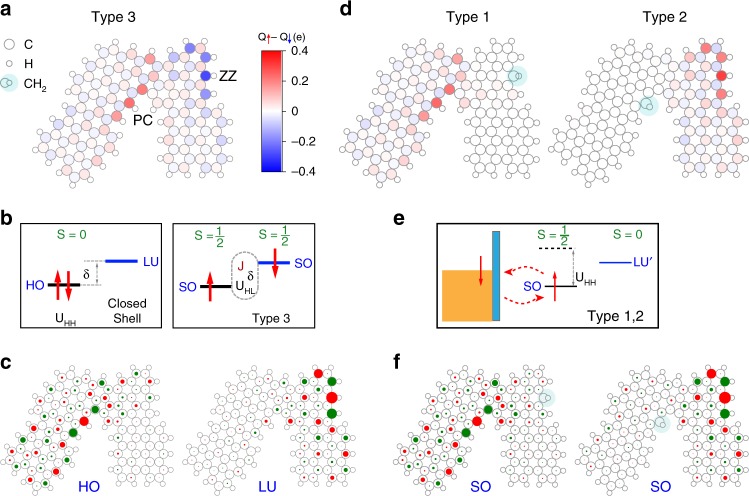
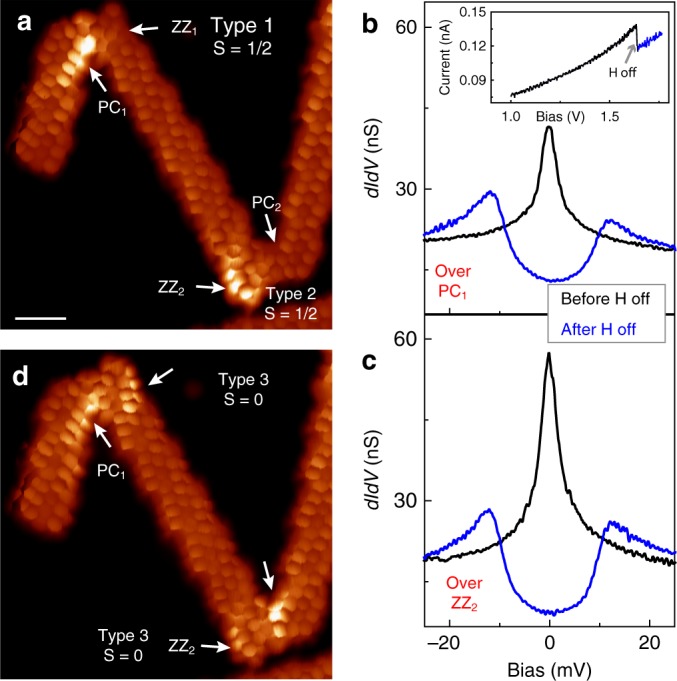
Turning graphene magnetic is a promising challenge to make it an active material for spintronics. Predictions state that graphene structures with specific shapes can spontaneously develop magnetism driven by Coulomb repulsion of π-electrons, but its experimental verification is demanding. Here, we report on the observation and manipulation of individual magnetic moments in graphene open-shell nanostructures on a gold surface. Using scanning tunneling spectroscopy, we detect the presence of single electron spins localized around certain zigzag sites of the carbon backbone via the Kondo effect. We find near-by spins coupled into a singlet ground state and quantify their exchange interaction via singlet-triplet inelastic electron excitations. Theoretical simulations picture how electron correlations result in spin-polarized radical states with the experimentally observed spatial distributions. Extra hydrogen atoms bound to radical sites quench their magnetic moment and switch the spin of the nanostructure in half-integer amounts. Our work demonstrates the intrinsic π-paramagnetism of graphene nanostructures.
将石墨烯磁化为铁磁体是一项极具前景的挑战,有望使它成为自旋电子学的活性材料。预测表明,具有特定形状的石墨烯结构可以在π电子的库仑排斥作用下自发地发展出铁磁性,但其实验验证具有挑战性。在这里,我们报告了在金表面上的石墨烯开壳层纳米结构中单个磁矩的观察和操纵。通过扫描隧道谱,我们通过近藤效应检测到通过碳主链的某些锯齿形位点局域化的单个电子自旋。我们发现附近的自旋耦合到单重态基态,并通过单重态-三重态非弹性电子激发来量化它们的交换相互作用。理论模拟描绘了电子相关如何导致具有实验观察到的空间分布的自旋极化自由基态。额外的氢原子与自由基结合会使它们的磁矩猝灭,并使纳米结构的自旋以半整数数量级切换。我们的工作证明了石墨烯纳米结构的固有π顺磁性质。