Bae SunMee, Park Moon-Soo, Han Jin-Woo, Kim Young-Jun
Department of Oral Medicine and Diagnosis, Research Institute of Oral Science, College of Dentistry, Gangneung-Wonju National University, 7 Jukhyun-gil, Gangneung, 25457 South Korea.
Department of Oral and Maxillofacial Radiology, Research Institute of Oral Science, College of Dentistry, Gangneung-Wonju National University, Gangneung, South Korea.
Maxillofac Plast Reconstr Surg. 2017 Jul 5;39(1):19. doi: 10.1186/s40902-017-0117-1. eCollection 2017 Dec.
The aim of this study was to assess correlation between pain and degenerative bony changes on cone-beam computed tomography (CBCT) images of temporomandibular joints (TMJs).
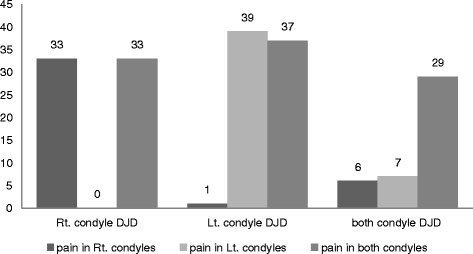
Two hundred eighty-three temporomandibular joints with degenerative bony changes were evaluated. Pain intensity (numeric rating scale, NRS) and pain duration in patients with degenerative joint disease (DJD) were also analyzed. We classified condylar bony changes on CBCT into five types: osteophyte (Osp), erosion (Ero), flattening (Fla), subchondral sclerosis (Scl), and pseudocyst (Pse).
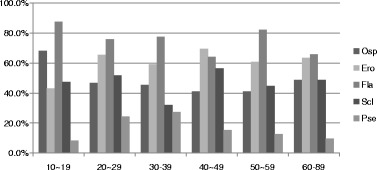
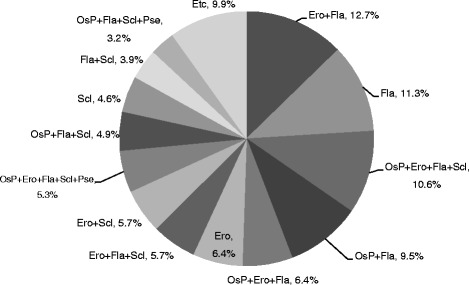
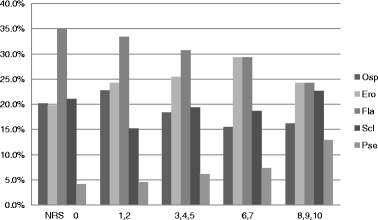
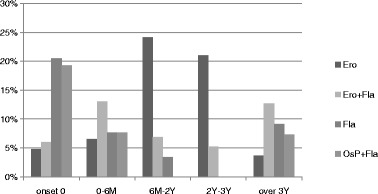
Degenerative bony changes were the most frequent in the age groups of 1019, 20-29, and 5059 years. The most frequent pain intensity was "none" (NRS 0, 34.6%) followed by "annoying" (NRS 3-5, 29.7%). The most frequent condylar bony change was Fla (219 joints, 77.4%) followed by Ero (169 joints, 59.7%). "Ero + Fla" was the most common combination of the bony changes (12.7%). The frequency of erosion was directly proportional to NRS, but the frequency of osteophyte was inversely proportional. The prevalence of Ero increased from onset until 2 years and gradually decreased thereafter. The prevalence of Osp, Ero, and Pse increased with age.
Osp and Ero can be pain-related variables in degenerative joint disease (DJD) patients. "Six months to 2 years" may be a meaningful time point from the active, unstable phase to the stabilized late phase of DJD.
本研究旨在评估颞下颌关节(TMJ)锥形束计算机断层扫描(CBCT)图像上疼痛与骨质退行性改变之间的相关性。
对283个存在骨质退行性改变的颞下颌关节进行评估。还分析了退行性关节病(DJD)患者的疼痛强度(数字评定量表,NRS)和疼痛持续时间。我们将CBCT上髁突骨质改变分为五种类型:骨赘(Osp)、侵蚀(Ero)、扁平(Fla)、软骨下硬化(Scl)和假性囊肿(Pse)。
骨质退行性改变在1019岁、2029岁和50~59岁年龄组中最为常见。最常见的疼痛强度为“无”(NRS 0,34.6%),其次是“烦人”(NRS 3 - 5,29.7%)。最常见的髁突骨质改变是Fla(219个关节,77.4%),其次是Ero(169个关节,59.7%)。“Ero + Fla”是最常见的骨质改变组合(12.7%)。侵蚀的频率与NRS成正比,但骨赘的频率成反比。侵蚀的患病率从发病起至2年增加,此后逐渐下降。Osp、Ero和Pse的患病率随患病率随年龄增加。
Osp和Ero可能是退行性关节病(DJD)患者与疼痛相关的变量。“6个月至2年”可能是DJD从活跃、不稳定阶段到稳定后期的一个有意义的时间点。