Gardner Julianna G, Bhamidipati Divya R, Rueda Adriana M, Nguyen Duc T M, Graviss Edward A, Musher Daniel M
Departments of Medicine and.
Departments of Medical Care Line (Infectious Disease Section), Michael E. DeBakey Veterans Affairs Medical Center, Houston, Texas; and.
Open Forum Infect Dis. 2017 Feb 24;4(2):ofx034. doi: 10.1093/ofid/ofx034. eCollection 2017 Spring.
An elevated white blood cell (WBC) count is a characteristic finding in pneumococcal pneumonia. Very low WBC counts, occurring in some cases, are often associated with overwhelming pneumonia and have been attributed to alcohol-induced suppression of bone marrow. However, a systematic study of neutropenia, leukocytosis, alcohol ingestion, and cirrhosis in pneumococcal pneumonia has not been previously reported.
Using a database of patients with pneumococcal pneumonia at our medical center, we extracted data on WBC counts at admission, differential counts, alcohol ingestion, and cirrhosis, and we related these to 7-day and 30-day mortality.
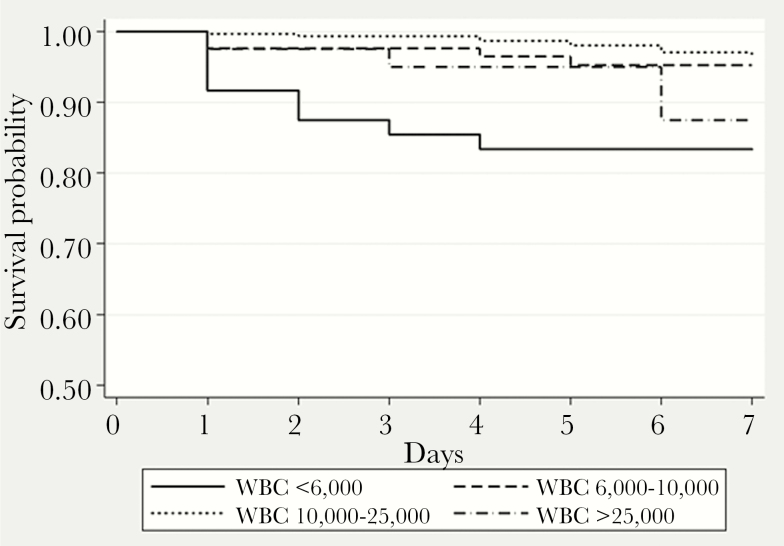
White blood cell counts were <6000/mm in 49 of 481 patients (10.2%) with pneumococcal pneumonia and >25000/mm in 40 (8.3%). Mortality at 7 days was 18.4% and 12.5%, respectively, 5-fold and 3-fold greater in patients with WBC <6000 or >25000 than in those with WBC counts between 6000 and 25000 ( < .001). Increased band forms were not associated with a worse outcome ( = .12). Alcohol use and cirrhosis were not associated with WBC counts <6000 ( = .63 and = .41, respectively).
In a large series of cases of pneumococcal pneumonia, WBC counts <6000 or >25000 correlated significantly with increased 7-day mortality. More than 10% band forms was not associated with a poor outcome. Alcohol abuse was not associated with low WBC or increased mortality. Our findings suggest that greater consideration be given to more intense care for patients with bacterial pneumonia who have very high or very low WBC counts at the time of hospital admission.
白细胞(WBC)计数升高是肺炎球菌肺炎的一个典型表现。在某些病例中出现的极低白细胞计数,常与重症肺炎相关,且被认为与酒精引起的骨髓抑制有关。然而,此前尚未有关于肺炎球菌肺炎患者中性粒细胞减少、白细胞增多、酒精摄入及肝硬化的系统性研究报道。
利用我们医疗中心肺炎球菌肺炎患者的数据库,我们提取了入院时白细胞计数、分类计数、酒精摄入及肝硬化的数据,并将这些数据与7天和30天死亡率相关联。
481例肺炎球菌肺炎患者中,49例(10.2%)白细胞计数<6000/mm³,40例(8.3%)白细胞计数>25000/mm³。白细胞计数<6000或>25000的患者7天死亡率分别为18.4%和12.5%,分别是白细胞计数在6000至25000之间患者的5倍和3倍(P<0.001)。杆状核细胞增多与预后较差无关(P=0.12)。酒精使用和肝硬化与白细胞计数<6000无关(分别为P=0.63和P=0.41)。
在大量肺炎球菌肺炎病例中,白细胞计数<6000或>25000与7天死亡率升高显著相关。杆状核细胞超过10%与预后不良无关。酒精滥用与白细胞计数低或死亡率升高无关。我们的研究结果表明,对于入院时白细胞计数极高或极低的细菌性肺炎患者,应给予更密切的关注和更积极的治疗。