Department of Neuropsychology and Psychopharmacology, Faculty of Psychology and Neuroscience, Maastricht University, Maastricht, the Netherlands.
Integrative Pharmacology and Neurosciences Systems Research Group, Institut Hospital del Mar d'Investigacions Mèdiques, Barcelona, Spain.
Psychopharmacology (Berl). 2018 Feb;235(2):481-490. doi: 10.1007/s00213-017-4699-1. Epub 2017 Jul 22.
MDMA has been shown to induce feelings of sociability, a positive emotional bias and enhanced empathy. While previous research has used only visual emotional stimuli, communication entails more than that single dimension and it is known that auditory information is also crucial in this process. In addition, it is, however, unclear what the neurobiological mechanism underlying these MDMA effects on social behaviour is. Previously, studies have shown that MDMA-induced emotional excitability and positive mood are linked to the action on the serotonin (5-HT) 2A receptor.
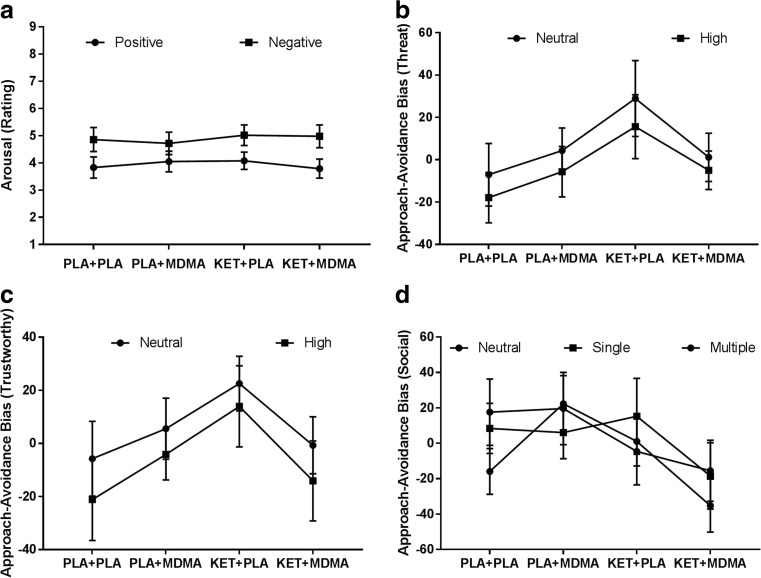
The present study aimed at investigating the effect of MDMA on processing of sounds (Processing of Affective Sounds Task (PAST)) and cognitive biases (Approach-Avoidance Task (AAT)) towards emotional and social stimuli and the role of 5-HT receptor in these effects.
Twenty healthy recreational users entered a 2 × 2, placebo-controlled, within-subject study with ketanserin (40 mg) as pre-treatment and MDMA (75 mg) as treatment. Behavioural (PAST, AAT) measures were conducted 90 min after treatment with MDMA, respectively, 120 min after ketanserin. Self-report mood measures and oxytocin concentrations were taken at baseline and before and after behavioural tests.
Findings showed that MDMA reduced arousal elicited by negative sounds. This effect was counteracted by ketanserin pre-treatment, indicating involvement of the 5-HT receptor in this process. MDMA did not seem to induce a bias towards emotional and social stimuli. It increased positive and negative mood ratings and elevated oxytocin plasma concentrations. The reduction in arousal levels when listening to negative sounds was not related to the elevated subjective arousal.
It is suggested that this decrease in arousal to negative stimuli reflects potentially a lowering of defences, a process that might play a role in the therapeutic process.
已证实 MDMA 可引起社交意愿、积极的情绪偏向和同理心增强。虽然之前的研究仅使用视觉情绪刺激,但交流不仅仅涉及单一维度,并且已知听觉信息在这一过程中也很重要。此外,尚不清楚 MDMA 对社交行为产生这些影响的神经生物学机制是什么。先前的研究表明,MDMA 引起的情绪兴奋和积极情绪与对 5-羟色胺(5-HT)2A 受体的作用有关。
本研究旨在调查 MDMA 对情绪和社交刺激的声音处理(情绪声音处理任务(PAST))和认知偏差(趋近回避任务(AAT))的影响,以及 5-HT 受体在这些影响中的作用。
20 名健康的娱乐性 MDMA 使用者参加了一项 2×2、安慰剂对照、个体内研究,使用氯氮平(40mg)作为预处理,MDMA(75mg)作为治疗。在 MDMA 治疗后 90 分钟分别进行行为(PAST、AAT)测量,在氯氮平治疗后 120 分钟进行行为测量。在基线和行为测试前后测量心境自评量表和催产素浓度。
结果表明,MDMA 降低了负性声音引起的唤醒水平。这种作用被氯氮平预处理所抵消,表明 5-HT 受体参与了这一过程。MDMA 似乎没有诱导对情绪和社交刺激的偏向。它增加了正性和负性情绪评分,并升高了催产素血浆浓度。当聆听负性声音时,唤醒水平的降低与主观唤醒水平的升高无关。
建议这种对负性刺激的唤醒水平降低反映了潜在的防御降低,这一过程可能在治疗过程中发挥作用。