Lakens Daniël
Human Technology Interaction Group, Eindhoven University of Technology, Eindhoven, the Netherlands.
Soc Psychol Personal Sci. 2017 May;8(4):355-362. doi: 10.1177/1948550617697177. Epub 2017 May 5.
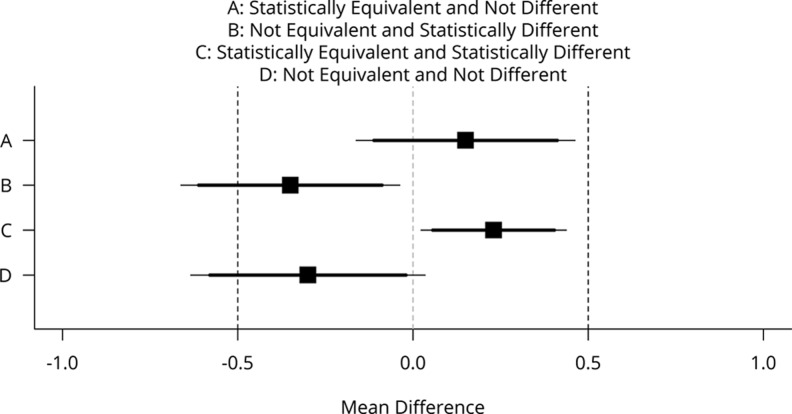
Scientists should be able to provide support for the absence of a meaningful effect. Currently, researchers often incorrectly conclude an effect is absent based a nonsignificant result. A widely recommended approach within a frequentist framework is to test for . In equivalence tests, such as the two one-sided tests (TOST) procedure discussed in this article, an upper and lower equivalence bound is specified based on the smallest effect size of interest. The TOST procedure can be used to statistically reject the presence of effects large enough to be considered worthwhile. This practical primer with accompanying spreadsheet and R package enables psychologists to easily perform equivalence tests (and power analyses) by setting equivalence bounds based on standardized effect sizes and provides recommendations to prespecify equivalence bounds. Extending your statistical tool kit with equivalence tests is an easy way to improve your statistical and theoretical inferences.
科学家应该能够为不存在有意义的效应提供支持。目前,研究人员常常基于无显著意义的结果错误地得出效应不存在的结论。在频率学派框架内,一种广泛推荐的方法是进行等效性检验。在等效性检验中,比如本文讨论的双单侧检验(TOST)程序,会根据感兴趣的最小效应量指定一个上限和下限等效界值。TOST程序可用于从统计学上拒绝存在足够大且值得考虑的效应。这本实用入门指南以及附带的电子表格和R包,使心理学家能够通过基于标准化效应量设置等效界值轻松进行等效性检验(以及功效分析),并提供预先指定等效界值的建议。用等效性检验扩展你的统计工具包是改善你的统计和理论推断的一种简单方法。